Get in touch with Tengyang Company

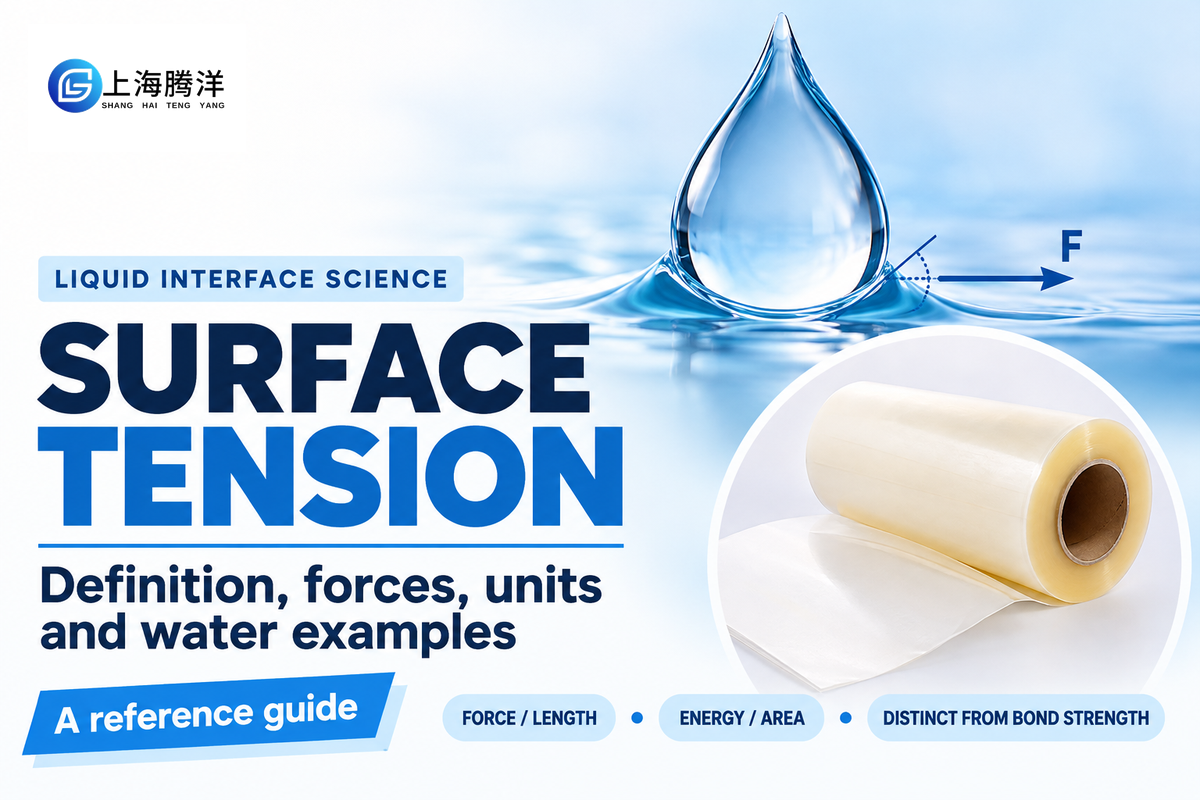
The surface tension definition is the work needed to create a unit area of liquid interface under certain conditions. The same quantity is defined as force per unit length. It explains why small drops tend to round up, why a water surface can support an insect, and why coating liquids spread differently.
Updated October 2026
Key takeaway
Surface tension is the reversible work per added interfacial area, or the tangential force per unit boundary length. Its SI unit is N/m, equivalent to J/m². Every value belongs to a particular interface and set of conditions.
Key points
- Matching units don’t make liquid surface tension, solid surface energy and bond strength interchangeable.
- Forces act along an interface, and an inward molecular-attraction sketch provides a different view of the system.
- Temperature and surface age can change a reported value.
- A soap film has two liquid-air interfaces, so its ideal edge-force calculation counts both.
Surface tension definition at a liquid interface
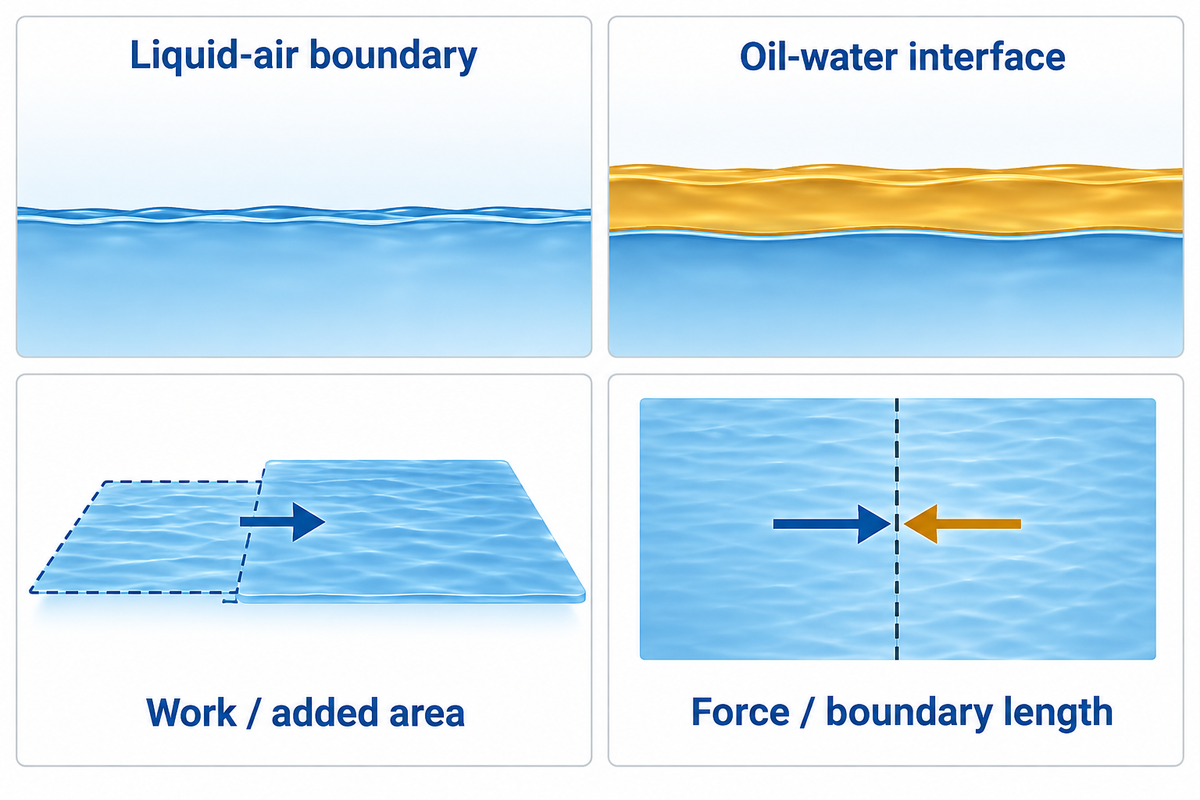
Surface tension refers to the energy needed to expand the area of a liquid interface; work is required to achieve that, just as one pulls on a film to extend it. In physical chemistry, the term connects that work to area; mechanically, it connects an interfacial force to the length of an imaginary cut.
“Work required to increase a surface area divided by that area.”
A free surface usually separates liquid from air or its vapor. An oil-water interface separates two liquids. When comparing surface and interfacial tension, distinguish a value for a liquid-air boundary from one for a liquid-oil boundary.
What is the difference between surface tension and interfacial tension?
Surface tension usually refers to a liquid-gas interface and interfacial tension refers to a boundary between two phases, usually two immiscible liquids. Both terms describe the cost of creating an interface, and the choice of a name illustrates which phases are involved. The liquid composition and the surrounding phase determine the number.
IUPAC uses a broad definition covering either surface or interface. For a broader learning path, visit the surface science hub. Laboratories reporting low interfacial tensions between liquids must identify the liquid pair, just as a coating report must identify its sample.
Molecular forces behind surface tension of water
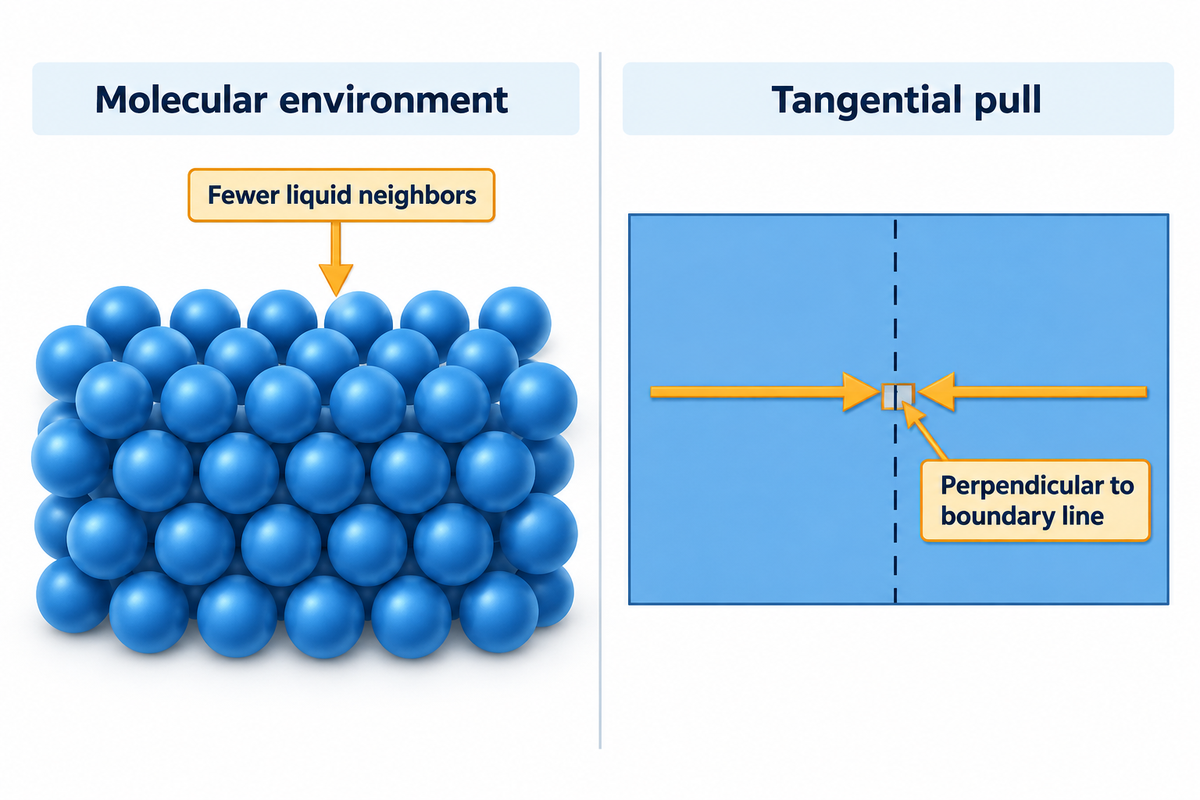
Water beads look like a stretched membrane, since creating more exposed interfaces costs free energy. Liquid molecules at a boundary have a different environment from molecules in the bulk of the liquid. Intermolecular forces and thermal motion together account for that cost; the strong intermolecular contribution from hydrogen bonding helps explain why water has a higher surface tension than many organic liquids.
What best explains the surface tension of water?
Cohesive forces between water molecules make creation of additional interface energetically costly. Molecules at the surface have fewer liquid neighbors compared to molecules in the bulk. That altered environment accounts for surface free energy, while a macroscopic balance of forces represents the overall tension acting along the surface.
Drawing attractive forces toward the interior helps visualize missing neighbors, but the resulting arrow is not the direction of macroscopic surface tension. Marchand and colleagues’ explanation of capillary forces defines an imaginary boundary in the interface. Material on either side exerts a tangential pull across that boundary, perpendicular to the boundary line.
The molecular picture includes potential energy and thermal effects, and the interpretation of molecular environment suggests that attraction isn’t simply “stronger at the surface.” Nor is an elastic membrane formed there: liquid molecules continue to move and exchange positions. “Elastic skin” is an analogy.
Surface tension units and a worked conversion
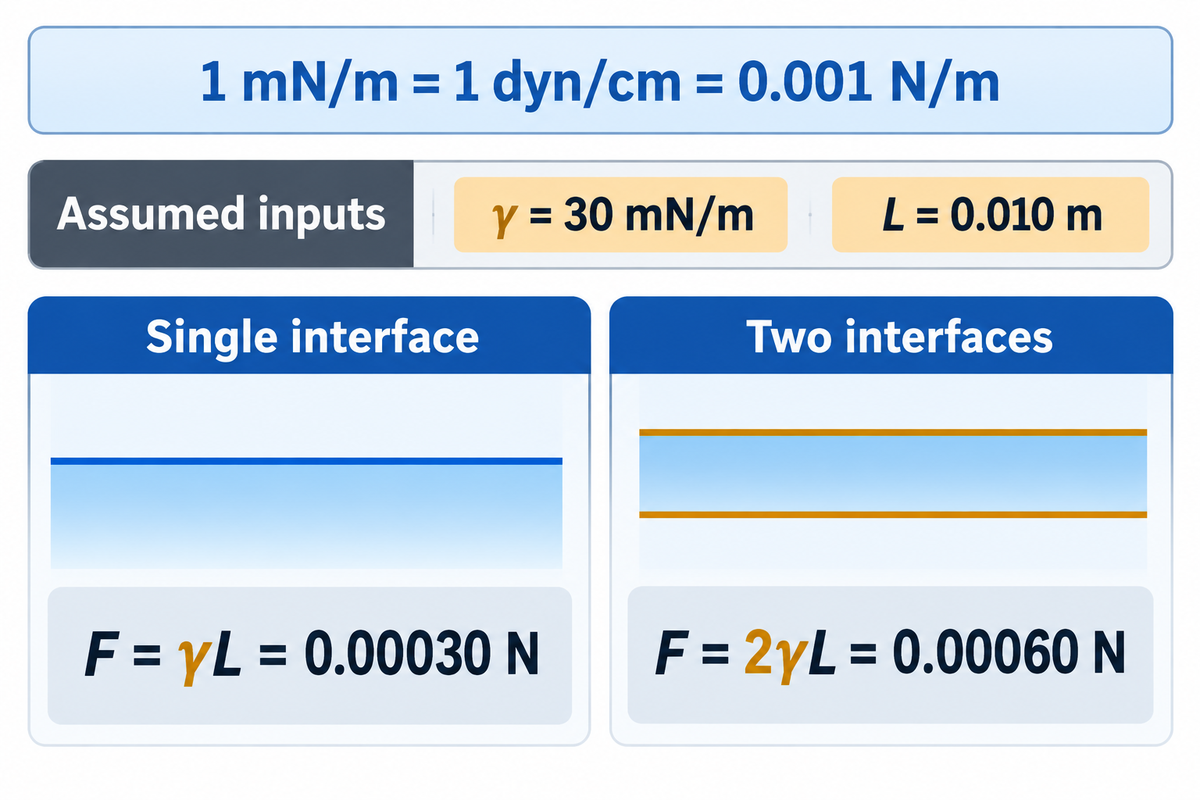
One millinewton per meter is equivalent to one dyne per centimeter, and 0.001 newton per meter. In terms of energy, that liquid interfacial quantity is expressed as 1 millijoule per square meter. The conversion changes the numerical scale or description; it does not turn a liquid measurement into a solid-material property.
3-Unit Surface Tension Translator
When comparing two reports, first convert liquid readings to mN/m, dyn/cm or N/m.
| mN/m | dyn/cm | N/m |
|---|---|---|
| 1 | 1 | 0.001 |
| 10 | 10 | 0.010 |
| 20 | 20 | 0.020 |
| 30 | 30 | 0.030 |
| 40 | 40 | 0.040 |
| 50 | 50 | 0.050 |
| 60 | 60 | 0.060 |
| 70 | 70 | 0.070 |
| 80 | 80 | 0.080 |
- Convert force. Use 1 N = 100,000 dyn.
- Convert length. Use 1 m = 100 cm; division gives 1 N/m = 1,000 dyn/cm.
- Apply the prefix. One millinewton is one thousandth of a newton, giving the mN/m result.
Also, 1 J = 1 N·m, so 1 J/m² = 1 N/m. The common symbol is γ, the Greek letter gamma.
Assumed inputs: A uniform liquid interface has a surface tension, γ = 30 mN/m, with a straight edge that’s movable and is of length L = 0.010 m. A student converts the reading to 0.030 N/m, and then determines F = γL = 0.030 × 0.010 = 0.00030 N. This is the force exerted by a single interface.
If the same edge carries an ideal soap film with two equivalent interfaces, both exert force: F = 2γL = 0.00060 N. The factor of two comes from counting surfaces, not from a difference in units. These results describe the stated edge geometry; a plate immersed in liquid also requires the wetted perimeter and contact angle in its force calculation.
For one interface enlarged reversibly at constant γ, ΔW = γΔA. This relates force per unit length with energy per unit area, without confusing either with pressure, whose unit is N/m².
Surface tension examples: droplets, insects and capillary rise
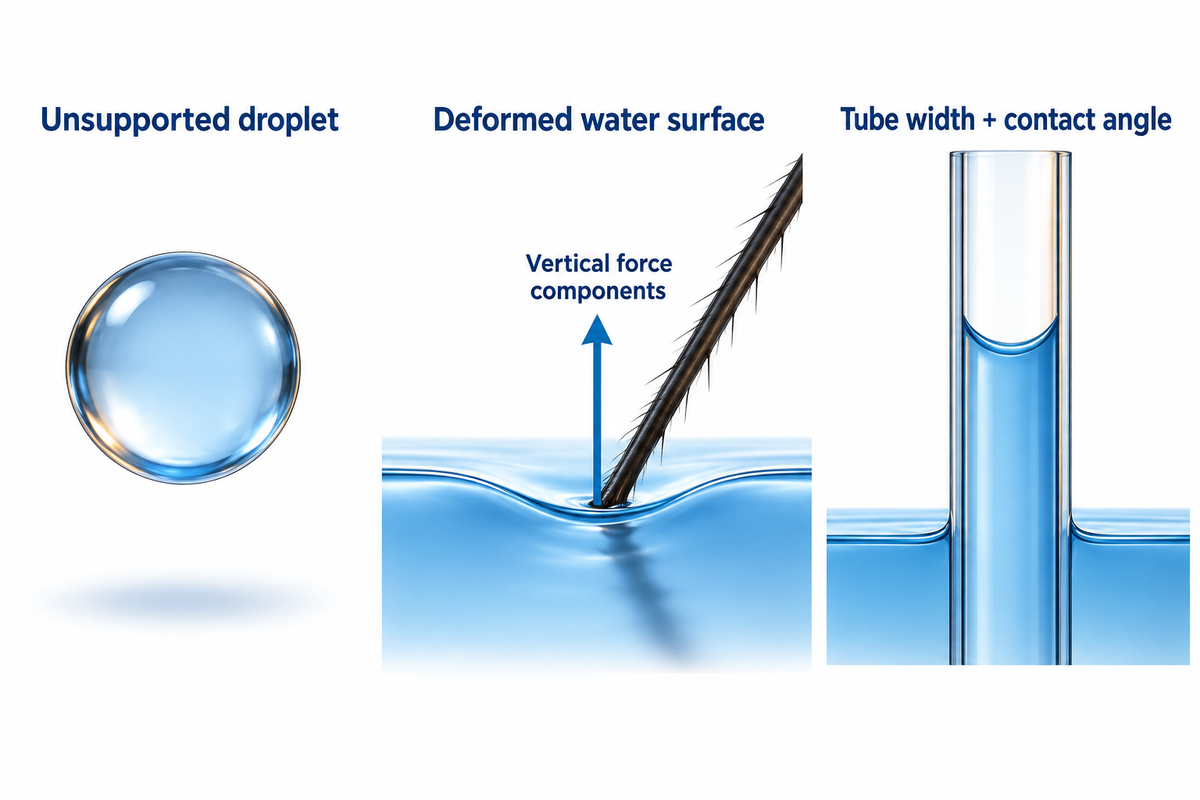
Droplets, water striders and curved menisci illustrate surface forces as competing with gravity and solid boundaries. A small unsupported droplet of liquid tends toward a spherical shape because a sphere has the minimum surface area for a fixed volume. On a solid, wetting and gravity determine the size and shape of a drop.
Saying a liquid “wants to minimize” its surface area is shorthand, not a description of intent. Equilibrium shapes tend to take the shape of least surface free energy (minimize surface area) when other contributions to energy are negligible. Changing the surface area of a mass at fixed volume changes its interfacial free energy contribution; larger drops can flatten because gravity becomes more influential. The surface area to volume ratio also changes with drop size.
What is an example of high surface tension?
Water striders can walk on water because their legs interact with the surface of water without readily penetrating it. In fact, the water-repellent legs of the insect deform the surface of the water. The vertical components of the interfacial forces help support the animal’s weight. Therefore, the surface of the water responds to the weight of the animal rather than supporting it like a rigid floor.
The US Geological Survey’s explanation of water science also describes a carefully placed paper clip. Steel is denser than water, but an undisturbed interface can help support a small paper clip. Wetting or disturbing the interface changes that situation; surface tension plays a role along with buoyancy and shape of the object.
Water can, in a narrow glass tube, form a concave meniscus and rise. Capillary action depends on the liquid being attracted to the solid as well as its cohesion. Rise of the liquid is dependent on tube width, contact angle and the balance between gravity and surface forces. A different liquid-solid pair can exhibit depression rather than rise.
Water reference values and conditions that change them
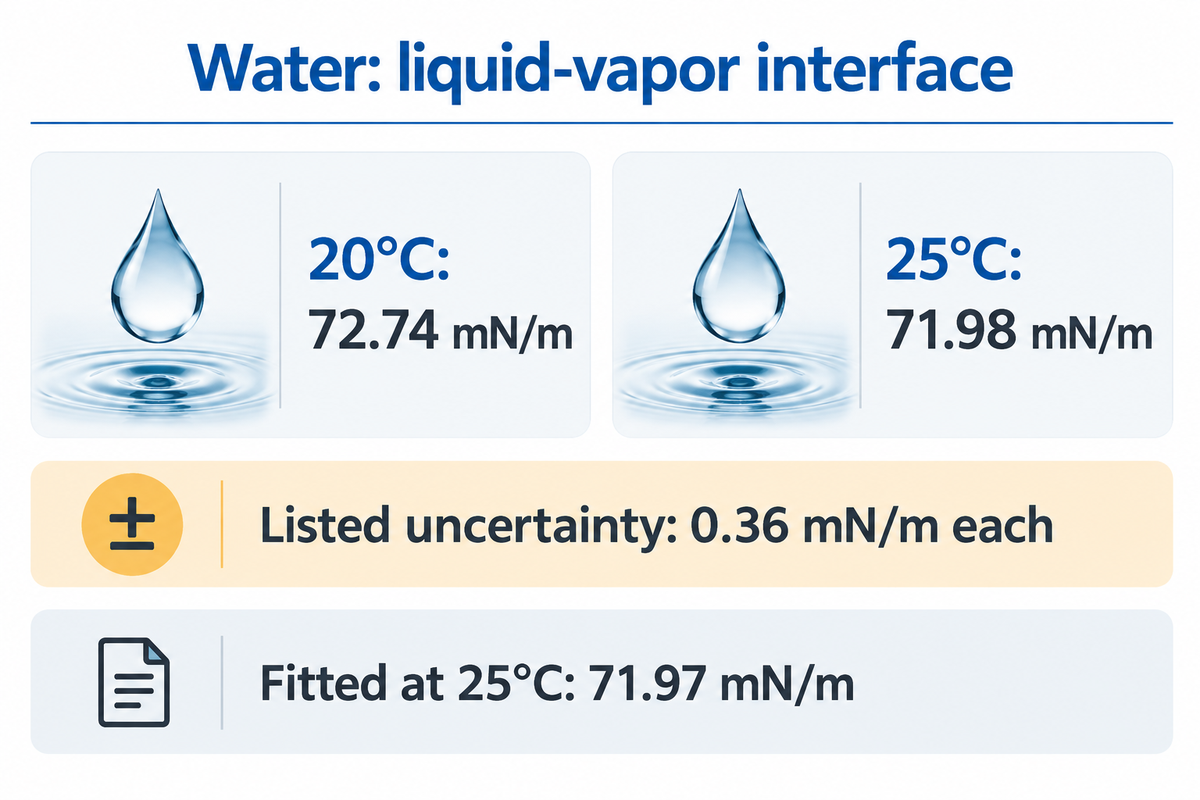
IAPWS reports the surface tension of ordinary water at its liquid-vapor interface as being 72.74 mN/m at 20°C and 71.98 mN/m at 25°C. Each of these figures has an uncertainty of 0.36 mN/m. A useful reference therefore includes temperature and interface, rather than treating “room temperature” as one exact condition.
| Temperature | Surface tension | Listed uncertainty |
|---|---|---|
| 0.01°C | 75.64 mN/m | 0.38 mN/m |
| 5°C | 74.94 mN/m | 0.37 mN/m |
| 10°C | 74.23 mN/m | 0.37 mN/m |
| 15°C | 73.49 mN/m | 0.37 mN/m |
| 20°C | 72.74 mN/m | 0.36 mN/m |
| 25°C | 71.98 mN/m | 0.36 mN/m |
| 30°C | 71.19 mN/m | 0.36 mN/m |
| 35°C | 70.41 mN/m | 0.35 mN/m |
| 40°C | 69.59 mN/m | 0.35 mN/m |
The IAPWS revised release also gives fitted values. Its fitted 25°C entry is 71.97 mN/m; the difference of 0.01 mN/m is much smaller than the listed uncertainty. It should not be interpreted as a resolved difference between two samples.
Consider a quality technician comparing two water-reference reports. One states a temperature; the other states “room temperature.” Before adjusting an instrument, the technician checks the temperature basis, whether both reports use the same interface, and whether they’re from the same table column. The smallest digit differences may be from fitting or rounding, and larger differences may justify checking sample cleanliness, temperature control, and method selected. Uncertainty associated with recommendations isn’t to be confused with automatic acceptance tolerance for every instrument. A laboratory must apply the uncertainty and control procedure appropriate to its own measurement. Otherwise, a real difference may be mistaken for a production problem.
Tension in water generally decreases with increasing temperature in this range. A surfactant can reduce the surface tension by adsorbing at the interface. Surface age is important for adsorption; so, an equilibrium and a dynamic value don’t necessarily have to be the same.
Surface tension versus viscosity, surface energy and contact angle
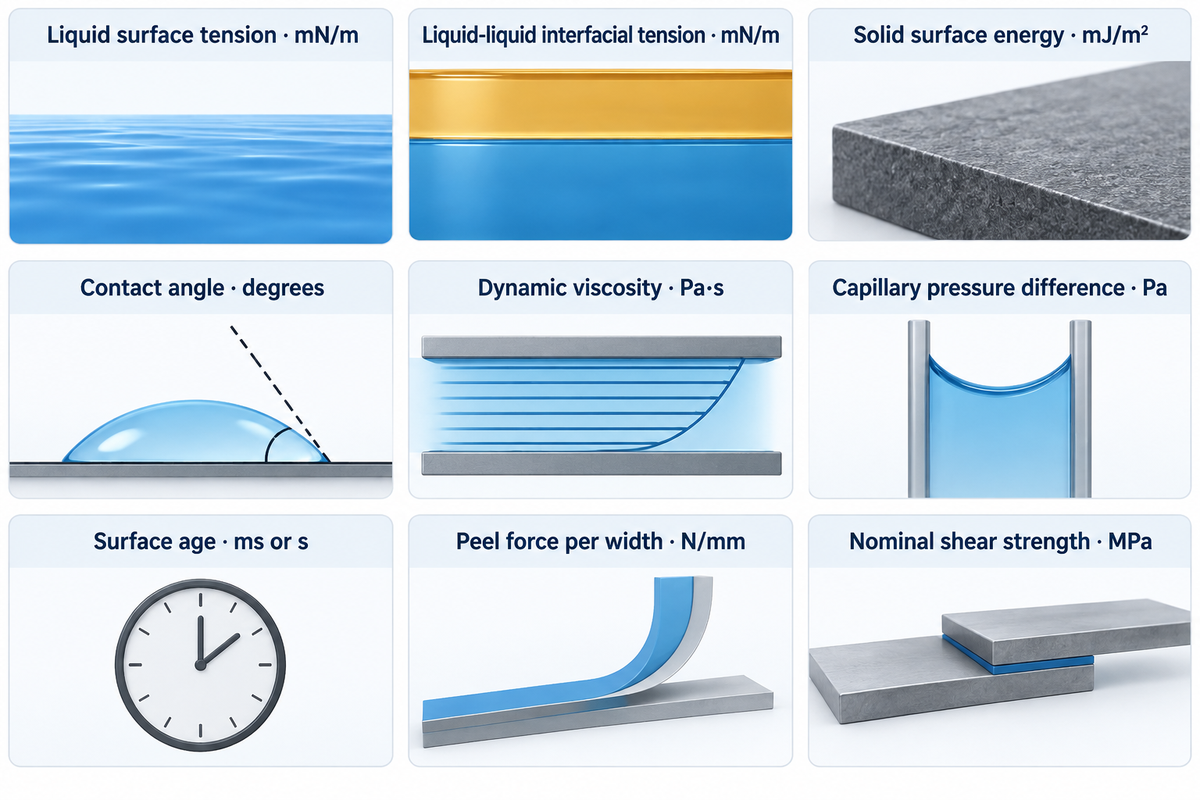
Viscosity describes the resistance to flow. Surface tension describes a liquid interface. Contact angle describes how a liquid meets a solid. And, surface energy describes a solid’s surface. Comparing these quantities helps distinguish between different types of defects (i.e., poor wetting vs. weak adhesion vs. slow spreading).
| Quantity type | Typical unit | Question it addresses |
|---|---|---|
| Liquid surface tension | mN/m | What is the cost or boundary pull of this liquid–gas interface? |
| Liquid–liquid interfacial tension | mN/m | How does this pair of liquid phases interact at its boundary? |
| Solid surface energy | mJ/m² | What energetic properties characterize the solid surface? |
| Contact angle | degrees | How does this liquid wet this solid under these conditions? |
| Dynamic viscosity | Pa·s | How strongly does the fluid resist shear flow? |
| Capillary pressure difference | Pa | How does curvature relate to pressure across an interface? |
| Surface age | ms or s | How long has the measured interface existed? |
| Peel force per width | N/mm | How does a prepared joint resist a specified peeling test? |
| Nominal shear strength | MPa | What test force per bonded area does the joint withstand? |
Even the peel force per width has the dimensions of a liquid interfacial property. Its numerical conversion cannot make it a liquid interfacial property: peeling also involves the joint geometry and deformation. Jensen and colleagues’ soft-adhesion study further explains why a solid’s surface stress isn’t always equal to its surface energy.
A sessile drop’s contact angle belongs to the liquid-solid-gas system. For the ideal equilibrium case, Young’s equation and its assumptions connect the relevant interfacial energies. Roughness, heterogeneity and motion complicate a practical reading. The contact-angle interpretation guide addresses those measurements separately.
Adhesive wetting and what a surface-tension number cannot prove
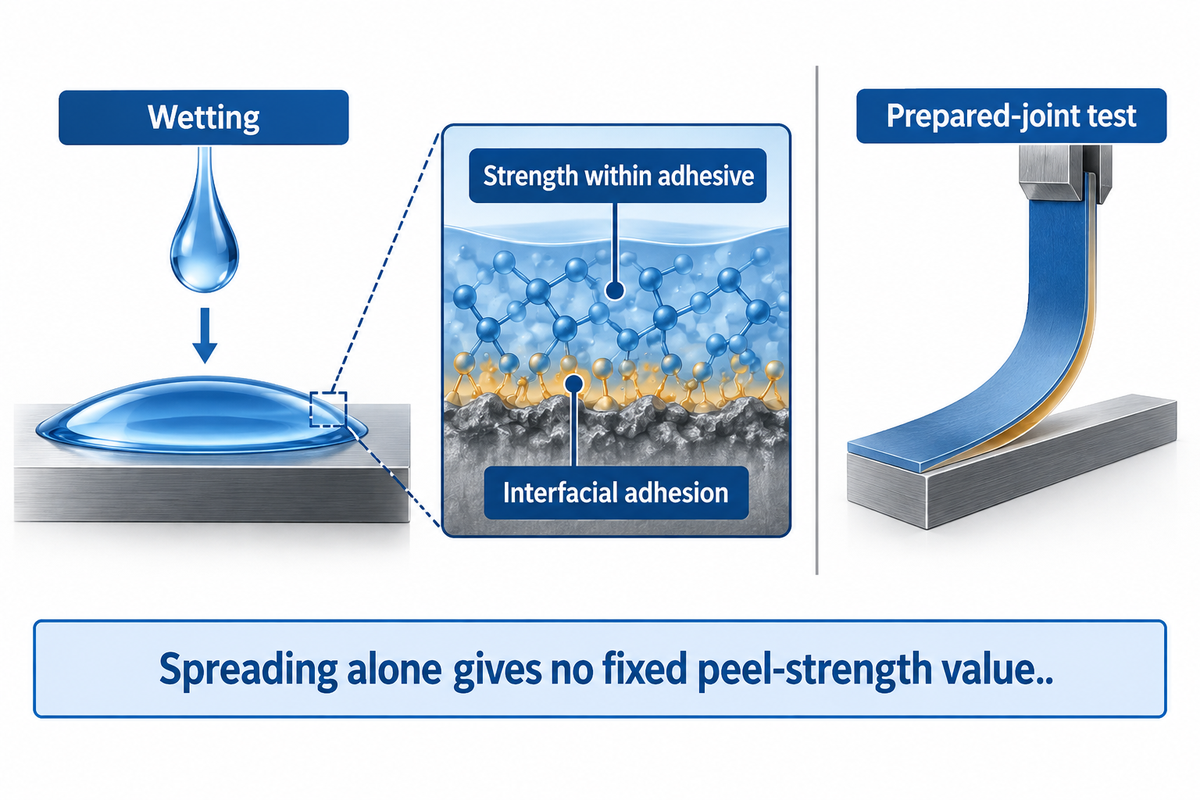
Successful adhesive bonding requires adequate wetting, interfacial adhesion and adequate strength within the adhesive layer. A liquid study helps to understand wetting behavior and a test on a prepared joint helps to evaluate the mechanical performance. Procurement and quality staff should therefore compare liquid properties under matching conditions and evaluate the resulting bond with a test suited to its loading.
Jürgen Klingen’s chapter on wetting, adhesion and cohesion makes these requirements distinct. A liquid will spread according to the interacting interfaces, while viscosity influences how quickly its shape changes. Spreading alone gives no fixed peel-strength value.
Suppose a coating team compares two formulations and thinks both look good after a drop has rested. On a fast coating line, the newly created surface is much younger. Surfactant molecules may not reach that interface at the same rate and the ranking may change. The process engineer compares dynamic measurements on the surfaces at the relevant ages; the quality staff checks and tests the coverage and the finished joint. Procurement keeps those measurements separate from the liquid property specifications and doesn’t pick the lowest number alone. This differentiation is based on the surface-age examples published in Paint and Coatings Industry. Many common surfactant solutions reach equilibrium in a number of seconds, while some can take a minute or longer.
When a liquid-interface reading informs a trial with hot melt adhesive film, keep the liquid measurement separate from the finished bond’s mechanical performance. For the solid side, use the surface-energy guide for adhesive bonding. For the joint, the peel-strength guide for flexible laminates covers the relevant test conditions.
Surface tension measurement: what the reported method tells you
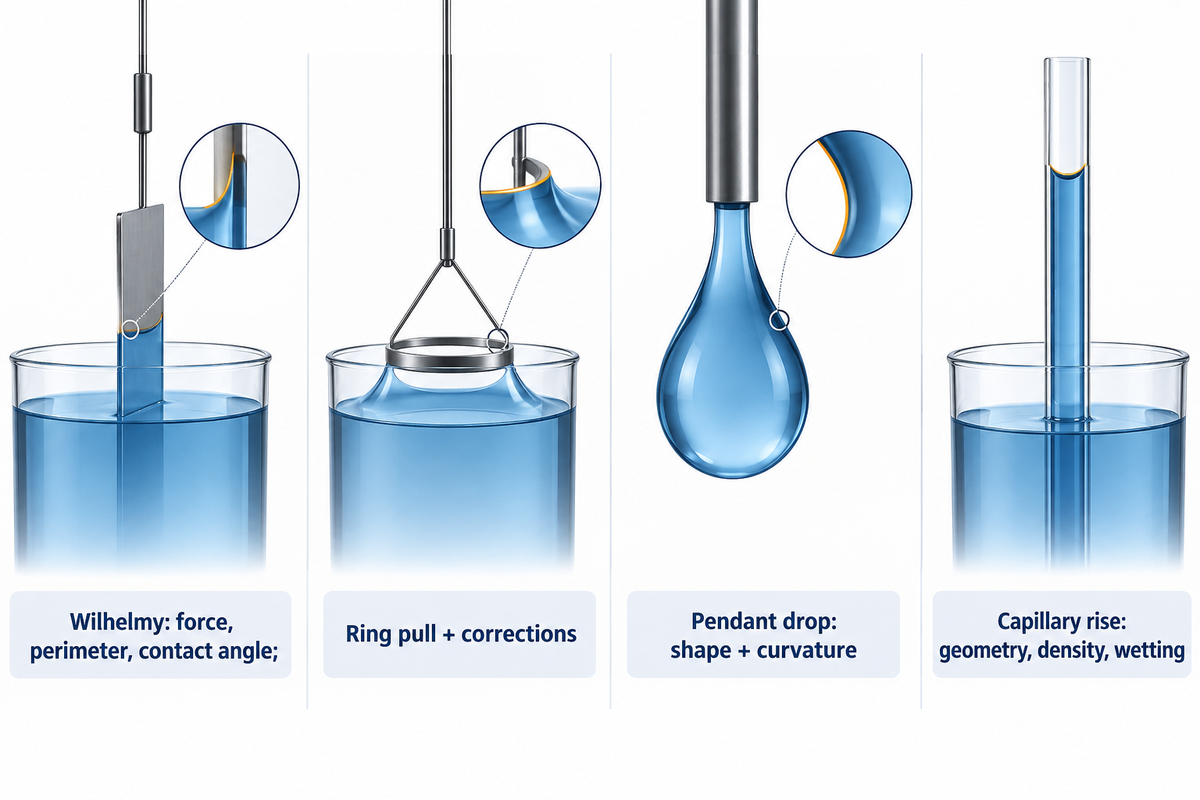
Tensiometers measure surface tension through force, shape or pressure observations interpreted with a model. The reported method identifies which observation produced the result. To compare results, record the sample identity, temperature and surrounding phase, along with the age of the liquid surface when it contains components that can adsorb over time.
The Wilhelmy plate method refers measured force to wetted perimeter and contact angle. A du Noüy ring method uses the pull on a ring, with method-specific corrections. “Maximum pull” alone isn’t the final property. The pendant drop method fits droplet shape using the Young-Laplace equation, which relates curvature to pressure difference.
The capillary rise method also needs geometry, density and wetting information. Measuring surface or interfacial tension requires a method-specific procedure, calibration sequence and uncertainty calculation.
What’s changing in surface-tension reporting
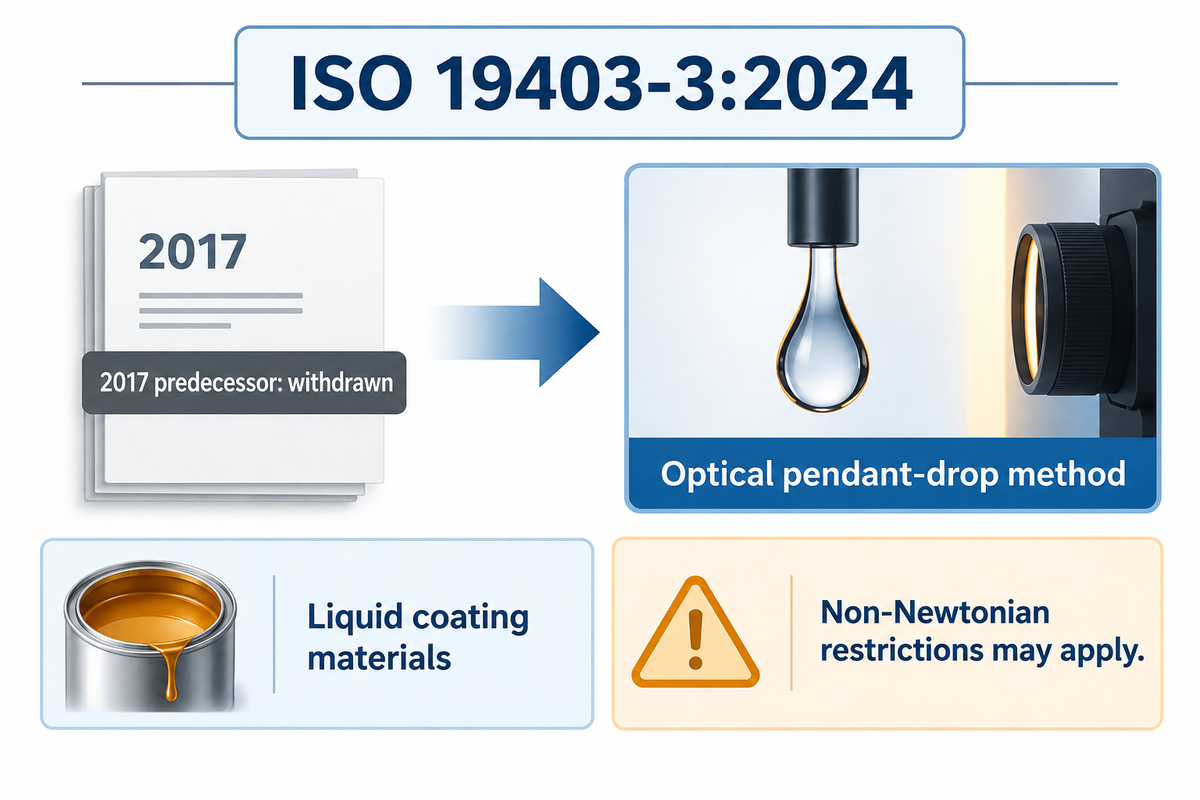
The 2024 edition of ISO 19403-3 updates the reference used for optical pendant-drop determination of liquid surface tension. Reports should identify the edition applied so a reader can determine the pertinent method. The physical definition is still work done per added interface area or force per unit boundary length.
ISO’s official catalogue lists edition 2, published in September 2024, and the withdrawn 2017 predecessor. The method can characterize liquid coating materials; restrictions may apply to certain types of non-Newtonian liquid. A lab using this standard should indicate the actual edition in question and the sample and state the temperature in a report.
For a new measurement request, specify whether the question concerns an equilibrium liquid property, a young interface in a coating process, or a finished joint. Different types of observations will be needed for each of these. A dated reference and a clearly defined interface will assist in using the resulting number in the report.
Frequently asked questions
What is surface tension in simple words for kids?
Answer
Surface tension is the tendency of a liquid surface to resist being made larger. Water molecules attract one another, so a small unsupported drop tends to round up rather than keep an elongated shape. The surface of a liquid can behave like a stretched cover, but it’s still fluid, with moving molecules rather than a separate solid skin.
Why is it called surface tension?
Answer
It’s called surface tension because the interface exerts a tensile pull along its surface. Imagine cutting an invisible line through that interface: the material on either side pulls across the line. In this mechanical description, tension is defined as the force divided by the line’s length, which connects the name to a measurable quantity without treating the surface as a solid membrane.
Is surface tension the same as surface free energy?
Answer
For a simple liquid interface under the appropriate fixed conditions, the tension equals the reversible free-energy change per added area. That’s why N/m and J/m² are equivalent. Solid surfaces require more care: their surface energy and surface stress can differ, so the same unit dimensions don’t make the properties interchangeable.
What symbol is used for surface tension?
Answer
Gamma, γ, is commonly used; sigma, σ, also appears in reference tables. Read the symbol definition in the source. Subscripts can identify the phases, such as liquid-vapor, because the property belongs to a particular interface.
What is the surface tension of water at room temperature?
Answer
It’s about 72 mN/m: IAPWS lists 72.74 mN/m at 20°C and 71.98 mN/m at 25°C. For a reference comparison, use a stated temperature rather than that rounded phrase. IAPWS distinguishes recommended experimental values from values calculated using its fitted equation, and the table lists uncertainty separately. Purity, contamination and the surrounding phase also matter when comparing a laboratory sample with reference water.
Why does soap lower surface tension?
Answer
Soap contains surface-active molecules that adsorb at water interfaces and change their free energy. Their concentration and adsorption time influence the result. This helps explain why soap changes wetting and allows soap bubbles to form without making water into an elastic solid.
Does a pendant-drop result measure adhesion strength?
Answer
No. A pendant-drop result measures a liquid interfacial property through analysis of droplet shape. Adhesion strength comes from a prepared joint tested under a defined loading arrangement. Wetting during application is related to the surface tension, but joint behavior also involves the substrate, adhesive layer and processing conditions. Keep the liquid-property report alongside the appropriate peel or shear results, with the units and test conditions identified for each measurement.
Technical basis: Published definitions and reference data are used for the examples. Assumptions used for the edge force example aren’t in-house measurements.
References & Sources
- IUPAC Gold Book: surface tension, International Union of Pure and Applied Chemistry.
- Why is surface tension a force parallel to the interface?, Marchand and colleagues.
- Surface Tension and Water, US Geological Survey.
- Revised Release on Surface Tension of Ordinary Water Substance, IAPWS, 2014.
- Wetting and phase separation in soft adhesion, Jensen and colleagues, PNAS.
- Wetting, Adhesion, and Cohesion, Jürgen Klingen, 2022.
- Formulation Problem Solving with Dynamic Surface Tension Measurement, Paint and Coatings Industry.
- ISO 19403-3:2024, International Organization for Standardization.