Get in touch with Tengyang Company


Jasonxue
I contribute to guides on hot-melt bonding materials and the practical choices involved in joining two surfaces. My writing focuses on material form, application conditions, and the questions to check when comparing film, web, powder, or granules for a bonding task.
Surface Tension Definition: Molecular Forces and Liquid Interfaces
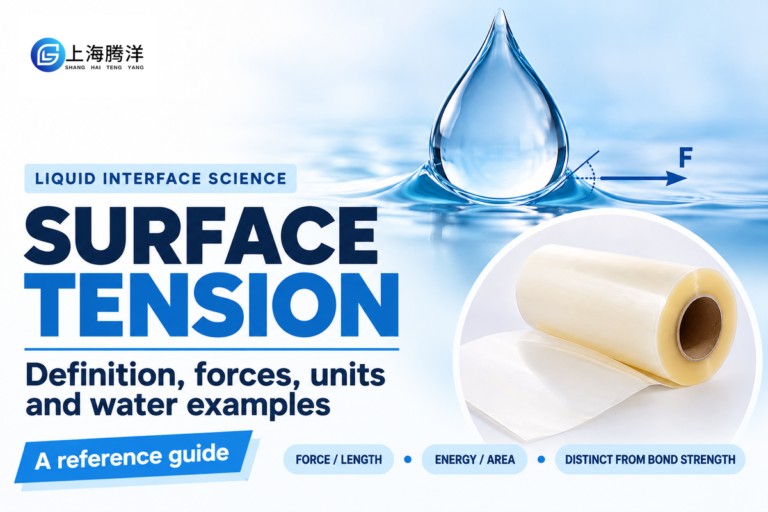
The surface tension definition is the work needed to create a unit area of liquid interface under certain conditions. The same quantity is defined as force per unit length. It explains why small drops tend to round up, why a…
Fracture Toughness: Why a Pre-Existing Crack Changes Failure
Measurement at a glance Object: a specimen containing a sharp crack. Common outputs: K in MPa√m; G and J in J First decision: identify the material, crack path and deformation before choosing a test. Fracture toughness is a material’s resistance…
Raman Spectroscopy of Polymers: Signals, Fluorescence and Film Samples

Updated October 2026 Raman spectroscopy detects chemical features in polymers by measuring the scattered light at different energies from the incident laser. Useful film spectra contain peaks at energies that pertain to the features of the layer of interest. The…
Intrinsic Viscosity: Dilute-Solution Measurements and Polymer Size
Intrinsic Viscosity: Dilute-Solution Measurements and Polymer Size Intrinsic viscosity describes how much a dissolved polymer modifies a solvent’s viscosity per unit polymer concentration as that concentration approaches zero. It connects dilute-solution measurements to molecular size, but a result like 0.80…
Thermomechanical Analysis: Probe Load, Expansion and Softening
Thermomechanical analysis measures dimensional change under a known load as a sample is heated or cooled. Expansion, penetration and deformation are different modes of measurement. Read the curve with its probe, force, dimensions and thermal programme; motion becomes a material…
Moisture Sorption Isotherms: Equilibrium Uptake and Hysteresis
Updated October 2026 A moisture sorption isotherm is a plot of equilibrium moisture content against water activity, or relative humidity, at constant temperature. Read adsorption and desorption separately. A loop can indicate material history or incomplete equilibration, and the curve…
Fatigue Testing for Polymer Materials: Cycles, Loads and Failure Criteria
Fatigue testing examines how a material or assembly responds to multiple load cycles. For polymers, a cycle count is useful only if the report identifies load range, specimen, temperature and failure criterion. A result from a rigid test bar can’t…
Thermal Conductivity of Plastics: Why Test Direction and Structure Matter

Plastics’ thermal conductivity depends on more than just the name of the resin. Other factors including chain orientation, fillers, pores and test temperature can also impact the result. When considering a film, heat can travel differently along the sheet than…
Measuring Heat Capacity by DSC: Baselines, Calibration and Reports
The Differential scanning calorimetry heat capacity measurement requires a corrected heat flow signal, a specific specimen mass, and a controlled temperature program. Alone, a melting peak doesn’t give specific heat capacity. For the three-run sapphire comparison described here, the laboratory…