Get in touch with Tengyang Company


Short answer. The young equation is an ideal equilibrium model for the contact angle of a liquid on a solid, balancing the three interfaces meeting at the contact line. In plain search language, this is the equation people mean when they ask about Young’s equation. In its common form, γSV − γSL = γLV cos θ. The symbols aren’t interchangeable: they refer to solid-vapor, solid-liquid, and liquid-vapor interfacial terms, while θ is measured through the liquid.
The assumptions are critical. The equilibrium angle can be impacted by factors such as surface roughness, inhomogeneities, impurities, swelling, surface reconstruction, droplet history and contact angle hysteresis. Regard Young’s equation as an equilibrium model, follow the measurement protocol, and perform an application-specific performance test before making a bonding decision.
What Young’s equation describes
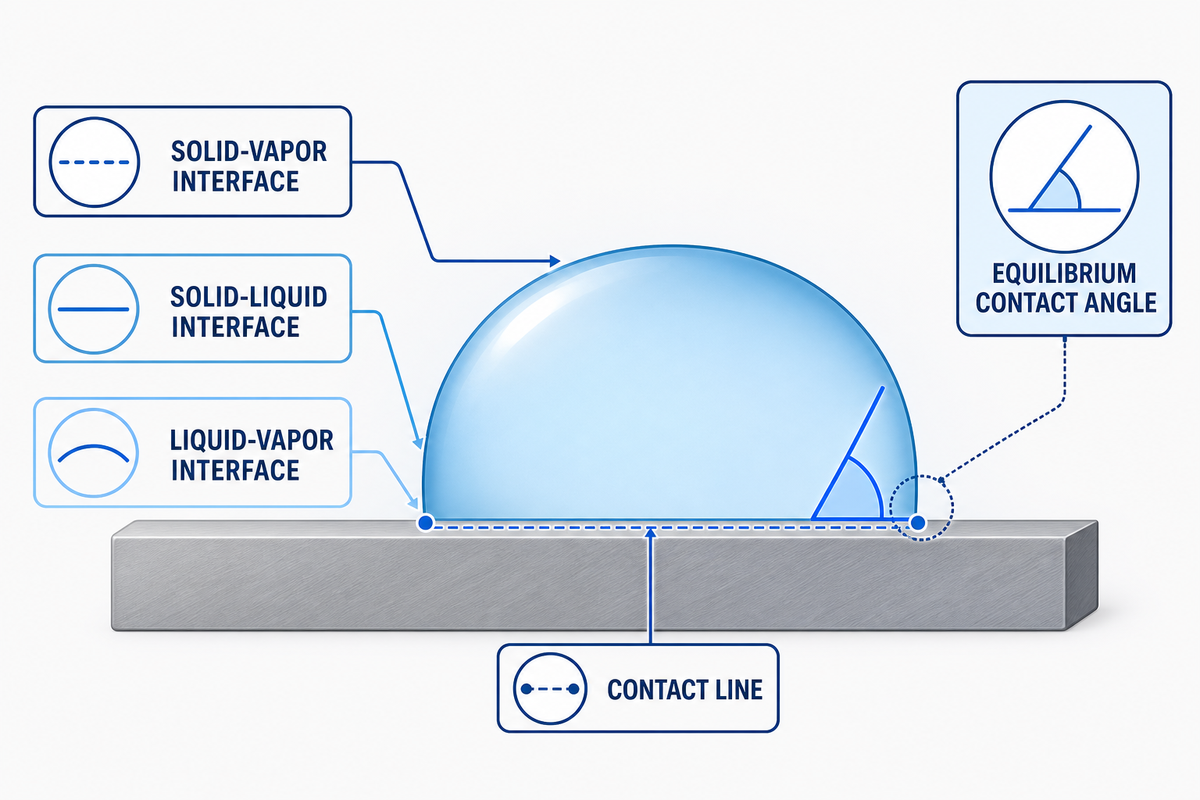
Young’s equation describes an ideal equilibrium contact angle by balancing the solid-vapor, solid-liquid, and liquid-vapor interfacial terms for each interface at a three-phase contact line; it is a macroscopic relation for a smooth, uniform solid, not a direct measure of bond strength or proof that a droplet has reached equilibrium; source context: historical Young-equation reference.
In the theoretical equation model, equilibrium of the three interfaces (solid-liquid, liquid-vapor, and solid-vapor) at the three-phase intersection is represented as a force per unit length balance across the interface at the contact line. Young showed that at the contact line, there exists a state of equilibrium of the solid, liquid and vapor, and that it provides an opportunity to predict an equilibrium state.
The wording is deliberate. Young’s equation does not assign a single surface-energy value to a solid, and pressure inside a curved droplet is instead described by the Young-Laplace equation. Another Young equation defines the elastic modulus of solid materials. These names share a historical reference, not a physical variable.
Contact angle models are central to many adhesion tests. The assumption of a contact angle model is an equilibrium state. The test should be as close to the model as possible. For an adhesion test, the contact angle can be experimentally measured with a declared probe liquid and measurement protocol. Based on the results of the test, statements can be made regarding wetting; statements regarding adhesion require an application-specific performance test.
The Young equation in one line
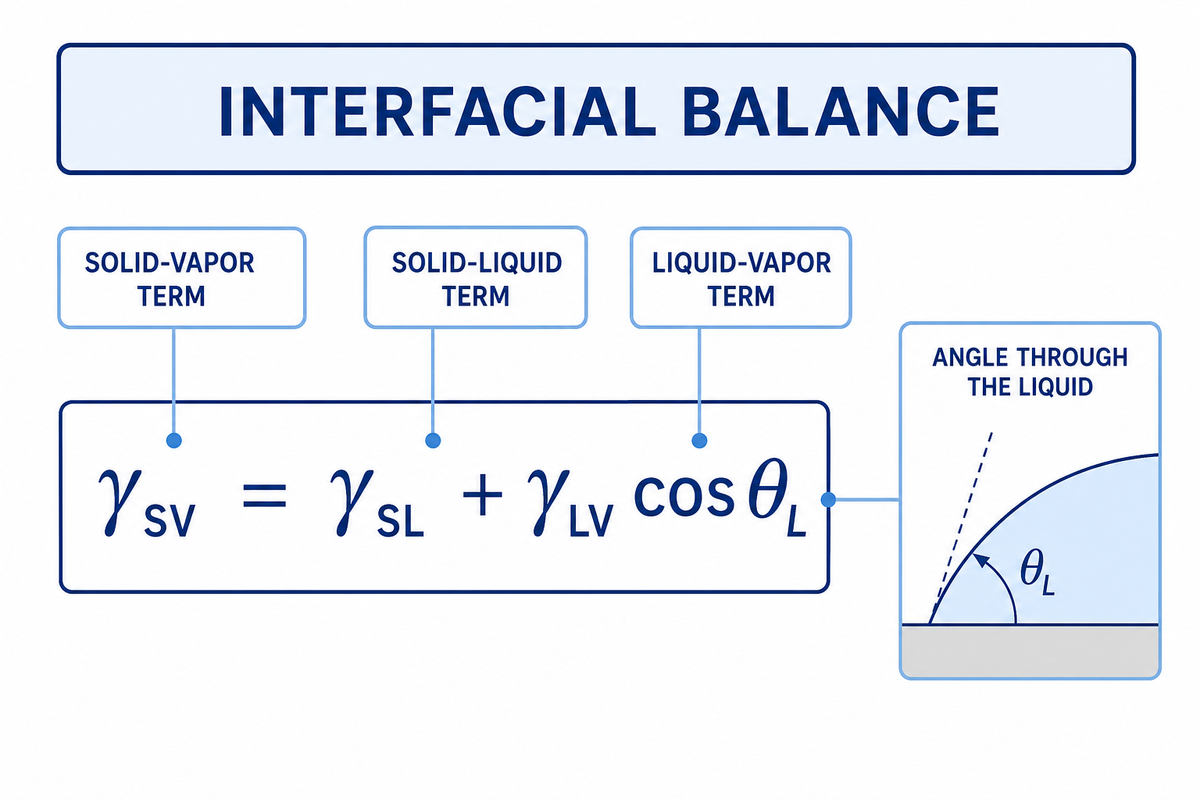
Source context: equation reference.
γSV − γSL = γLV cos θ
Here, θ is the contact angle measured through the liquid at the three-phase junction. According to this equation convention, small liquid angles imply that spreading isn’t resisted, while large liquid angles imply that spreading is resisted. The cosine of the angle is dimensionless, so the three interfacial terms must be expressed in the same units, such as mN/m or an equivalent force-per-unit-length unit in this equation.
The relation doesn’t contain new information. When values for γLV and θ are given, the model allows estimation of γSV-γSL. The model doesn’t allow estimation of the solid-side terms separately. Because the model yields only a difference between the solid-side terms, one liquid and one angle do not completely describe the surface.
What each term means: γSV, γSL, γLV and θ
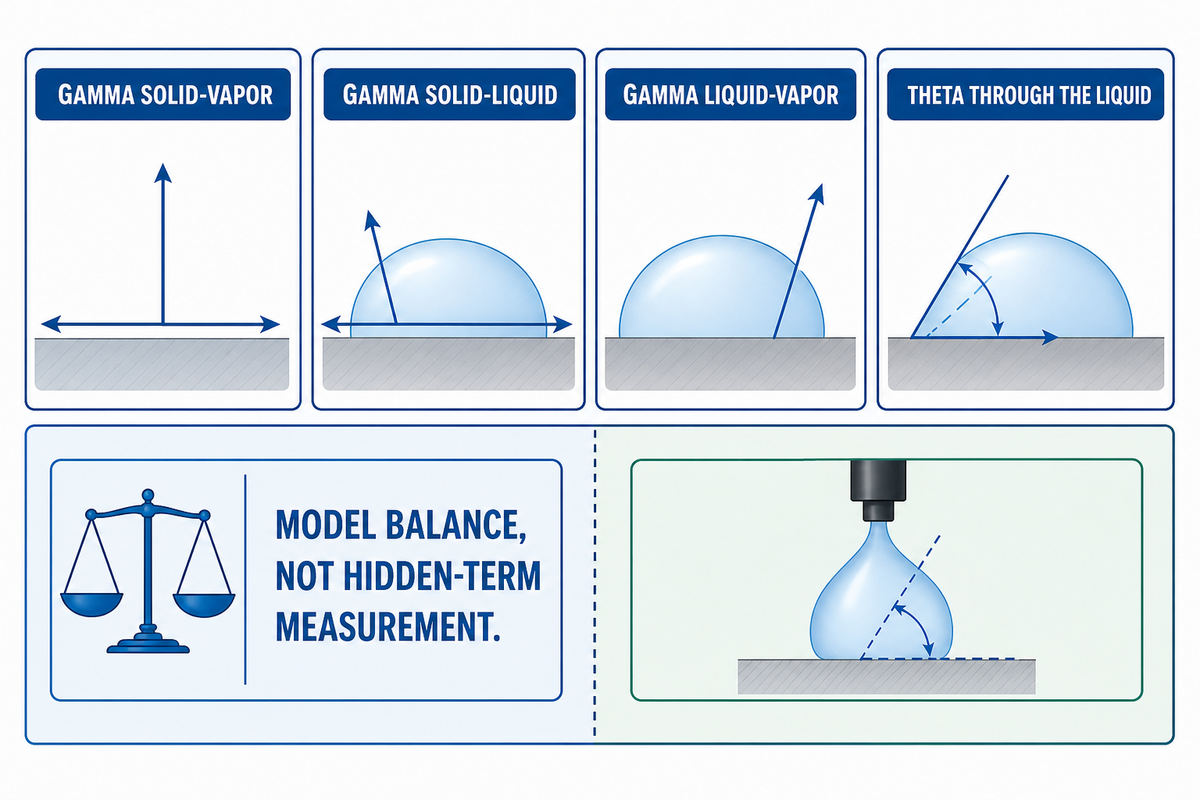
The symbols in Young’s equation identify solid-vapor, solid-liquid, and liquid-vapor interfacial terms, while θ is the contact angle measured through the liquid; each term has a specific interface identity, so consistent units and a declared angle convention are required when the relation is applied to measured data; source context: deviation study.
| Symbol | Interface or quantity | Practical interpretation |
|---|---|---|
| γSV | Solid–vapor interfacial term | The free-energy cost associated with the solid surface exposed to the surrounding vapor. For a real solid it depends on chemistry, contamination, reconstruction and the chosen environment. |
| γSL | Solid–liquid interfacial term | The energetic contribution when the liquid contacts the solid. It reflects interactions across that particular solid–liquid pair, not a liquid-independent constant. |
| γLV | Liquid–vapor surface tension | A property of the liquid and its environment. Temperature, purity and additives can change it, so the test liquid must be identified. |
| θ | Contact angle through the liquid | The geometric angle at the contact line. Static, advancing and receding values can differ when the line is pinned or the surface is heterogeneous. |
In older works, the term surface tensions was used for liquid surfaces and sometimes extended to surface and interfacial quantities at an interface, described as surface energies. In more recent works, a solid interface is represented by the term “interfacial free energy.” Be consistent with the notation in the reference and note any relevant variability in your report.
This also helps define a technical terminology. A technical glossary should distinguish a solid’s surface free energy from liquid surface tension because surface and interfacial quantities are not interchangeable. For example, in a derivation, an equilibrium may be assumed, and that theoretical calculation may describe a balance, not directly measure each hidden term, and not represent the actual conditions of the system. In a model, the mechanism, order, and strength of interactions may be described on many scales: an atom, a molecule, a particle, particles at the interface, and a capillary meniscus across the interface represent different observations. These phenomena can’t always be observed and described in the same way: force per unit length, capillary action, and contact angle θ shouldn’t be confused. For example, capillary action, the interaction between two phases, and contact angle θ are different observations and shouldn’t be confused or interchanged with Young’s equation. Interactions between surfaces may be self-organizing; however, the direction predicted by young’s equation may not be a direct observation of self-assembly in a system.
The surface-energy bonding and unit conversion are discussed more in depth in the surface Energy Guide.
At θ = 90°, the geometry works as a dividing point because cos θ equals zero. For the ideal equation, it means that γSV = γSL for the case of interest; it doesn’t mean that there’s no surface energy in the solid, or that the liquid can’t interact with it, or that the interface is satisfactory/unsatisfactory for an adhesive. In the measured angle, the interfacial terms can be in different combinations.
Assumptions behind Young’s equation
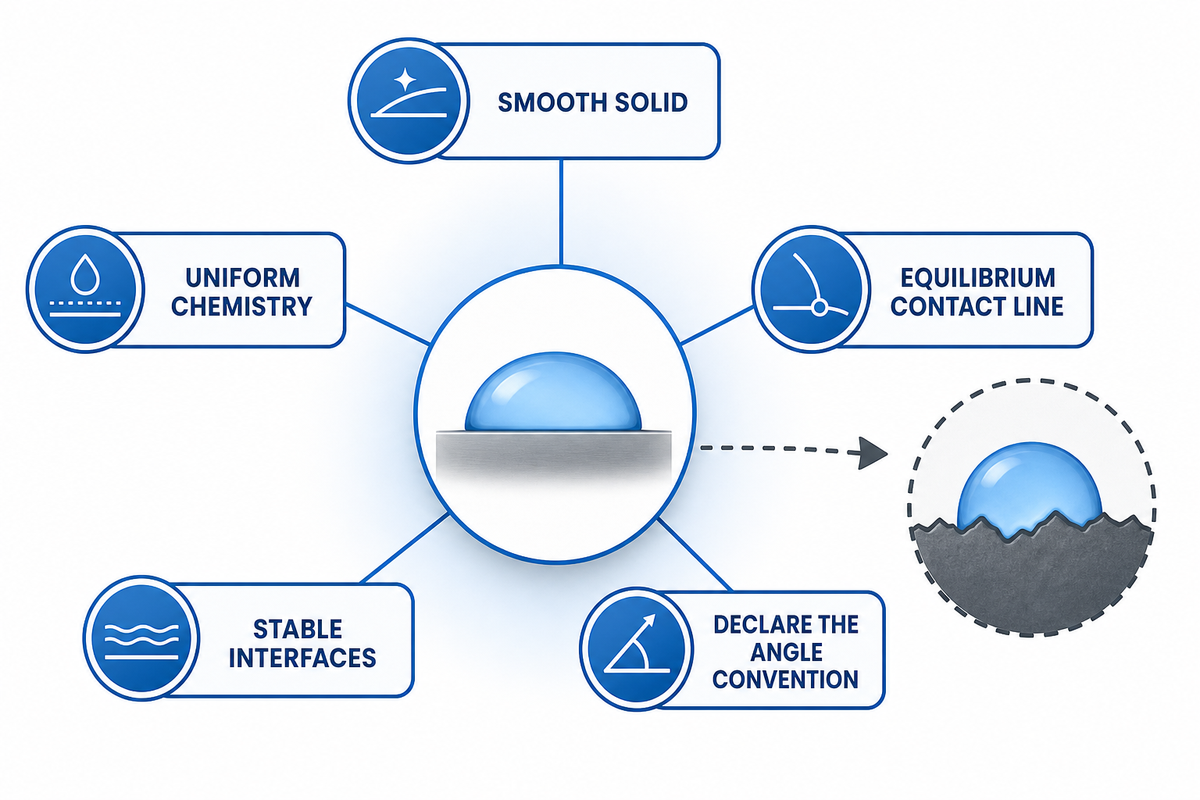
Young’s ideal model assumes a smooth and chemically uniform interface with a well-defined contact line; when real surfaces depart through roughness, chemical heterogeneity, contact-line dynamics or measurement history, the apparent angle should be reported as protocol-dependent; source context: deviation study.
If there are irregularities in the actual surface, such as roughness, chemical heterogeneity, or fluctuations in the contact line position, Young’s equation may not describe the apparent contact angle even when the measurement has been properly documented. Young’s ideal model may not be applicable, so the measurement protocol should accompany the reported result.
- equilibrium: the contact line has been stable for some time and is free to move.
- Smooth surface: roughness is small enough at the measurement scale for the observed geometry to represent the local interface.
- For a solid to fit the ideal liquid model, it should be chemically homogeneous and should not show a range of stable angles caused by contact-line pinning.
- Constant solid/liquid: the substrate doesn’t dissolve and/or swell, and the Probe liquid doesn’t chemically interact with the solid.
- Well-defined three-phase line: solid, liquid, and vapor meet at a traceable contact line during measurement.
- Negligible secondary forces: gravity, evaporation, and line-tension effects are controlled or small at the measurement scale.
Equilibrium is a condition, not a guarantee. A visually stable drop can still be metastable because the contact line is pinned. If advancing and receding angles differ, report the hysteresis instead of silently choosing one number as “the” Young angle.
How contact angle measurement connects to the equation
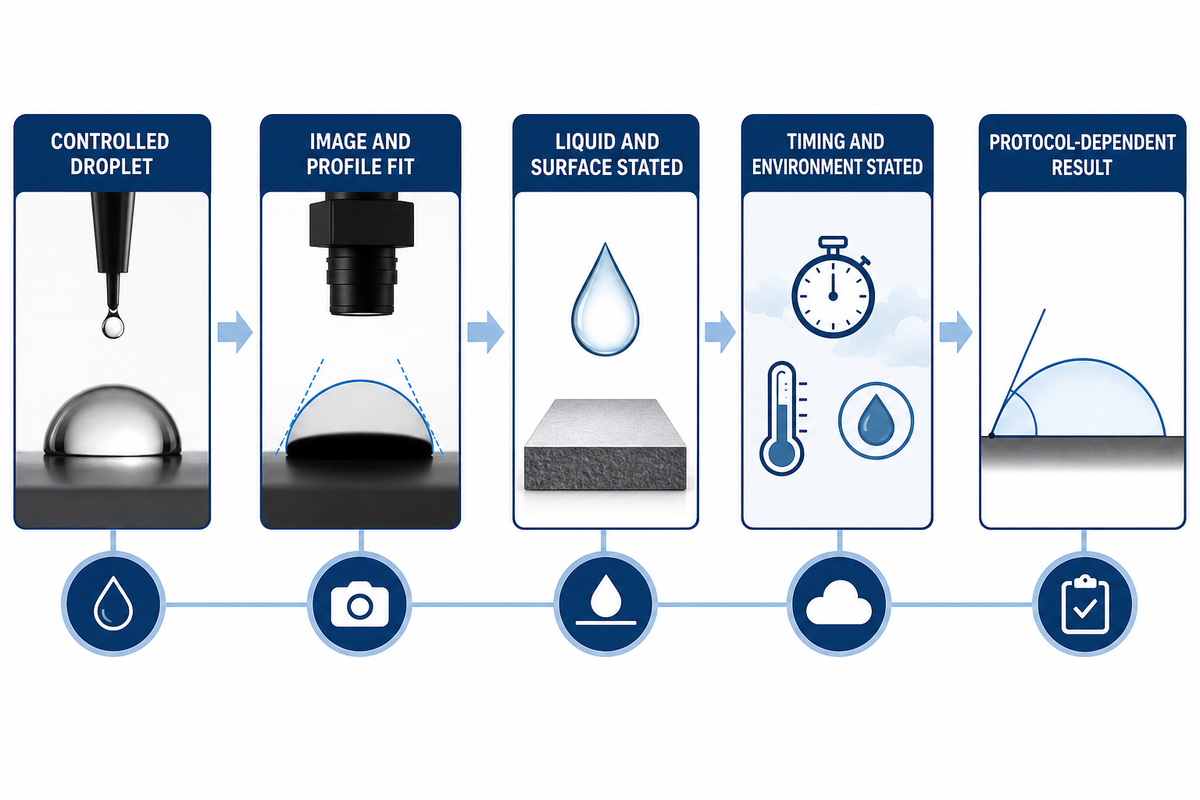
Contact-angle measurement connects the model to a sessile-drop protocol: a droplet profile is recorded, fitted and interpreted with its liquid, surface, timing and environmental conditions stated; a reported angle is therefore a protocol result rather than a context-free material constant; source context: measurement-context reference.
A standard sessile-drop test involves capturing an image of a droplet placed on a surface, and using the image to evaluate θ. Estimating θ requires attention to several details of the experiment, and a high degree of precision. For example, the purity and volume of the liquid droplet, surface cleanliness, needle handling, humidity, temperature, vibration, camera setup, baseline selection, and timing all affect the result. So do the baselines, the time that passes between when a deposit is made and when θ is estimated, and how the needle of the droplet is handled.
For a practical introduction to the measurement workflow, see the supplied contact-angle measurement and interpretation guide. That page is the deeper measurement handoff; this article stays focused on the equation and on how to decide whether its assumptions are credible.
For the wider cluster context, the surface-science hub connects contact-angle interpretation with related surface characterization topics. Use that hub for the broader workflow, while this article remains the equation-level reference.
The term “sessile angle” typically refers to a single measurement. An advancing angle occurs when liquid is added to the substrate and the contact line moves outward (measured). An angle that recedes occurs when liquid is withdrawn from the substrate (measured). The difference between the advancing and receding angles is referred to as contact-angle hysteresis. Hysteresis may indicate surface roughness, chemical heterogeneity, or contact-line pinning. In the absence of independent evidence, hysteresis should not be attributed solely to instrument deficiencies.
A measured angle is a measurement including a protocol. Along with the angle, the size of the drops, the conditions of the environment and the time are recorded. If different baselines are fitted in two laboratories, the angles can’t be compared, even if both instruments are functioning correctly.
Why real surfaces depart from the ideal model
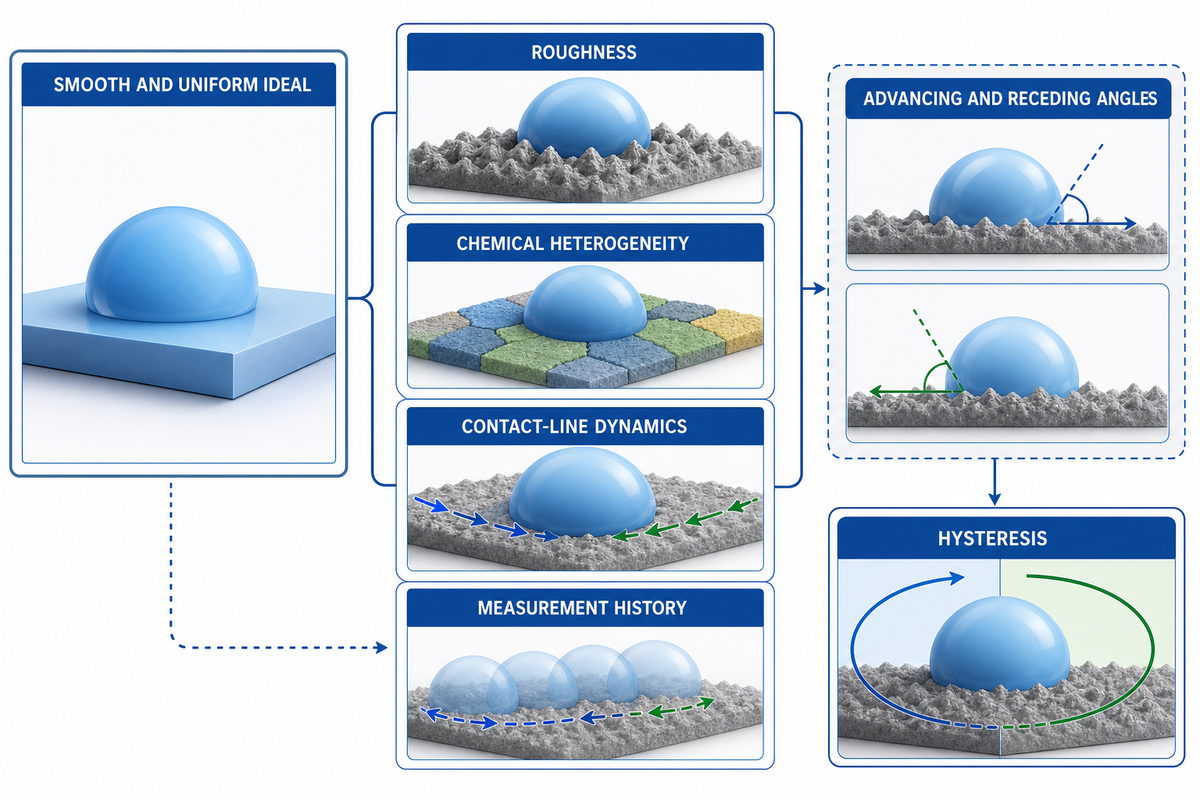
Young’s equation provides symbols to define the interfacial terms between solid and vapor, liquid and vapor, and solid and liquid, together with the contact angle in the relation; a rough or heterogeneous interface means that the apparent relation may vary. The relation is also protocol-dependent. If the apparent angle changes with contact-line dynamics or measurement history, the surface observation may depart from the ideal relation. Source context: deviation study.
Deviations from the ideal surface model occur due to the presence of imperfections, the effect of time, incompatibility, and the influence of the measurement scale. The objective is to recognize the mechanism causing each deviation before treating an apparent angle defect as an equilibrium property.
Roughness and apparent angle
Textural features of a surface may allow a drop of liquid to spread beyond its true contact area, thus modifying the contact angle. In the Wenzel model, the liquid spreads to conform to the irregularities of the substrate. On the other hand, in the Cassie-Baxter model, liquid contacts a rough substrate and vapor trapped in the irregularities instead of filling them.
Chemical heterogeneity and pinning
Certain polymer systems can exhibit metastability, resulting in multiple equilibrium positions for the location of the contact line. An analysis of this type may reveal asymmetry in the movement of the drop front. Reporting the range of the locations mapped is more useful than calculating a mean.
Contamination, absorption and time
Impurities in the interface affect the liquid. Some migration of polymer additives can occur, resulting in the absorption of part of the liquid. A polymer can reorient and, as a result, the final angle doesn’t necessarily represent the initial angle. Because of the effects described above, the final angle should be reported with the time delay and surface history, not as the final state of the system. Measurement of the treatment-to-test time and the delay before image capture is required in the test record.
These combined effects show why Young’s equation can be correct as an equilibrium relation while a practical measurement may fail to reach that equilibrium. Discarding the equation isn’t the remedy. Rather, what terms are being approximated and which non-ideal effects are being controlled should be stated.
Young’s equation versus related equations
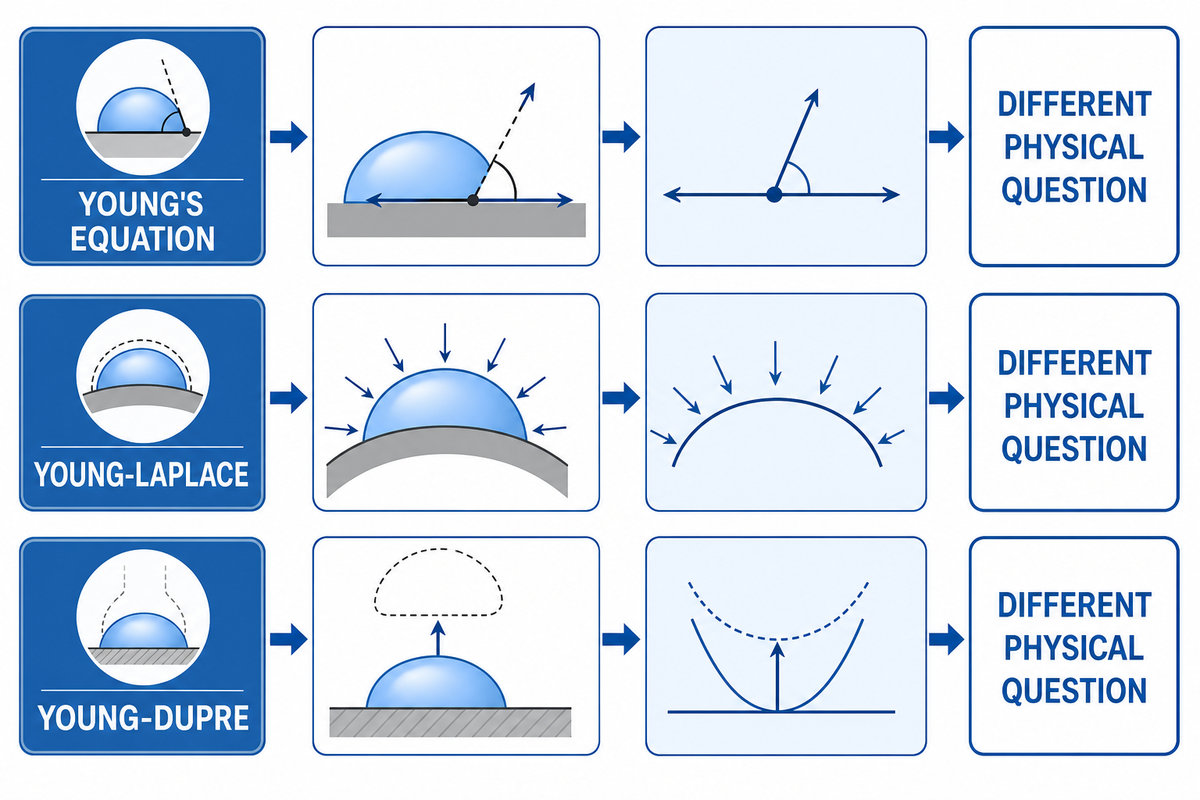
For a scholarly discussion of the contact line and the nanoscale, see the nanoscale Young-equation reference.
| Equation or model | Physical question | Common mistake |
|---|---|---|
| Young’s equation | What equilibrium contact angle follows from the three interfacial terms? | Calling a pinned, time-dependent apparent angle an intrinsic equilibrium constant. |
| Young–Dupré relation | How can contact angle and liquid surface tension be related to work of adhesion in an idealized pair? | Treating calculated work of adhesion as a direct durability or lap-shear guarantee. |
| Young–Laplace equation | How do surface tension and curvature create a pressure difference across a curved interface? | Using it to explain solid wetting when the question is actually the contact-line balance. |
| Wenzel model | How might roughness change an apparent angle when liquid follows the texture? | Applying a roughness factor without verifying the wetting state. |
| Cassie–Baxter model | How might a composite solid–vapor contact change the apparent angle? | Assuming trapped vapor or texture remains stable during a real process. |
| Young’s modulus | How does a material resist elastic deformation? | Confusing a mechanical stiffness equation with a surface-wetting equation. |
What a contact angle can, and cannot, tell an adhesive user
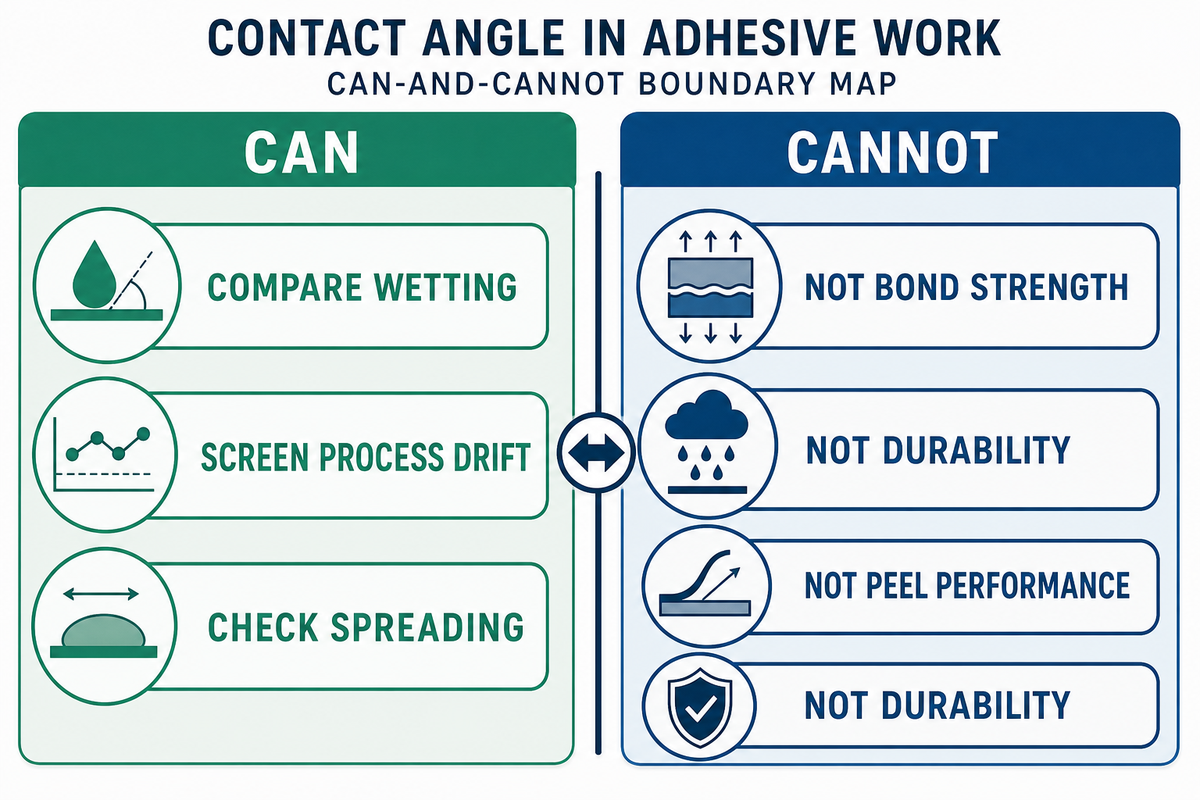
A contact angle can reference wetting according to a defined standard, but it can’t assess adhesive bond strength, resistance to humidity, peel performance, aging, and/or general compatibility. Its scope is restricted to the comparative assessment of processes. Therefore, when making a decision on bonding, there’s a need for complementary assessment by other means, including tests which evaluate the end-use conditions, reliability and durability, as well as the working environment. Refer to the interpretation limits.
Generally, a lower result for the contact angle test implies higher water wetting. However, several factors affect the outcome of the test and should be considered. For example, the viscosity of the adhesive and the condition of the surface being tested are relevant. This test can be used to evaluate treatment change. It can’t be used to measure the long term stability of a bond.
For application level trial planning, see the controlled bonding trial matrix.
When evaluating film and coating formulations, there are three things to consider.
| Question | Useful evidence | What not to claim |
|---|---|---|
| Will the test liquid wet the surface consistently? | Contact angle, advancing/receding range, replicate map and timing. | “This angle guarantees adhesion.” |
| Is the process surface stable before conversion? | Time-to-use study, storage condition, contamination controls and repeat measurements. | “The treatment lasts for a universal shelf life.” |
| Will the finished construction perform? | Application-specific peel, lap-shear, print, coating or failure-mode test. | “A single droplet replaces an adhesion test.” |
This demarcation line defends both engineering judgments and marketing. Signals in process windows are valuable screening ideas for process control. However, if these screening ideas are sold as the highest-ranked, safest, or absolute guarantees, they lose technical value.
A practical reporting checklist for contact-angle data
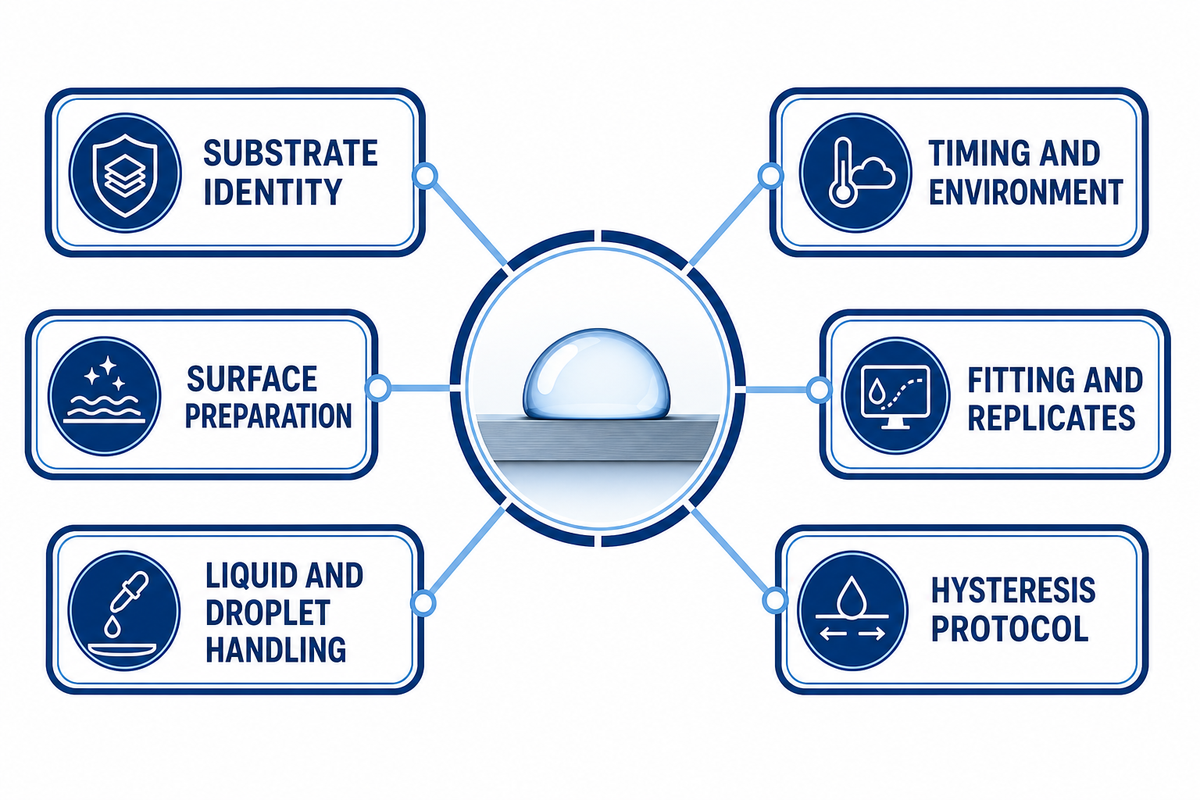
Source context: interpretation reference.
This record should be used before comparison of test results across variables including lot, supplier, or laboratory.
- Substrate identity: Identify the substrate as a polymer (name, lot number and storage history) as well as any treatment or coating applied to the polymer.
- Surface preparation: The nature of the cleaning and drying prior to the deposition of the droplet. State the treatment, if any, and the time thereafter that the droplet was deposited.
- Probe liquid: name, purity, age, temperature and any additives.
- Describe the volume of the droplet and state the method of deposit. Droplet protocol: Note details of contact and/or removal of the needle and state the duration of evaporation.
- Environment: Note the environmental conditions including temperature and humidity, and state measures taken to control vibration.
- Image analysis: The camera and magnification used, method of baseline definition, and model of fitting, if any. State whether the right and left sides of the picture were averaged.
- Contact-line mode: State the mode of operation and hysteresis, if measured.
- State the number of replicates and the reasons for their exclusion. Replicates and exclusions: State the range or standard deviation of the data.
- Decision link: Define the test to be performed to verify the predicted conversion.
This checklist transforms “contact angle = 62°” into a traceable observation. It helps distinguish a real process change from a nominal difference in timing, liquid, fitting, or surface history.
For a comparative analysis of the readings, please refer to the contact-angle summary.
Decision framework: when to use Young’s equation as a model
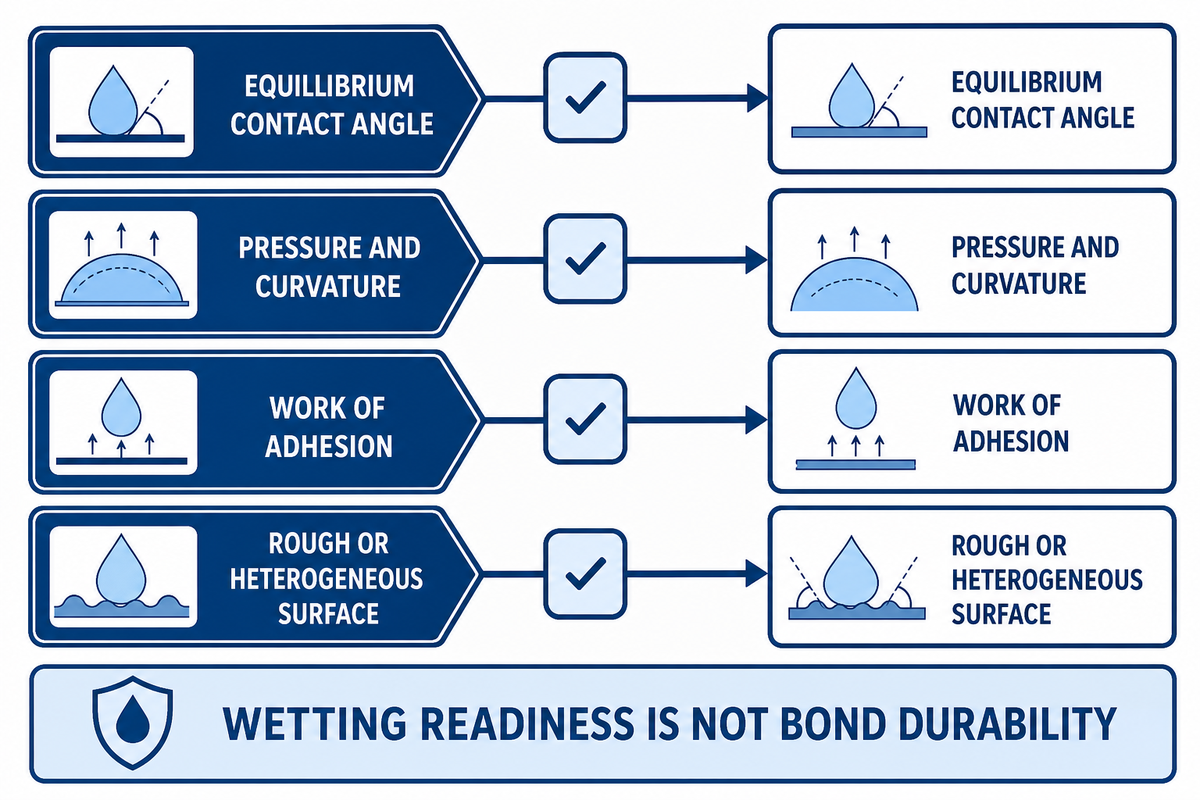
Source context: model-scope reference.
The following questions must be answered before using a measured angle to analyze or test interfacial behaviors.
- Is the surface close to equilibrium? The apparent angle and contact-line motion depend on time, pinning, and the rate of change. If the change is rapid, the angle is said to be dynamic.
- Have we defined roughness and chemistry at the appropriate length scales? If not, report a range, and don’t give a single value for an intrinsic solid property.
- Has the liquid and surrounding environment stayed the same? If a different liquid or temperature is used, then γLV can also change.
- Is the number used as a “blind” number? Blind numbers are screening numbers and don’t necessarily represent performance. A performance claim undergoes an independent test.
- Can the number stated be independently verified? A number stated should be defined by an adequate protocol such that the timing, fit and choices made by the investigator are clearly communicated. Only then should the number be used to make a decision.
Generally speaking, Young’s equation can be useful in modeling expected wetting behaviors. In cases where most of the listed conditions are met, Young’s equation can be very helpful. More weight should be given to the measured hysteresis in cases where answers to the conditions are mixed. Also, more weight should be given to location-to-location spread in cases where the results of application aren’t satisfactory.
Protocol detail: make the model testable
Source context: historical reference.
Young’s original 1805 discussion provided the historical basis for contact angle relation. However, his interpretation predates today’s measurement protocols. A capillary drop is a fluid object. Its thermodynamic interpretation depends on the liquid, the solid, and the surrounding vapor. So the phrase “interfacial tension” should be defined in the context of the interface under consideration. It shouldn’t be used as a general phrase to define product grade.
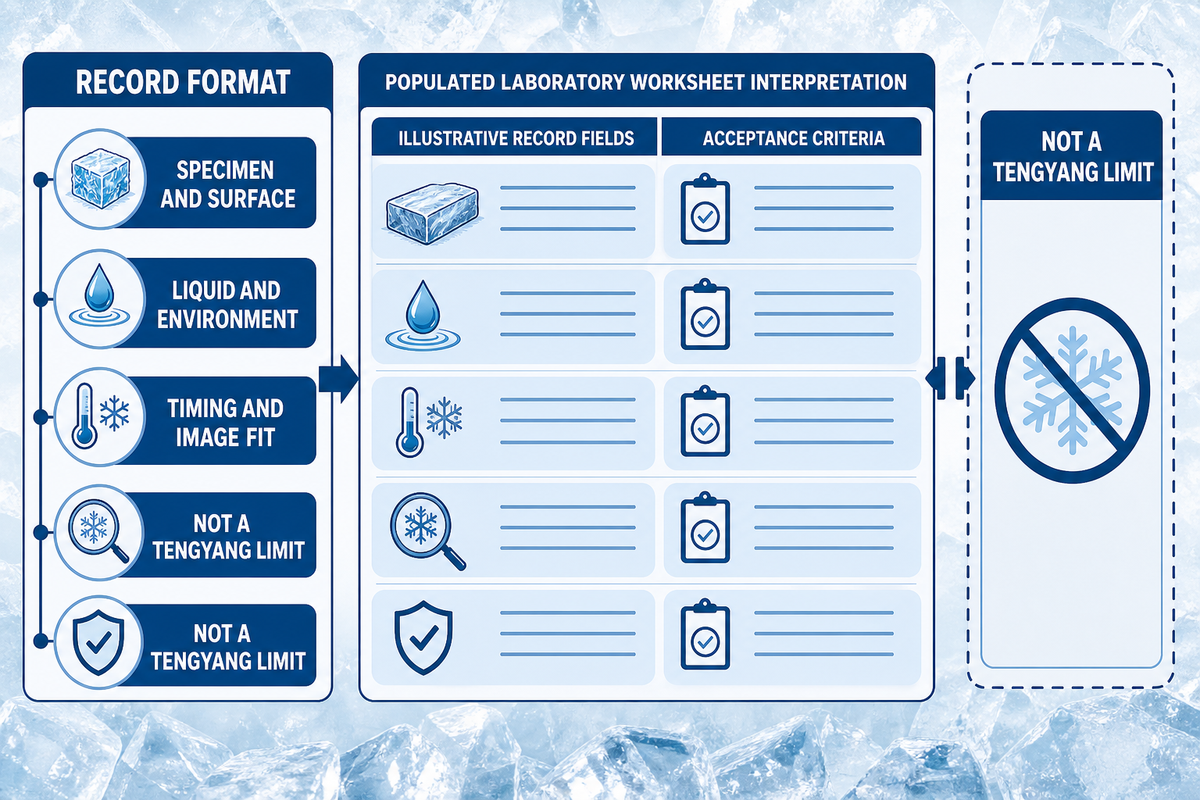
The table below is an example contact-angle record. The record formats shown below are illustrative and don’t define acceptable limits. Timing and unit values are to be included with the results.
| Category | Type of record | Illustrative field | Decision use |
|---|---|---|---|
| Substrate | identity | polymer grade, film side, lot | separate material history from measurement variation |
| Surface preparation | conditioning | cleaning method and treatment-to-test delay | expose contamination or recovery risk |
| Liquid | fluid property | name, purity and temperature in °C | bind γLV to the actual probe liquid |
| Droplet | geometry | nominal volume in µL and needle procedure | make drop size and placement comparable |
| Environment | condition | relative humidity in % and room temperature in °C | identify evaporation or conditioning effects |
| Timing | sequence | image at a stated delay in s | distinguish transient from stable behavior |
| Contact line | mode | static, advancing or receding angle in ° | make hysteresis visible |
| Replication | sampling | locations, count and outlier rule | avoid hiding heterogeneity in one mean |
| Application | performance check | peel, shear, print, coating or durability result | test whether wetting readiness transfers to the construction |
These elements, together with supporting documentation, define a reproducible experiment and let a reviewer judge whether a capillary-scale observation can address the adhesion question. Contact-angle results should only be included in a report if the question requires it.
Illustrative units only: a record might show a 1 mm baseline check, 23 °C room temperature, a relative-humidity field, a 30 s delay, a 1 PSI chamber note, a 0.5 kW treatment log, a 2 hr storage interval, and a 5 mN/m liquid reference. These examples show how to create a record; they don’t show Tengyang limits or acceptance levels.
Blank-form notation example: A laboratory worksheet may include sections for 5 µL liquid volume, 0.5 mm baseline width, 10 px/mm image scale, 15 s fitting delay, 22 °C room temperature, a humidity field, 50 µm film thickness, 1 PSI pressure, 2 m/min line speed, 0.2 kW treatment power, 4 hr storage, n = 5 measurement locations, 72 mN/m liquid tension, 1 N force, and a 60° angle. The numbers on the worksheet aren’t suggested values for the process controls. Each is an example for the format of data to be entered into the process controls.
A second example of a blank-form representation might include a 0.1 mm scale, a 0.1 ms camera timestamp, and a 1 N field. Representative process-control form fields might use placeholder entries of 3 mm, 4 mm, and 5 mm, not acceptance limits.
Other process control examples of blank forms might include 2 mm scale, 25 °C, humidity field, 20 s repeat delay and 1 hr process control time.
| Decision checkpoint | Evidence to retain | Failure mode made visible |
|---|---|---|
| Surface identity | lot, side and storage history | wrong substrate or aged sample |
| Cleaning | solvent, rinse and drying sequence | residue or uncontrolled contamination |
| Treatment timing | activation-to-drop and activation-to-bond times | recovery mistaken for drift |
| Liquid control | purity, age and temperature | γLV changed between runs |
| Image fit | baseline rule and profile model | operator-dependent θ |
| Location map | coordinates and replicate spread | heterogeneity hidden by one mean |
| Hysteresis | advancing and receding sequence | pinned line called equilibrium |
| Application test | peel, shear, print or coating result | wetting screen treated as proof |
| Release wording | screen, trend or performance claim | universal threshold implied |
Frequently asked questions
What is Young’s equation for contact angle?
Young’s equation states that the equilibrium balance at the solid-liquid-vapor contact line is given by γSV-γSL = γLV cos θ. The angle θ is measured through the liquid. The relation relates the observed equilibrium geometry to three interfacial terms, but doesn’t dictate them. On a surface in less than ideal condition (e.g. rough or contaminated) the sessile contact angle measured through the liquid may differ from Young’s equilibrium contact angle and should be reported as protocol-dependent.
What do the three surface-tension terms in Young’s equation mean?
With respect to interfaces, the interfacial terms must be consistent. The liquid-vapor surface tension (γLV) is determined by the liquid and the environment. The two solid-side terms are related to the solid-vapor and solid-liquid interfaces and are determined by the respective pair and the condition of the surface. From a given perspective, the three terms may be called the “surface energy”, which, however, may mask the differences.
What assumptions does Young’s equation make?
Young’s equation assumes a stable liquid, a defined three-phase contact line, a smooth and chemically uniform solid, and an equilibrium contact angle. Gravity, evaporation, and line tension must be negligible or controlled. Report roughness, heterogeneity, contamination, swelling, and hysteresis during measurement.
Is Young’s equation the same as the Young–Laplace equation?
No. Young’s equation balances three interfacial terms at a contact line to describe an equilibrium contact angle. Young-Laplace relates interface curvature and liquid surface tension to the pressure difference across a curved surface. They can appear in one experimental droplet measurement but answer different questions in physics. Their measured variables differ.
Can a contact angle alone predict adhesive bond strength?
No. Contact angle can screen wetting or process drift, but bond strength also depends on adhesive chemistry, defects, cure, and joint geometry. Hysteresis, aging, and contamination can hide variation. Confirm performance with application-specific peel, shear, print, coating, or durability tests.
Contact angles can be determined using a standardized and documented procedure. Results of such measurements, along with other relevant tests, can be used to assess the suitability of bonding for a given application. Wetting doesn’t guarantee the longevity of a bond. Contact angle trends should be interpreted in the context of other data and a thorough analysis of the system.
Contact angles may be measured to help interpret the degree of wetting. The procedure specifies the liquid, state of the surface, time, and other parameters. Based on the measurement and the procedure, the test person may compare the result with a specification, but fulfillment also requires an appropriate performance check.
References & Sources
- A description of Young’s equation is provided in Young’s equation overview.
- Biolin Scientific: Young’s equation outlines the historical context for Thomas Young and contact-angle work.
- The contact angle relationships for Young’s equation are described in Nature: Young’s equation.
- The interpretation of the equation is discussed in On deviations from Young’s equation.
- J. Am. Chem. Soc. 2026 analyzes the molecular basis for wetting from the perspective of free energy.
- Young’s equation at the Nanoscale is an example of research that focuses on the nanoscale and is comparable to work done at the atomic scale.
- Young’s equation redux describes the limits of interpreting the equation.
- Young-Laplace covers related pressure, curvature physics; it’s kept distinct from Young’s equation here because the two relationships answer different questions.
The article illustrates the measurement model and isn’t a certification, validation, or performance assessment of an adhesive.