Get in touch with Tengyang Company

Contact Angle: A Practical Measurement and Interpretation Guide for Polymer Films

Surface Science for Film Converting
A contact angle is an indicator of whether a test liquid wets a surface under defined conditions. It cannot, by itself, certify that an ink will print cleanly, an adhesive will hold, or a treated polymer film will remain bondable after storage. So ask two things of every reading: what is the angle, and what decision can this measurement support?
What Contact Angle Tells You—and What It Does Not
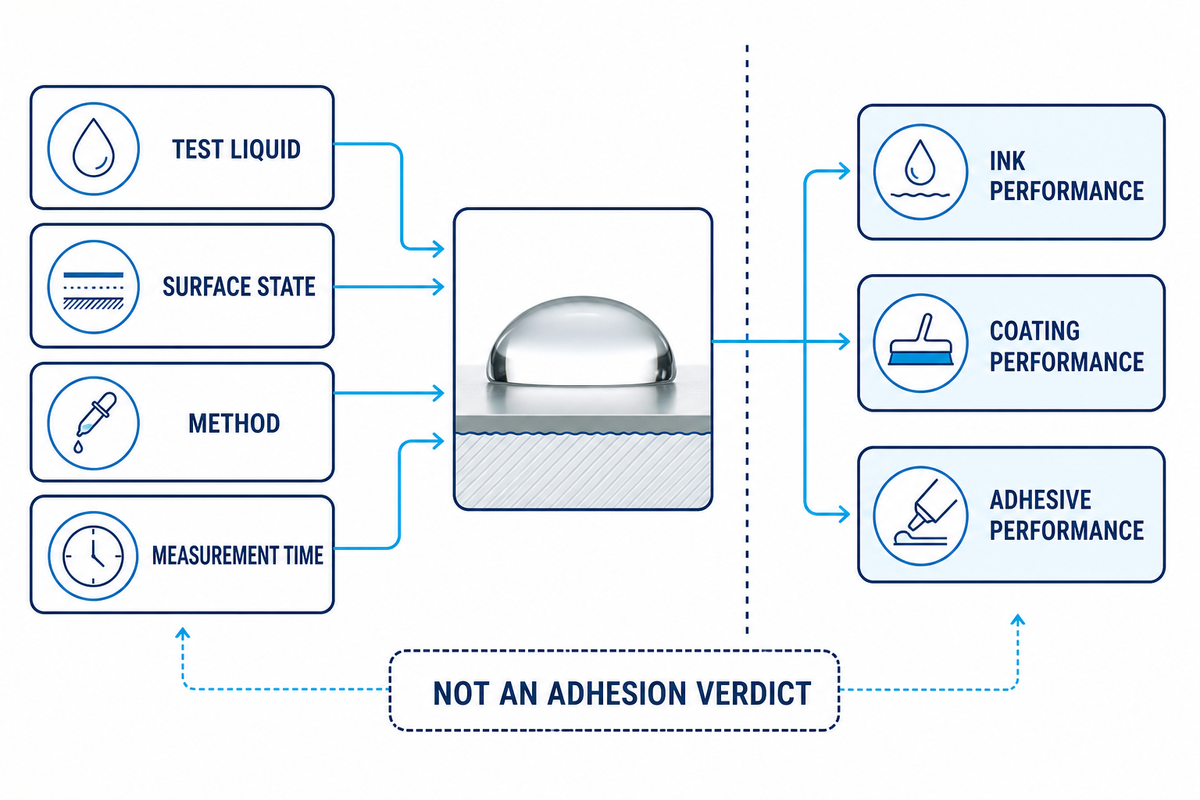
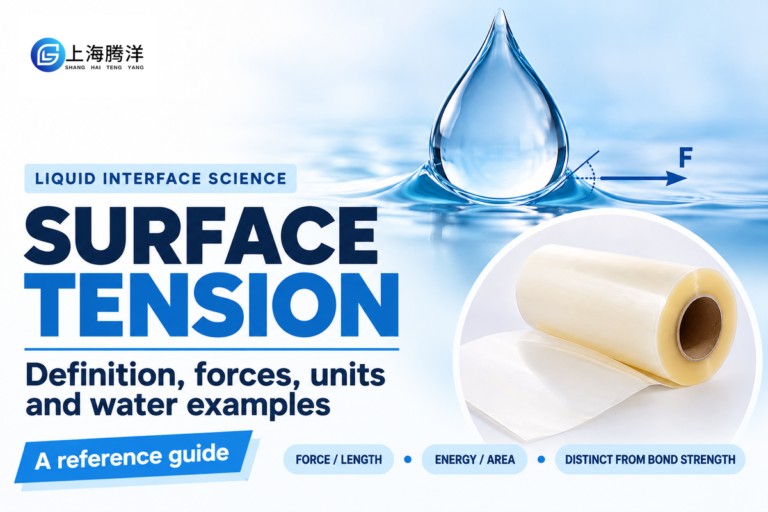
Contact angle occurs at the measured interface of a liquid, solid and gas. At the three-phase contact line (TPL), adsorption and molecule-scale interactions govern how the liquid spreads. A smaller Contact angle usually means that the chosen liquid spreads easily. A larger Contact angle means that the liquid tends to retain a more droplet-like shape. The result belongs to a specific liquid–surface–method–time system, not to the solid alone.
This makes a difference on a converting line. Water may spread well on a treated film while an adhesive with different surface tension, viscosity, and cure chemistry behaves differently. A low water contact angle can confirm that surface wettability and hydrophilicity changed, but it can’t show if the laminate will peel, coating will flake off, or there will be aging. The surface-science learning path indicates where this measurement appears in a bond qualification record.
The 90-degree benchmark is a guideline, and is not an absolute limit. Water is generally said to wet the surface below 90 degrees, and to bead up above 90 degrees. Production acceptance still depends on the material, liquid, surface history, timing and downstream requirement. The official scope text for ASTM D5946-24 is specifically about water contact angle on corona-treated polymer films. It is not a general bond release specification.
Choose the Measurement Mode Before Choosing a Threshold
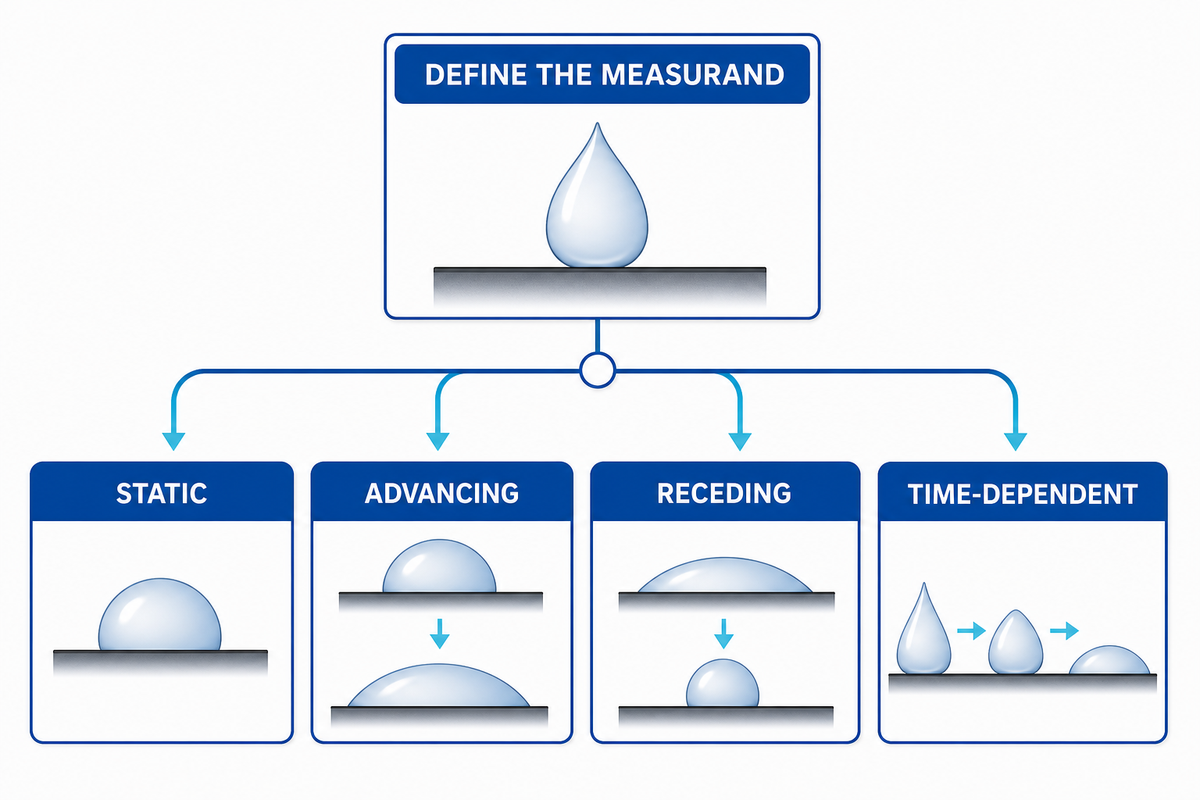
Contact angle methods address different needs. Uncritically comparing and using them interchangeably creates a specification that looks precise but, in fact, compares unlike measurements.
| Measurement | Best use | What it reveals | Main caution |
|---|---|---|---|
| Static sessile drop | Fast routine comparison on a controlled surface | Apparent wetting at a defined time after deposition | The result can fall anywhere within a hysteresis range and depends on drop history |
| Advancing angle | Observe wetting of previously dry surface as liquid volume grows | Resistance to forward movement of the contact line | Dosing rate, needle position, and surface heterogeneity must be controlled |
| Receding angle | Observe dewetting as liquid volume decreases | Retention, pinning, and release from the surface | Evaporation and removal method can distort the endpoint |
| Time-dependent or process-dynamic test | Absorbing, swelling, evaporating, or moving systems | How wetting changes on the timescale that matters | “Dynamic” must be defined because laboratories use the term differently |
The difference between advancing and receding angles is hysteresis. It can reflect chemical heterogeneity, roughness, contamination, friction at a pinned contact line, or changes in the liquid phase. Roughness can also account for hysteresis. Friction at a contact line can also cause hysteresis. The KRÜSS explanation of hysteresis states that a high initial angle alone may not reflect how a droplet will release. For quality assurance, a static test may be adequate for a stable process, while a measurement may be needed to explain why a high initial angle is not associated with stability.
Hysteresis is not a mechanism identifier. With some responsive polymers, the probe liquid can physically alter interface during the measurement; an example is an adaptive-wetting study on cross-linked PDMS. If the angle is changing, look at possible explanations other than pinning.
Measurement Mode Selector
- Use static measurements when you want a quick, repeatable comparison to an internal standard.
- Add advancing and receding angles when static results hide nonuniformity, pinning, or dewetting behavior.
- Add time dependency when the surface or test droplet changes during the bonding process.
- Stop and redefine the measurand when the same term is used for different procedures in different labs.
Control the Instrument, Droplet, Baseline, and Timing
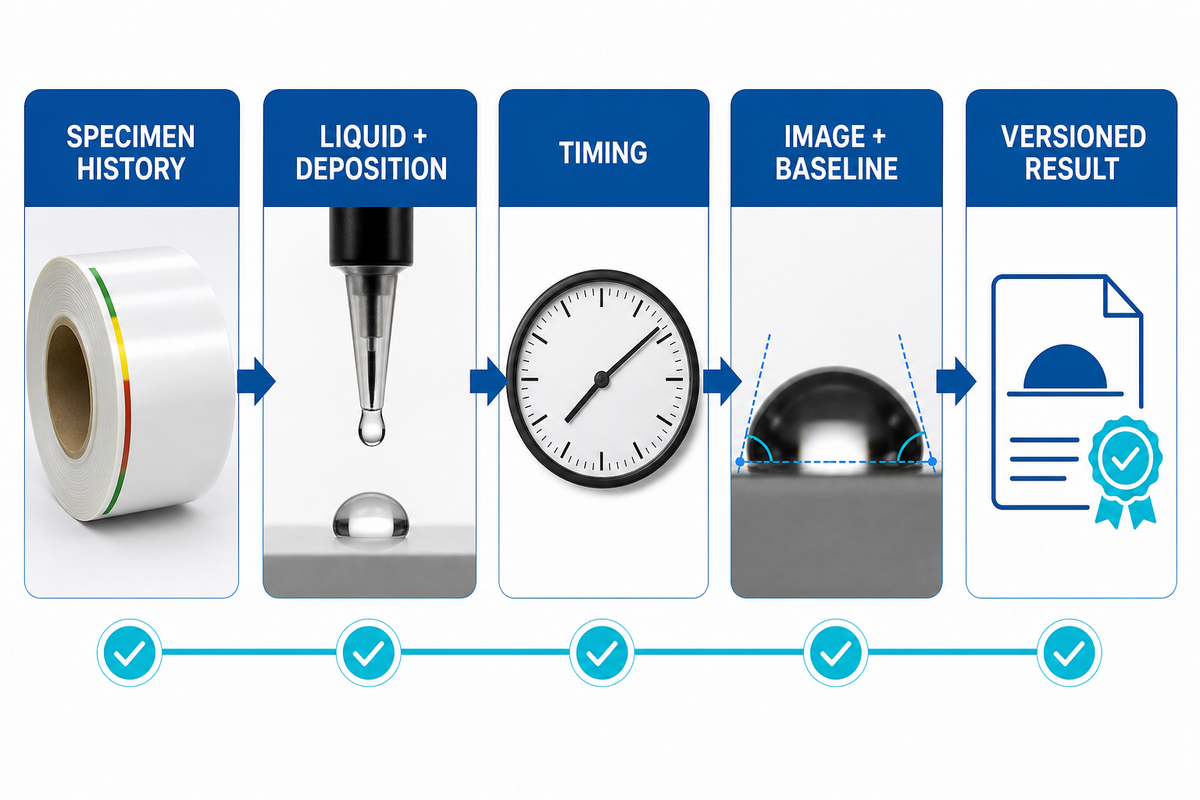
Repeatable contact angle measurements start before the droplet reaches the surface. Record the grade and lot of the film, the side that was treated, the treatment method and settings, the history of the film (especially if it was cleaned), the conditions of storage and transport, how it was handled, and the elapsed time since it was treated. A reading without surface history cannot distinguish process change from sample change.
Control the specimen and sampling plan
- Sample multiple areas across the web or part.
- Avoid repeated contact by the same liquid which may swell, alter, or contaminate the surface.
- Declare the side of the film which was tested, as well as how orientation was maintained.
- Define exclusions before measurement instead of removing inconvenient values afterward.
Control the liquid and deposition
Identify liquid, purity, storage, temperature, droplet volume, dispensing rate, needle position, deposit height, and rule for needle withdrawal. Trace surfactants, glycol contamination, or a changed solute concentration can alter liquid properties, while a hard droplet impact can produce a different history from gentle deposition. The measurement time must be precisely measured, as evaporation, absorption, and surface rearrangement, can change the result.
Control the image and analysis
Use fixed optical magnification, camera alignment, and lighting. Baseline rules must also be strictly followed. A baseline shifted by a few pixels can move the fitted angle, especially on small drops or rough edges. The image-fitting technology and its theoretical model should be versioned with the result. A thorough, peer-reviewed evaluation of sample and measurement influences, shows that droplet size, method of analysis, and sample preparation, must be in the method, not in the footnotes.
Compare Contact Angle, Surface Energy, and Dyne Testing
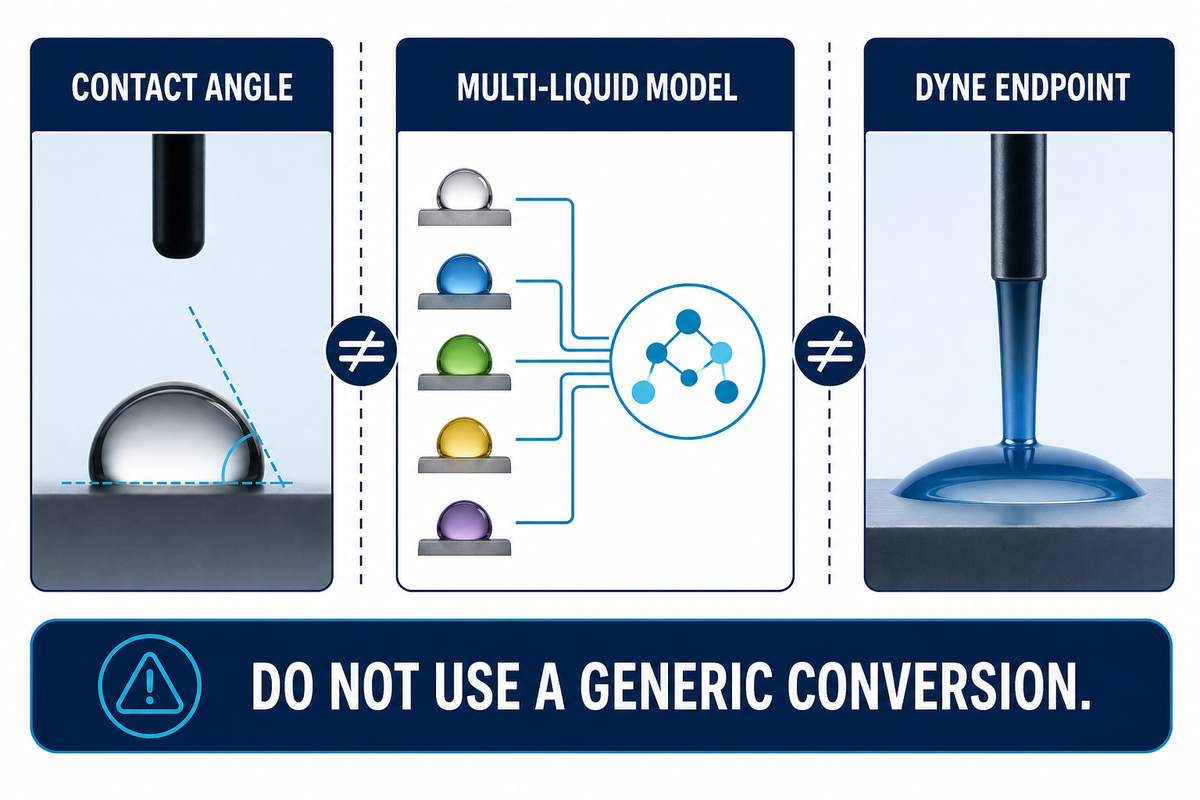
These methods are based on the physics of wetting, but produce different observable results.
| Method | Output | Strength | Limit |
|---|---|---|---|
| Contact-angle imaging | An angle for a declared liquid, surface, method, and time | Quantitative images and spatial comparisons | One liquid does not yield a complete solid surface-energy description |
| Multi-liquid surface free energy | Model-derived total and component values | Useful for comparing polar and dispersive interactions when assumptions are met | The answer depends on probe liquids, model, and contact-angle quality |
| Dyne ink or wetting-tension test | A comparative wetting-tension endpoint | Fast floor-level screening on polymer films | Operator timing, liquid condition, contamination, and subjective endpoint affect the result |
ASTM D2578 addresses wetting-tension testing of polyethylene and polypropylene film with specified test solutions. That differs from the water-droplet image method in ASTM D5946. A correlation between them may be useful inside one controlled process, but it must be demonstrated with paired data. Don’t apply a lookup table copied from another material, laboratory, or treatment line; build the correlation from paired data on your own film.
Surface free energy also is an inference rather than a measured value directly determined by a single water droplet. To distinguish polar and dispersion, or to evaluate possible hydrogen bonds, several probe liquids and a defined model are required. This means that a statement like “the contact angle fell, therefore surface energy is X” is an overstatement of what is supported by the data. See the associated guide on surface energy and bonding relevance.
Translate Readings Into a Film-Treatment Decision
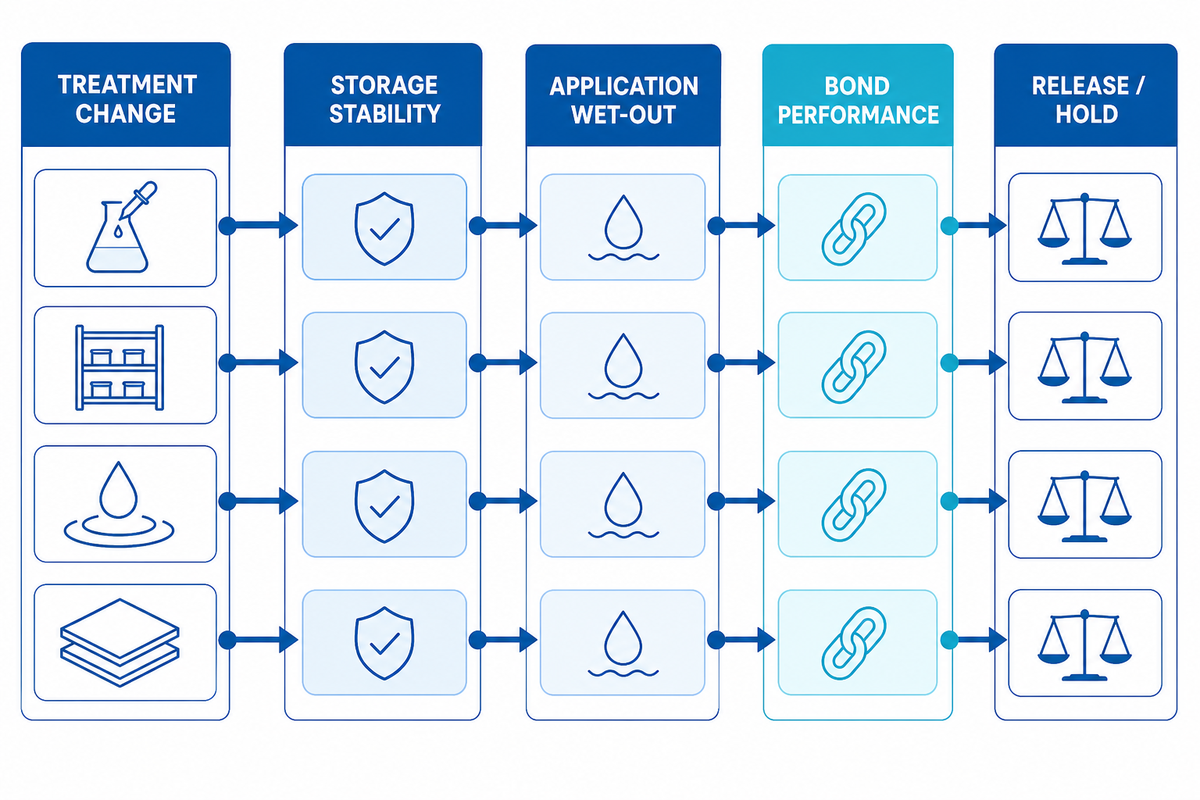
Begin with the end in mind. Are you testing to see whether a corona treatment changed the surface, treatment remains stable over time, an adhesive wets within its open time, or a finished laminate meets durability requirements? Different evidence is required for each case. The method scope of ASTM D5946-24 may be useful for the first case, but not the last.
| Decision | Primary observable | Comparison basis | Corroborating evidence | Hold condition |
|---|---|---|---|---|
| Did treatment change the surface? | Defined contact-angle method | Untreated or known-state reference from the same material family | Treatment settings and sampling map | Protocol or surface history differs |
| Is treated film stable through storage? | Angle distribution at declared time points | Same packaging, temperature, humidity, and elapsed-time rules | Surface chemistry or process history when available | Time zero or storage conditions are missing |
| Will the application liquid wet? | Actual liquid or a validated surrogate | Validated good and bad process populations | Wet-out observation under relevant speed and temperature | Only water data are available |
| Will the bond perform? | Application-specific adhesion/durability test | Defined cure, geometry, aging, and acceptance basis | Contact angle as supporting surface-state evidence | Functional testing is absent |
| Did cleaning change the exposed surface? | Defined contact-angle method before and after cleaning | Same substrate lot and handling window | Cleaning record and contamination check | Cleaner residue or rinse condition is unknown |
| Is treatment uniform across the web? | Mapped angle distribution | Declared cross-web and machine-direction locations | Line settings and electrode condition | Sampling positions cannot be reconstructed |
| Did handling contaminate one face? | Side-specific angle distribution | Protected control and handled specimens | Glove, packaging, and contact history | Film side identity was lost |
| Can two laboratories compare results? | Common-specimen reproducibility study | Harmonized liquid, dosing, timing, and analysis | Shared images and protocol versions | The measurands still differ |
| Is a routine screen still valid? | Control-chart behavior under the frozen method | Validated reference population | Periodic functional-test correlation | Process, material, or method changed |
Don’t pick a threshold from a generic hydrophilic/hydrophobic label. Build it from known-good and known-bad populations measured under the frozen protocol, then confirm that it predicts the decision you care about. Keep in mind both the center and the spread of the data, and take into account an appropriate coefficient of variation as justified. An average that is stable can conceal a tail that is expanding and contains untreated or contaminated locations. The corona-treatment and aging guide provides additional information regarding the timing aspect of this question.
Surface treatment can decay as polymer chains rearrange or additives migrate. A 2025 study of aged and corona-treated films and other current literature in the research set reinforce the need to state the time between treatment, measurement, and conversion. This time is strictly controlled, or the comparison is meaningless.
Diagnose Disagreement Before Changing the Process
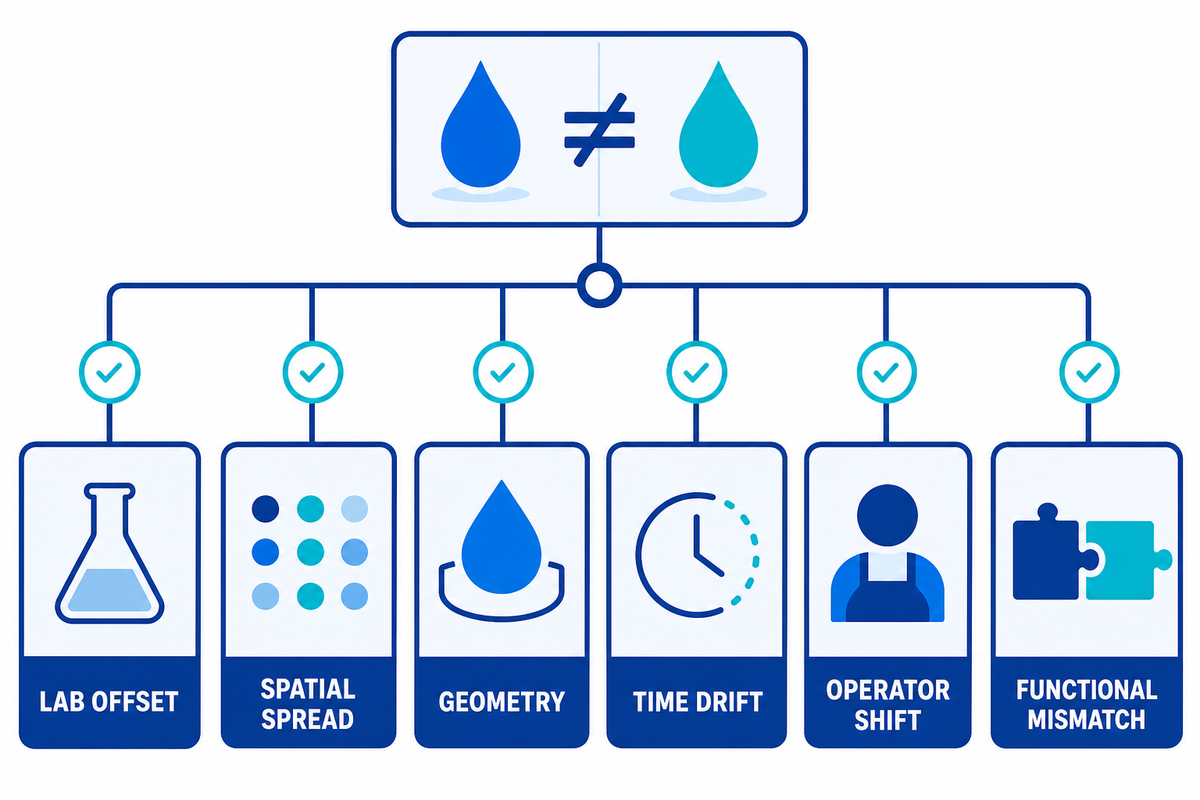
When the results of two different measurements differ, do not immediately adjust treatment power to correct. First categorize the pattern. Disagreement can be genuine surface variation, a timing effect, a protocol mismatch, or an image-analysis problem; the peer-reviewed study of sample and measurement influences on static contact angles documents several of these effects.
| Failure category | Observed signature | Likely checks | Next action |
|---|---|---|---|
| Laboratory | Nearly uniform offset between laboratories | Liquid lot, temperature, droplet volume, timing, calibration, baseline and fitting model | Exchange common specimens and run a harmonized protocol |
| Spatial | Large spread across one specimen | Treatment uniformity, contamination, roughness, film side, sampling positions | Map locations; do not hide the distribution in one average |
| Geometry | Left/right angles disagree | Stage level, camera alignment, surface slope, droplet impact, baseline | Correct geometry and retain both angles until the cause is resolved |
| Temporal | Angle drifts after deposition | Evaporation, absorption, swelling, reaction, vibration, surface rearrangement | Report a time curve or define a justified measurement window |
| Operator | Operator-specific shift | Dosing, needle withdrawal, focus, baseline selection, exclusion decisions | Use a shared work instruction and blinded common-image analysis |
| Aging | Angle rises with treatment age | Storage, packaging, humidity, additive migration, treatment decay | Control the aging clock and correlate with the real converting window |
| Liquid | Water and application liquid rank samples differently | Surface tension, viscosity, chemistry, purity, and test timing | Keep each liquid tied to its own validated decision |
| Analysis | One image produces different fitted angles | Baseline, contour model, magnification, and software version | Freeze the analysis recipe and reprocess common images |
| Functional | Wetting improves but bond performance does not | Weak boundary layer, cure, joint geometry, aging, and failure location | Use the relevant adhesion test before releasing the process |
Repeatability asks whether the same setup and operator can reproduce the result. Reproducibility asks if different operators and/or laboratories can. Stability asks whether the measurement and surface systems remain the same over time.
Do not take for granted that disagreement is generally a protocol error. A harmonized method can remove measurement differences, but it can also reveal a real spatial distribution caused by nonuniform treatment, roughness, or sample history. Separate routine, common-specimen method checks from a formally designed production-sampling study before concluding your findings.
Build an Evidence Chain From Wetting to Adhesion
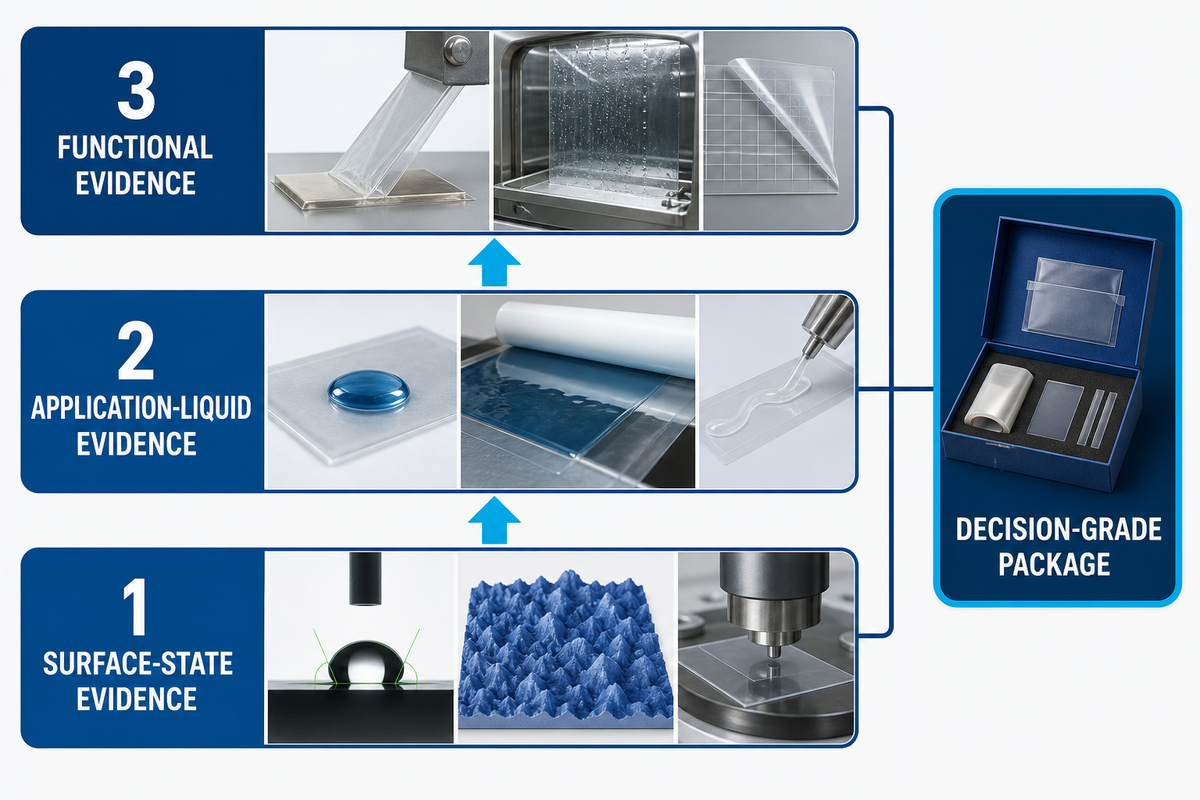
A strong supplier or internal qualification package consists of three tiers of evidence. This also satisfies the public caution in ASTM D5946-24 that contact angle alone is not a total adhesion measure.
- Surface-state evidence: Documented contact angles, raw readings, images, method, timing, sampling and variability before and after treatment.
- Application-liquid evidence: Wet-out by the true ink, coating or adhesive in the presence of the relevant process conditions.
- Functional evidence: the adhesion or durability test that matches the joint, cure, aging, environment, and failure mode.
This sequence avoids a common category error. Better wetting can be essential for adhesion, but is not sufficient. Weak boundary layers, contamination, insufficient cure, joint geometry, residual stress and aging can still govern failure. ASTM’s own public description of D5946 has long cautioned that contact angle alone is not a complete measure of ink, coating or adhesive adhesion. The site’s adhesive surface-science diagnosis guide illustrates these failure routes.
Evidence to request from a surface-treatment supplier
- Substrate identity, grade, lot, side, and prior surface history
- Untreated control and current-process comparison
- Treatment settings and time to measurement
- Declared test liquid, droplet volume, timing, environment, and analysis method
- Individual readings, sample count, locations, exclusions, and representative images
- Aging or storage window relevant to the buyer’s process
- Actual-liquid wet-out and an application-specific adhesion or durability test
- The limits of transfer from the tested sample to the production item
Use Equations Without Over-Reading a Single Number
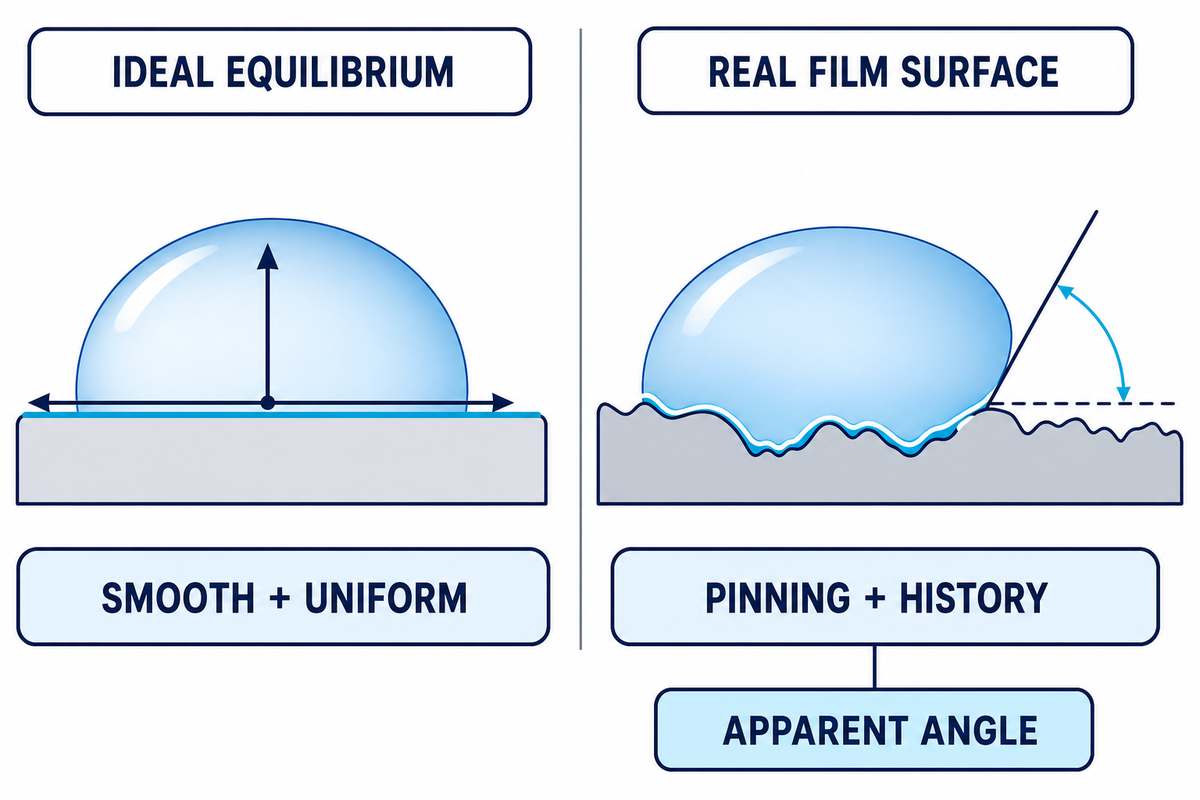
Young’s equation expresses a fundamental interfacial balance and an ideal equilibrium contact angle for a smooth, rigid, chemically uniform surface. Real industrial films can be rough, heterogeneous, mobile, contaminated, swelling, or time-dependent. Thus, the camera captures an apparent angle due to surface physics and measurement history, as reviewed in the evidence of measurement influence.
Roughness may strengthen the wetting behavior or produce composite states, so the wetting of rough surfaces needs an appropriate model for the observed state. Chemical patches pin the contact line. An as-placed static droplet may settle at different positions between the advancing and receding limits. The equation, however, is useful to organize the physics. It does not convert every observed angle to a unique material constant. The assumptions for the Young equation, as described in the Young equation assumptions guide, describe some of these boundaries.
An angle-to-adhesion converter would create false precision, because the material, liquid, surface and validation inputs it needs change from one film and process to the next.
Apply a Protocol-to-Decision Workflow
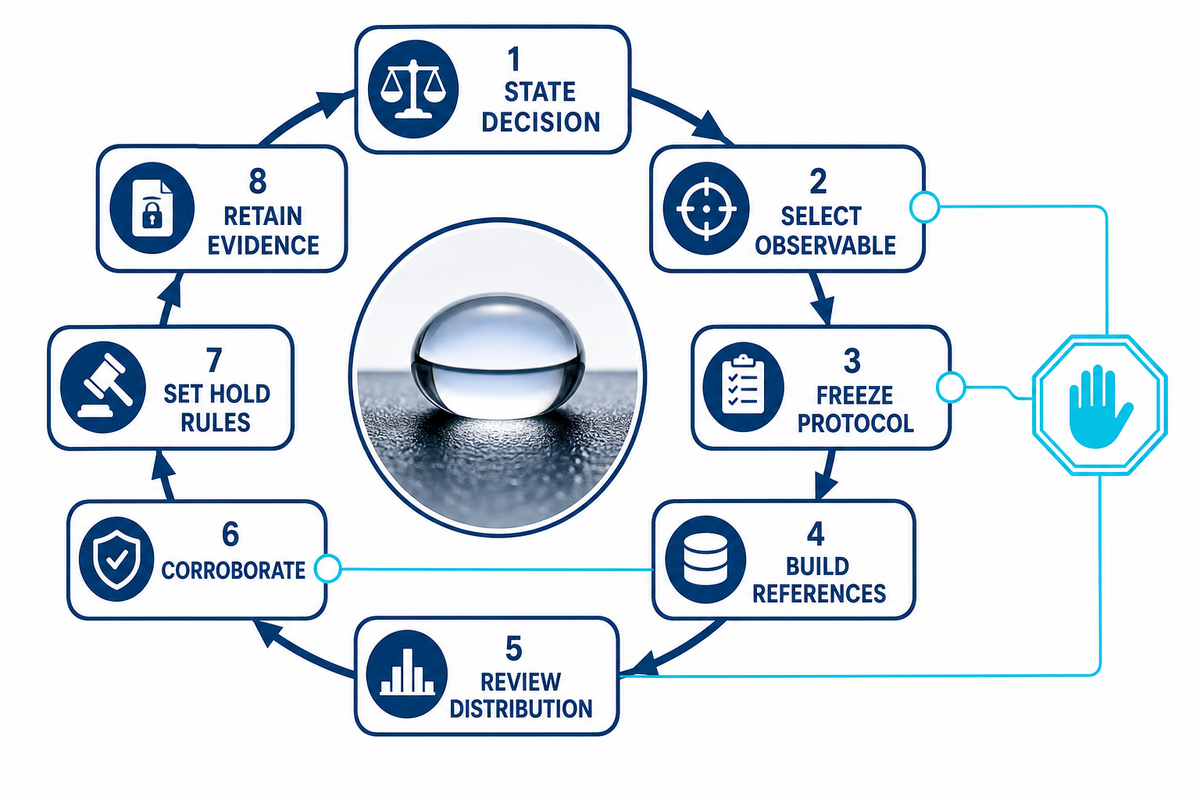
Use the declared scope of ASTM D5946-24 or the current method as the protocol anchor, and then add the application evidence dictated by the release decision.
- State the decision. Did the sample pass the test for change, storage stability, liquid wet-out, or finished adhesion?
- Select the observable. Static, advancing/receding, time-dependent, or application-specific.
- Freeze the protocol. Sample, liquid, environment, dosing, image analysis, and timing.
- Build reference populations. Known-state controls and realistic production variation.
- REVIEW THE DISTRIBUTION. Consider locations, specimens, tails, and failure signatures, not just the mean.
- CORROBORATE THE CLAIM. Match the evidence tier to the decision.
- Set hold rules. Missing surface history, protocol drift, or contradictory functional results should stop release.
- Retain evidence. Raw data, images, exclusions, versioned protocol, and decision maker.
Frequently Asked Questions
What does a contact angle of 90° mean?
A result near 90 degrees means the chosen liquid is at a traditional boundary between stronger spreading and stronger beading on that measured surface. It is not a general production limit; for water on corona-treated polyolefins and many other low-surface-energy films, the ASTM water contact angle method gives guide ranges of above 90° for marginal or no treatment, 85 to 90° for low treatment and below 71° for very high treatment. What does the result mean? It depends on the nature of the sample, the surface condition and roughness, the method of measurement, the timing of the test, and liquid identity. Compare the result to validated process populations, not just population means, to make a determination.
Does a low water contact angle guarantee good adhesion?
No. It shows that water wets surface more readily under the stated protocol. To determine the factors that affect adhesion strength, weak boundary layers must be considered along with the joint design, curing, stress and aging of the adhesive. Wetting must be confirmed using the application liquid, and the adhesion test must be done to prove performance.
How many contact-angle measurements are enough?
Take multiple readings at independent locations: the ASTM water contact angle method for corona-treated polymer films notes that almost all materials vary in contact angle from point to point and that nonuniform corona treatment adds variability. A contact angle measuring plan should show independent specimens and locations rather than repeated instances at the same location. Choose sampling from process risk, expected heterogeneity, and confidence required for the decision. Report all valid observations, locations, exclusions and distributions to allow another team to assess if the sample represents the lot.
Why can two laboratories report different values?
They may be measuring different states of surface or different observables. Other factors including cleaning, storage and treatment times, purity of the liquid, volume of the droplet, and dosing, as well as timing, humidity, baseline placement and fitting models may all influence the outcome. Exchange the specimens and standardize the procedure first before coming to the conclusion that the instrument is wrong.
Is a dyne pen equivalent to contact-angle measurement?
No, Dyne liquids provide a quick and easy way to assess wetting-tension. Contact angle measurements provide a means to record the geometry of droplets for a given liquid and method. The endpoints, contamination risks, and operator effects differ. Establish any relationship with controlled paired testing on the film and process. Do not use a generic conversion factor.
References & Sources
- ASTM D5946-24, water contact angle on corona treated polymer film.
- ISO 15989, water contact angle measurement for treated plastic film and sheeting.
- Peer-reviewed evaluation of static contact-angle measurement influences.
- KRÜSS contact-angle hysteresis reference.
- ASTM D2578, wetting tension of polyethylene and polypropylene film.
ABOUT TENGYANG
Industrial hot melt adhesive materials for bonding routes
Shanghai Tengyang New Materials Technology Co., Ltd. supports material discussions for production teams working with bonded products.
Available forms: hot melt adhesive film, web, powder and granules. Material families: TPU, EVA, PA, PES and PO.
CONTACT PROFILE
Betty Fang
Contact for material inquiries.