Get in touch with Tengyang Company

Contact Angle Hysteresis: Advancing and Receding Angles

Surface science guide
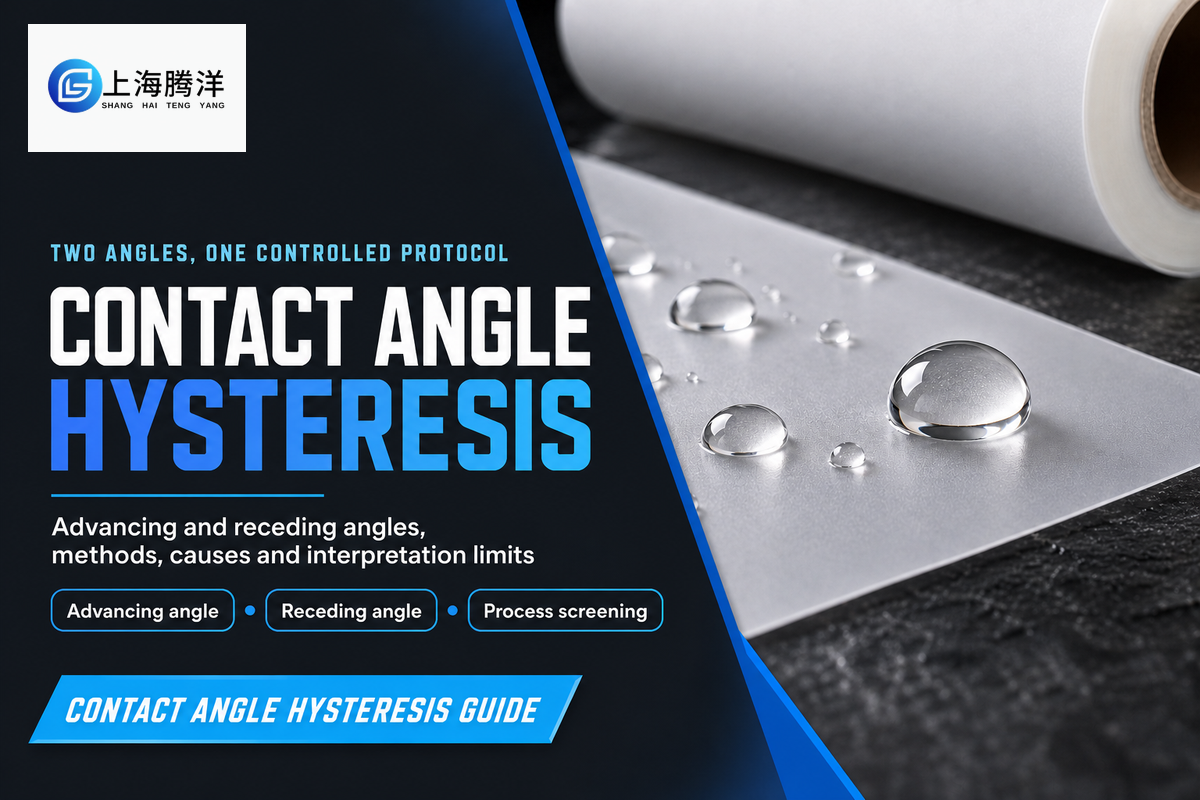
Contact angle hysteresis is the difference between an advancing contact angle and a receding contact angle measured on the same liquid-solid system under a stated protocol. It can often times reveal contact-line pinning and wetting history, which may not be detectable in a single static angle measurement. It’s a qualitative method, and several factors such as the volumetric flow rate of the liquid, the surface condition of the solid, the type of adhesive, the temperature, the humidity, and others, should be taken into account along with the measurement.
Report advancing and receding angles with the liquid, method, rate, timing and event rule. Use contact angle hysteresis as a process-screening signal, not as a universal adhesive grade.
Quick definition: Δθ = θA − θR, where θA is the advancing angle and θR is the receding angle. Larger gaps often mean more resistance to contact-line motion, but the gap cannot be inverted into one unique roughness, chemistry or adhesion value.
What contact angle hysteresis means
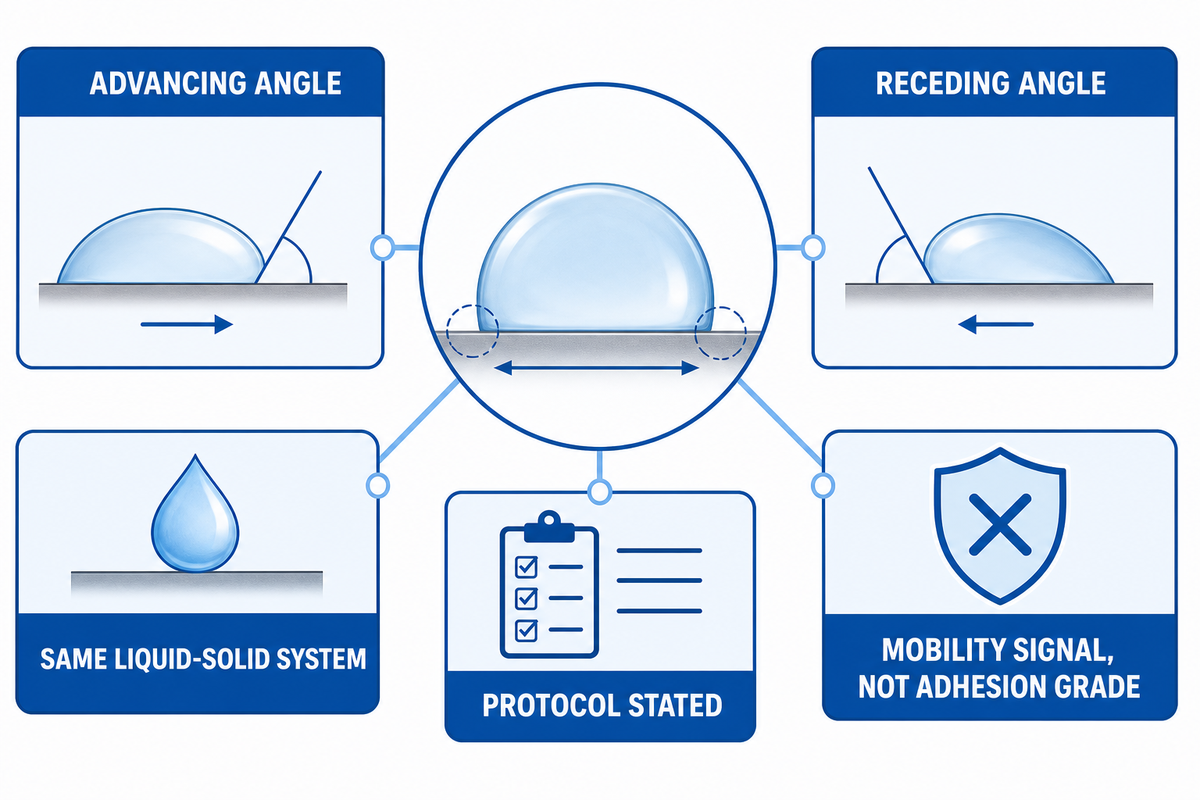
The equilibrium angle a droplet can form is the angle it freezes to, and ideally, all angles would have an equal value. This ideal condition, however, doesn’t exist in nature. In a metastable condition, a liquid can remain frozen to a surface indefinitely, and in the absence of an external force, the surface remains in a pinned state. This state is referred to as the contact line. This phenomenon is quantified by comparing advancing and receding angles.
A contact angle measured using the sessile drop technique records the wetting state of the solid surface. Dynamic contact-angle testing determines how the contact line responds to motion. The angle is measured at the three-phase contact line among solid, liquid and gas. An observed contact angle, or apparent contact angle, refers to the apparent angle of a substrate that may be heterogeneous or contain irregularities. Quantify true wetting with surface energies, free energy, and interfacial energies. Real surfaces, however, may violate the assumptions of the ideally wetting surface. Therefore, a dynamic contact test may be required, particularly with superhydrophobic and polymeric surfaces. The principle is similar for drops of various sizes (tilt). The contact angle hysteresis or CAH technique abbreviation should be explained in a report prior to its use.
The methods are relatively simple, but context still matters and may require experience. State the name of the liquid, temperature, and geometry and technique of surface preparation, as well as the rate and duration of liquid withdrawal. The time one must wait to take the equilibrium angle with respect to Δθ should also be given. Do not use the equation to compare results from different methods.
That two-angle view also explains why an equilibrium contact angle is difficult to observe directly on a practical substrate. Reviews in Current Opinion in Colloid & Interface Science describe the advancing, receding range as the measurable window around real contact-line behavior. Surface tension, surface area and the angle convention should remain visible in the record; when the angle increases, note whether volume, tilt or time changed first. For a stable contact angle, record the observed contact angle, water contact angle and contact angle values for the contact area. When measuring contact angles, a sessile drop contact angle provides a baseline; a dynamic contact angle measurement and dynamic contact angle hysteresis follow a moving contact line. Tie the selected contact angle methods and contact angle measurement methods to the contact angle results, range of contact angle, maximum contact angle, largest contact angle, initial contact angle and roll-off angle. This context helps explain a water droplet on smooth surfaces, structured surfaces, hydrophobic surfaces or superhydrophobic surfaces, including self-cleaning surfaces and other properties of the surface in analysis of surfaces. In this analysis of surfaces, the macroscopic contact angle and macroscopic CAH describe the observed result, not Young’s angle; note how the contact angle is measured and what changes when the contact angle increases. For the broader contact angle measurement and interpretation guide, keep the same angle convention and record both motion limits.
Advancing vs. receding contact angle: what changes at the contact line?
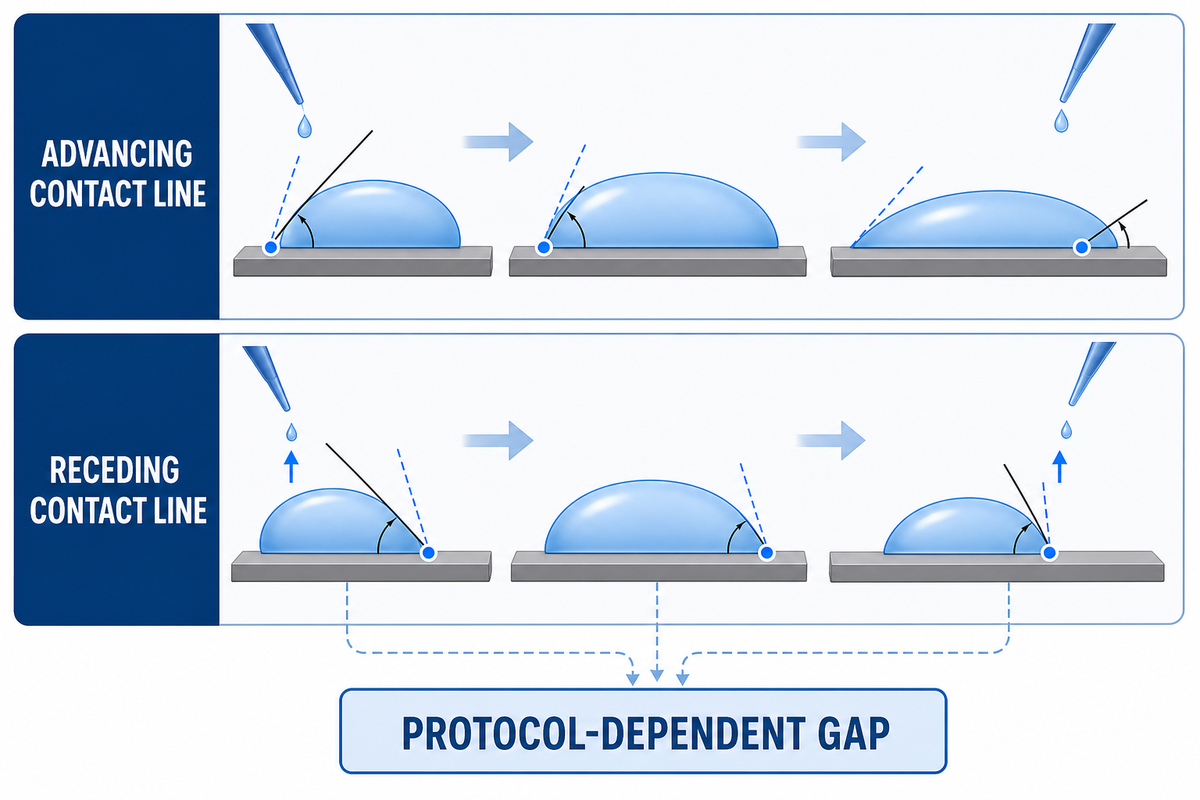
Advancing and receding angles are not identical images of an unchanging drop. The contact line is driven in opposite directions, and the drop may sample different defects, chemical patches or liquid-retention states. The advancing angle marks onset of outward motion; the receding angle marks onset of retreat, so Δθ captures their difference under the same protocol.
| Measurement | Operational event | What it can reveal |
|---|---|---|
| Advancing angle (θA) | Liquid is added or the wetting front is driven outward until the line advances. | The upper limit before outward motion; sensitivity to leading-edge pinning. |
| Receding angle (θR) | Liquid is withdrawn or the wetting front retreats until the line recedes. | The lower limit before retreat; sensitivity to trailing-edge pinning and liquid retention. |
| Hysteresis (Δθ) | The difference between the two angles from the same stated protocol. | A practical signal of mobility and history dependence, not a unique cause. |
ISO 19403-6 and ISO 19403-7 provide method context for dynamic angles, but a standard reference is not a certificate for a sample or laboratory. How a sample is handled and the conditions under which a measurement is made are part of the data.
How to measure contact angle hysteresis
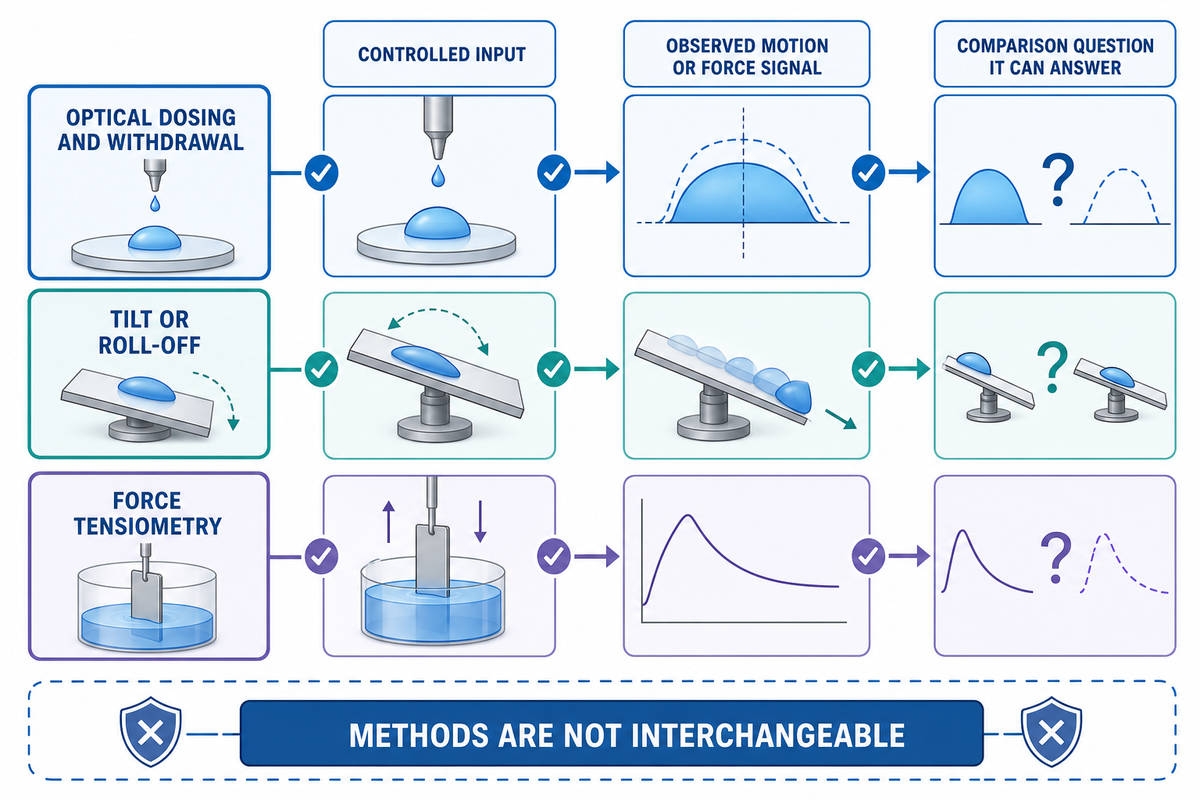
There are three types of situations that occur in a laboratory. Recognize the situation that most closely resembles your experiment. The preceding section separated advancing from receding motion; the method selected here determines which signal can be compared. Use the contact angle reference when standardizing the method across samples.
- The optical method, also known as the needle-in method, requires the following. Position the needle to define the baseline, add liquid to change angle A, and remove liquid to change angle R. To observe the true contact-line movement, a rule should be established in advance.
- The tilt may be changed to introduce a controlled motion of the contact line. Record the value of tilt, the size of the drop, and the direction of motion. Also, state whether the edges of the drop move co-linearly. Roll-off of a drop from a substrate shouldn’t be confused with volume-change angles.
- Force/Wilhelmy method. Force data are recorded as a sample is pulled or pushed through a liquid. This method is used to measure the wetting force of samples with irregular shapes.
Instrument guides from Biolin Scientific and Nanoscience Instruments describe these choices. Brand name matters less than a frozen protocol and a clear event rule.
Stability means the contact angle does not change over the recorded interval. The contact angle of water is measured using a contact angle goniometer as a contact angle hysteresis (i.e. a dynamic contact angle). Record the contact angle across the area of interest. To determine true motion, the frame of the image is analyzed.
Protocol comparison worksheet
Keep a record of the methods used in your research for auditing purposes using the following template. These prompts shouldn’t be interpreted to accept or reject a method.
[11/17/2021 Mapping Prompts]
| Method / source | Protocol signal | Comparison decision | Evidence to retain |
|---|---|---|---|
| Optical volume change | Add and withdraw liquid on one sessile drop | Compare θA and θR in one run | Raw image sequence and rate |
| Optical needle-in | Keep the needle position fixed while volume changes | Check whether the event rule is repeatable | Needle clearance and baseline fit |
| Tilting stage | Increase tilt until leading or trailing motion starts | Compare mobility, not just a static angle | Tilt direction and onset frame |
| Roll-off observation | Record the first sustained displacement | Flag stick-slip before averaging | Video, tilt and drop geometry |
| Wilhelmy plate | Translate a plate through the liquid | Use force data for long or narrow samples | Force trace and immersion depth |
| Captive bubble | Use a gas bubble under an immersed solid | Separate geometry effects from a sessile drop | Bubble volume and liquid identity |
| Location map | Repeat measurements across the sample face | Test coating or cleaning uniformity | Coordinates and exclusions |
| Time challenge | Repeat after a defined wait or storage interval | Check sorption, evaporation or swelling effects | Elapsed time and conditioning |
| Orthogonal check | Pair wetting with chemistry or microscopy | Avoid assigning one cause to Δθ | Independent test and raw result |
Use a run sheet to record the chosen 0.5–1 mm needle clearance, 1–2 mm baseline span, 2–5 mm/s dosing or withdrawal rate, 20–25 °C temperature, 40–60% relative humidity, 1–5 µm roughness screen, 1–3° tilt increment, 10–30 hours between challenges and 2–4 independent days. These are documentation fields to freeze for the project, not product specifications or universal limits.
Why surfaces show hysteresis: roughness, chemistry and history
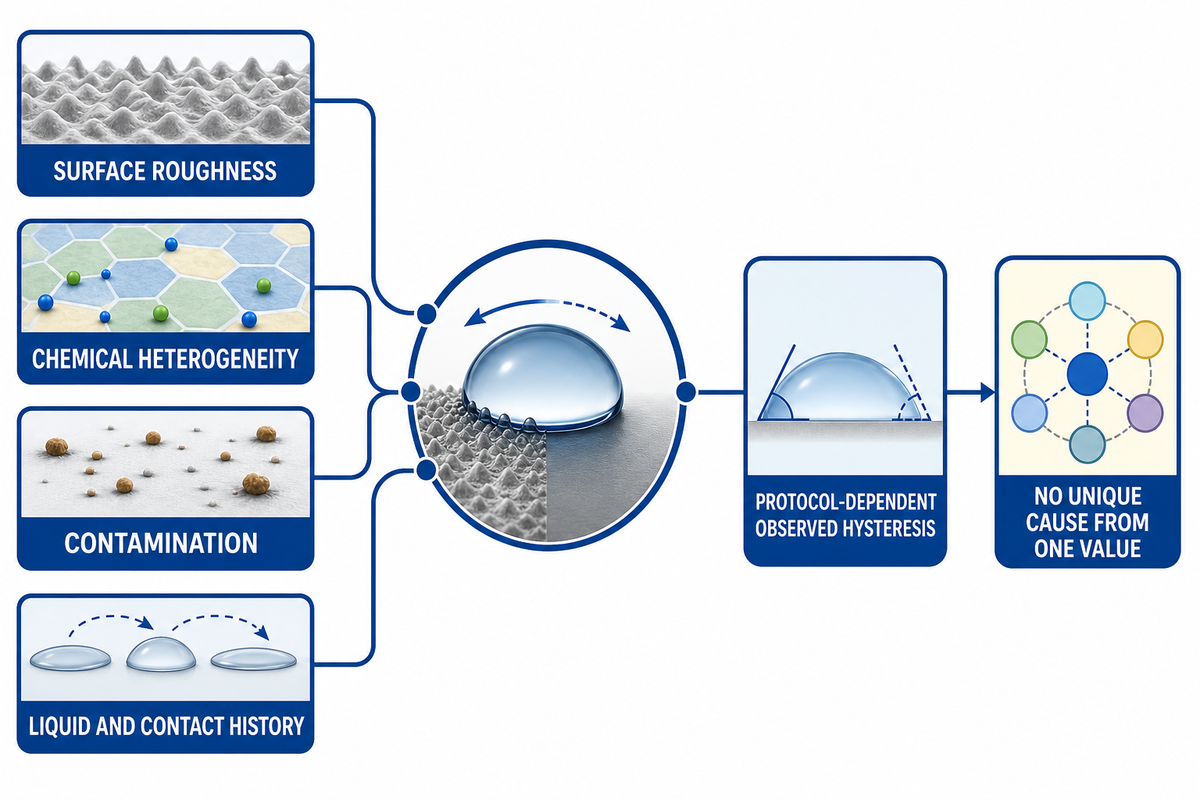
Surface roughness and chemical heterogeneity can create metastable droplet states. A contact line may be pinned by a ridge, contaminant, interface or change in the surface chemistry of the solid. Therefore, the drop may keep a particular shape while the liquid volume changes. Large Δθ values may represent strong pinning, but they do not identify the type of defect.
Liquid-side effects matter too. Contact time, molecular size, sorption or retention, evaporation and swelling can change the observed receding event even on a surface that looks smooth. The open-access review of contact-line friction is useful for separating pinning from a simplistic “roughness equals hysteresis” story.
The Two-Angle Repeatability Check
It may be instructive to examine a number of pairs of oppositely moving angles. An angle pair may represent a change in the system. It may be important evidence.
How to interpret low and high hysteresis without overclaiming
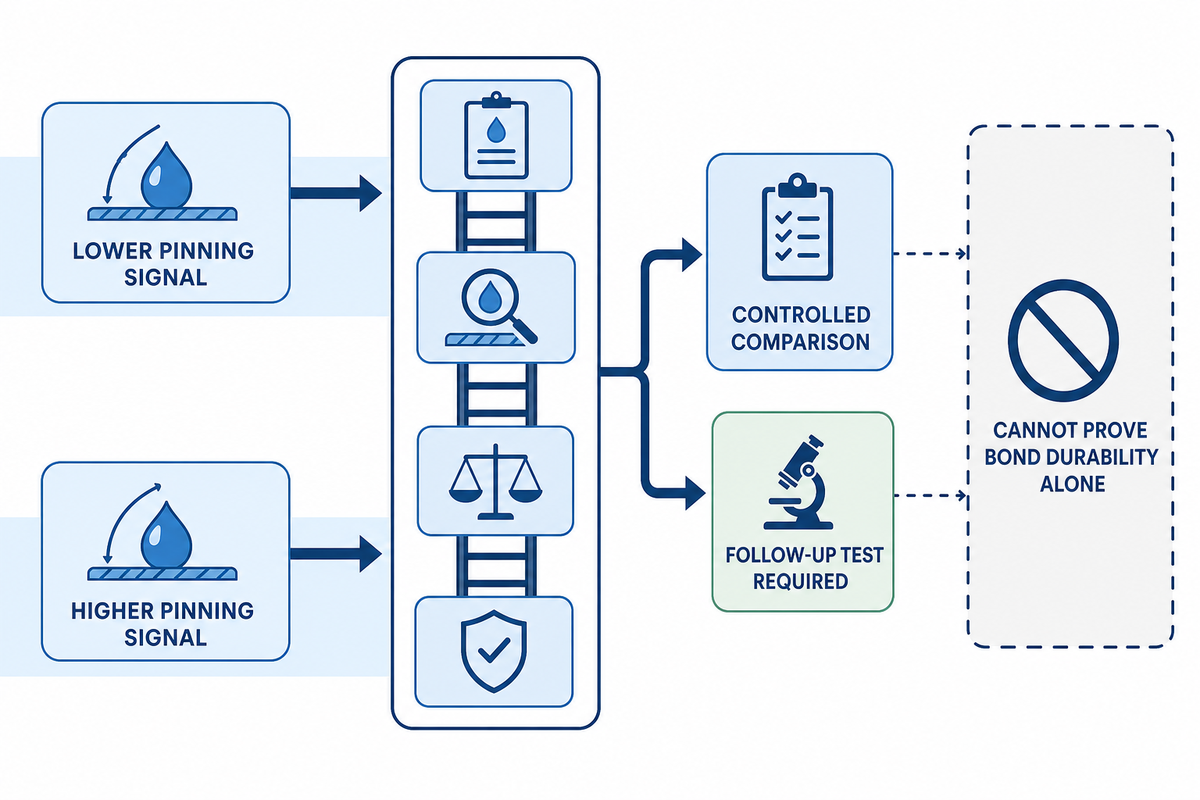
Hysteresis may be related to the mobility of a contact line. High values may indicate strongly pinning defects. Low values may indicate less strongly pinning defects. Each of these cases may represent a broad distribution of drop mobility. High initial angles may indicate strongly pinning defects. A value less than 90 degrees may also indicate a strongly pinning defect.
| The result can support | The result cannot prove alone |
|---|---|
| Comparison of two controlled surface states or cleaning conditions. | Final bond strength, durability, coating certification or a universal adhesive pass/fail limit. |
| A prompt to investigate pinning, nonuniformity, contamination or process drift. | The unique chemical or topographical origin of the drift. |
| A mobility signal that can guide a follow-up test plan. | A replacement for peel, lap-shear, coating or aging validation. |
KRÜSS describes the rose-petal effect. This occurs when a surface shows a high apparent density while maintaining a low true density. Describe the measurement as “under this protocol” and avoid assigning a universal threshold.
Measurement type and interpretation matrix
The second matrix groups measurement types according to the questions they answer. Categories in this matrix are different from the comparison matrix above.
| Method type | Category | Measurement model | Primary question |
|---|---|---|---|
| Static optical | Baseline | Sessile-drop profile | What angle is visible before motion? |
| Dynamic optical | Advancing | Volume-addition sequence | When does the front edge move? |
| Dynamic optical | Receding | Volume-withdrawal sequence | When does the rear edge retreat? |
| Dynamic optical | Tilt | Gravitational driving | Does the drop roll or stick? |
| Force tensiometry | Wilhelmy | Force versus immersion | What wetting force is resolved? |
| Bubble method | Immersed surface | Captive-bubble profile | Does geometry change the angle? |
| Spatial sampling | Uniformity | Location map | Is the coating consistent? |
| Time series | Stability | Repeated interval | Does contact time alter receding? |
| Orthogonal test | Cause check | Chemistry or microscopy | What independent evidence supports the hypothesis? |
Data-quality controls for a repeatable hysteresis result
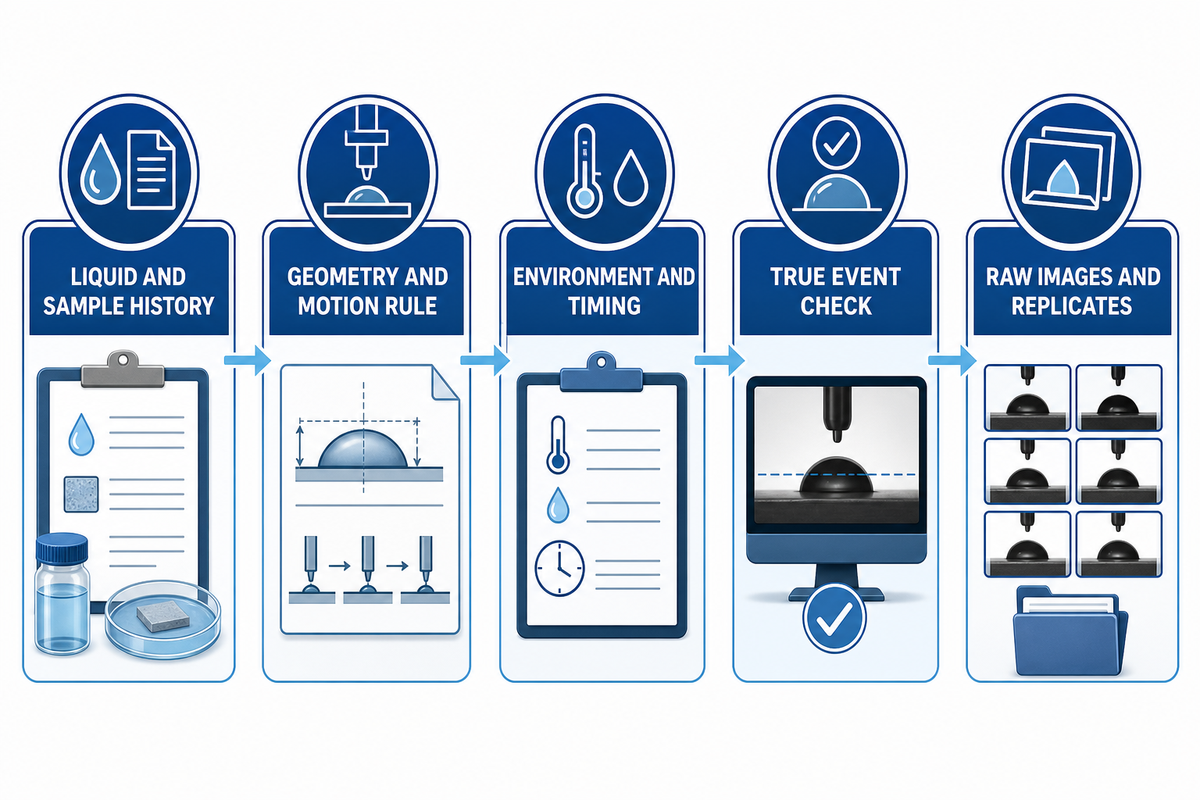
Eight fields are shown below. These fields support the conclusion of an experiment. These fields turn the preceding interpretation limits into an auditable record.
- liquid identity, purity and preparation;
- sample face, cleaning history and conditioning;
- drop volume or immersion geometry;
- dosing and withdrawal rate, or tilt rate and direction;
- temperature, humidity and elapsed time after dosing;
- baseline placement, image resolution and fitting model;
- True advancing and receding motion are ruled by the event methodology. Storage and evaporation controls should be documented.
- replicate count, location map and raw images.
Contact angles may change over time. One Scientific Reports study recorded a contact-angle difference of up to 60% for a sample. Changes in contact angles are related to storage time and other environmental conditions. From a protocol perspective, changes in contact angles are a deviation from the mean and protocol requirements and should be documented as such. Contact angles may be rounded to the nearest degree and average contact angles may be reported.
Where the protocol uses image exclusions, state the chosen 1–2 mm edge exclusion, 2–3° camera-level check and 1–2 days of conditioning, then retain the record for 3–4 days of review. Threshold conditions are based on 1-2 mm edge lengths and 2-3 degree camera angles. In addition, conditioning for 1-2 days is required. The image is retained for 3-4 days.
What if the contact line appears to move before the receding event?
Local changes in surface topography should be distinguished from true contact angle changes before concluding that the true contact angle is less than the local surface tension. In the event of local surface topography changes, a stick-slip transition may occur. In case of doubt, report the ambiguity.
Using hysteresis data in bonding, coatings and surface-treatment decisions
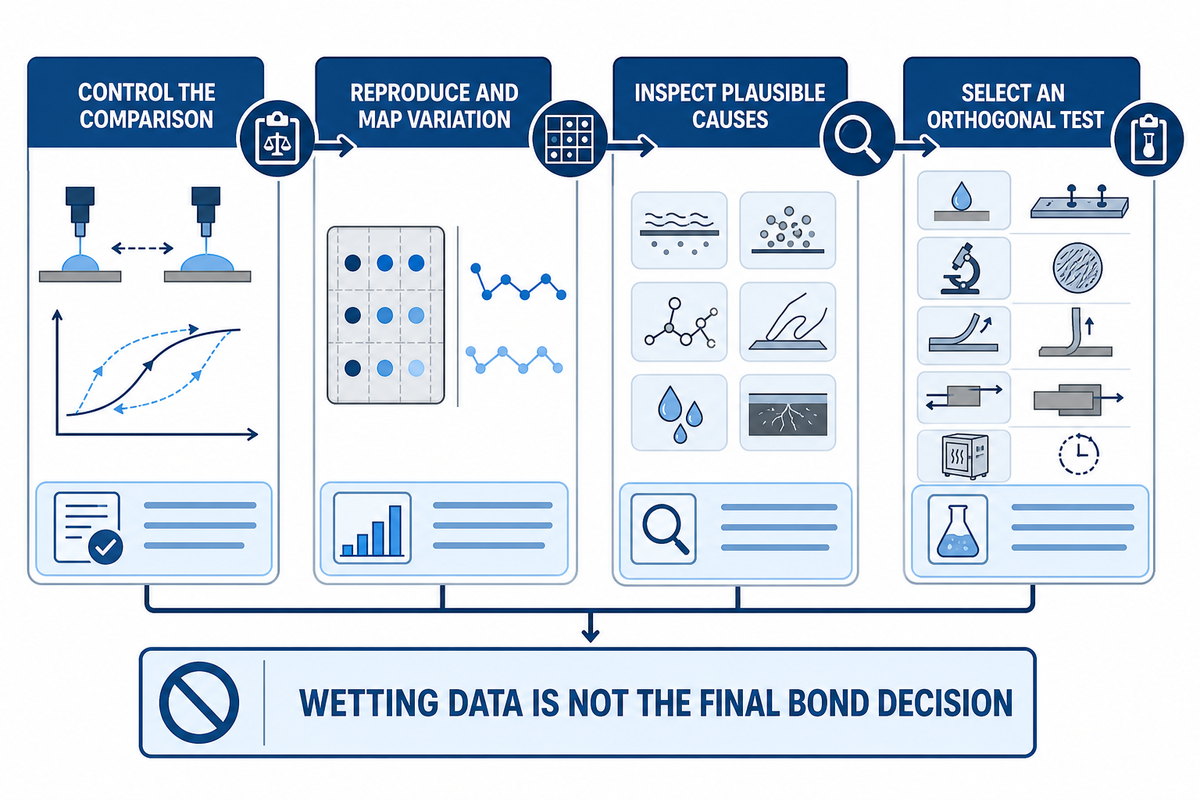
Use hysteresis as a process-screening tool. Compare, for instance, a treated sample to a film or Web prior to treatment. Keep the liquid, volume, instrument, time and analysis rule constant. If the angle changes, evaluate the adhesive surface prior changing the adhesive formulation. See the surface wetting interpretation reference for related measurement context.
For a controlled comparison, a team logs 3-5 locations, 2-4 repeats, 0.1-0.3 mm image scale check, 2-5 mm/s motion, 20-25 °C conditions, 10-30 hours of duration, and 1-2 days of recheck. Logged values are composed by the team’s run plan and are to be modified based on a change in sample geometry and/or the team’s decision.
The Pinning-to-Process Test
(1) Reproduce the angle pair, (2) map the variation by location and time, (3) inspect plausible causes such as contamination, roughness or liquid retention, and (4) select an orthogonal test, surface chemistry, microscopy, peel, lap shear or aging, to test the process hypothesis. Finally, consider other process alternatives, for example, tests for surface chemistry and microscopy, lap shear and peel tests. If evidence of the process is wet and durable, it should be paired with independent evidence for process ability.
For more on Contact-angle measurement and Interpretation, refer to Tengyang’s surface science reference. This article isn’t going to cover project-specific test plans and quotations, and isn’t meant to replace them.
Need to turn a hysteresis question into a test plan?
Use the contact form to provide the web, liquid, process, and measurement criteria to evaluate the current process. Process ability is determined by the parameters provided. Include the liquid identity, sample condition, rate, timing and decision rule so the result can be interpreted against a repeatable baseline.
A practical outlook: prioritize repeatability as measurement practice evolves
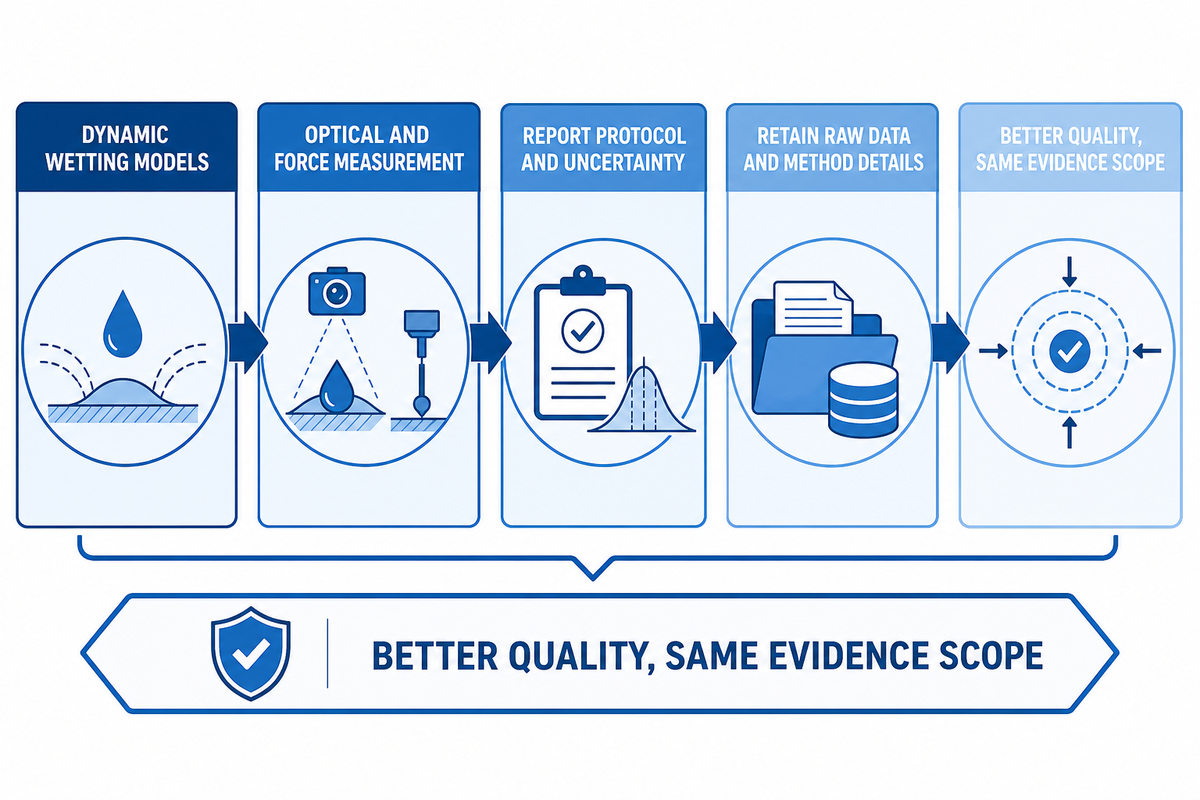
Research is continuing on improvements to models for dynamic wetting, optical and force tensiometry, and energy balances for rough surfaces. That measurement work extends the process-screening questions raised in the previous section. Progress in these areas improves the quality of the measurements but does not increase the measurement scope. Include the protocol and uncertainty, and retain raw data and method details when comparing lots, treatments or storage conditions.
When considering hysteresis loops from a process control perspective, asking “is this hysteresis loop acceptable?” isn’t effective. Better questions are “what other tests would validate this hysteresis loop?” and “what evidence would support that this process step is complete?”
FAQ: contact angle hysteresis questions engineers ask
What is contact angle hysteresis?
Contact angle hysteresis describes the advancing and receding contact angles of a system and refers to liquid/surface mobility and interaction history. The gap often reflects contact-line pinning, surface heterogeneity or liquid history, so it is a mobility signal rather than a standalone adhesion grade.
How do you calculate contact angle hysteresis?
Use Δθ = θA − θR. Keep the liquid, sample conditions, method, rates, timing, and angle convention the same to allow for direct comparisons. The result is meaningful only when liquid, surface preparation, volume, rate, temperature and event rule are held constant.
Is a high hysteresis value bad?
No, this doesn’t happen by itself. Other factors can cause stronger pinning or lower drop mobility. In and of itself, this doesn’t assess adhesion or coating durability. Compare it with controlled references and independent bond, coating or aging tests before a durability decision.
Which method should measure advancing and receding angles?
Optical dosing is preferred. Choose optical dosing, tilt/roll-off or force/Wilhelmy based on sample geometry and the decision you need to make. Don’t compare values from these methods. Optical volume addition and withdrawal are common choices; tilt or force methods can help when geometry or access makes imaging unsuitable.
Can contact angle hysteresis predict adhesive durability?
No, this shouldn’t be used to assess durability. This may be used to determine process drift and help assess the adequacy of wettability. Durability and other assessments should be determined using appropriate tests for the service condition. A durability conclusion therefore requires service-condition testing because wetting, roughness and retention can change independently of long-term bond performance. Pair that result with peel, lap-shear, aging, thermal or humidity exposure data and define the acceptance criterion before calling a surface treatment durable.
Why do repeated measurements disagree?
Causes for a difference may include: change in sample conditions, storage conditions, contamination, non-uniform surface conditions, evaporation, change in drop volume, poor baseline fitting, unknown/unclear motion. Use a protocol and review images before attributing disagreement to the material or treatment.
References & Sources
- Butt et al., “Contact angle hysteresis,” Current Opinion in Colloid & Interface Science.
- Biolin Scientific, “What is contact angle hysteresis?”
- Biolin Scientific, “How to measure contact angle hysteresis.”
- KRÜSS Scientific, “Hysteresis of the contact angle.”
- Nanoscience Instruments, “Contact Angle Measurements and Wettability.”
- ISO 19403-6:2017, Paints and varnishes, Wettability, Part 6.
- ISO 19403-7:2024, Paints and varnishes, Wettability, Part 7.
- Contact-Angle Hysteresis and Contact-Line Friction on Slippery Liquid-like Surfaces.
- Scientific Reports study on sample and measurement-induced influences in contact-angle work.
- Tengyang surface-science reference: contact-angle measurement and interpretation.
ABOUT TENGYANG
Industrial hot melt adhesive materials for bonding routes
Shanghai Tengyang New Materials Technology Co., Ltd. supports material discussions for production teams working with bonded products.
Available forms: hot melt adhesive film, web, powder and granules. Material families: TPU, EVA, PA, PES and PO.
CONTACT PROFILE
Betty Fang
Contact for material inquiries.