Get in touch with Tengyang Company

Update: Nov. Updated November 2026 · 2026 Technical Surface Science Guide · Reviewed by DD, Bonding Materials Specialist
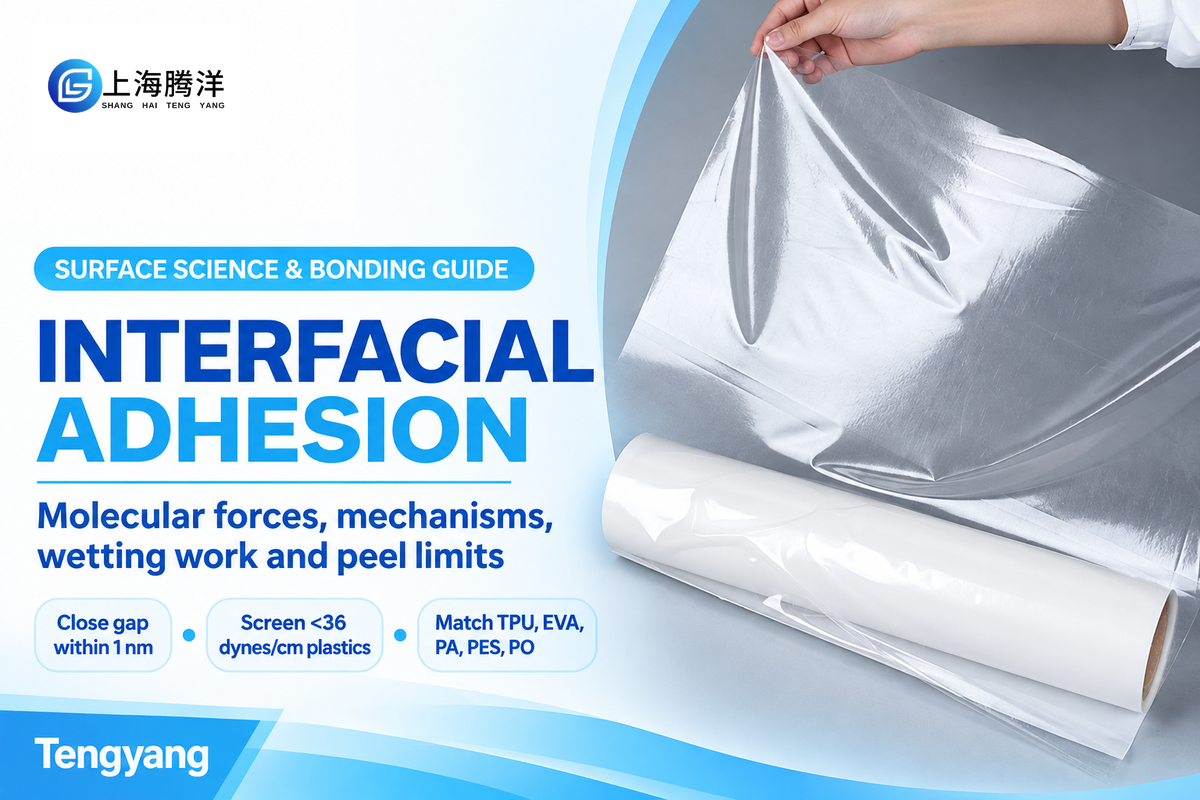
Adhesion is the cross-boundary attraction in materials science that holds dissimilar materials together at sub-nanometer contact. Intermolecular dispersion forces, polar hydrogen bonds, or interfacial covalent links generate that holding power once surfaces close within 1 nm. In contrast, cohesion acts on like molecules within the same bulk material.
Quick Engineering Specifications: Interfacial Adhesion
- Effective capture of molecular forces happens within 1 nm across the outermost three layers of contacting solids.
- Low-surface-energy plastics measure below 36 dynes/cm, including untreated polypropylene at 29 to 31 dynes/cm.
- For maximum joint strength, the bondline thickness is held between 3 and 5 mil.
- Solid surface free energy testing follows ISO 19403-2:2024 using polar and dispersive probe liquids.
- Flexible laminate peel evaluation follows ISO 11339:2022 (revising withdrawn ISO 11339:2010) and ASTM D903.
- Suppliers such as Shanghai Tengyang quote 3 to 5 working days for standard film samples across TPU, EVA, PA, PES, and PO.
200 nm
Gecko spatular tip width engaging dry van der Waals contact (PubMed)
<36 dynes/cm
Low-surface-energy plastic boundary requiring activation or polyolefin chemistry (3M)
≥4 MPa
Fresh push-out strength of peroxide-crosslinked thermoplastic film (US11535778B2)
What Adhesion Means Across Interfaces (and What It Is Not)
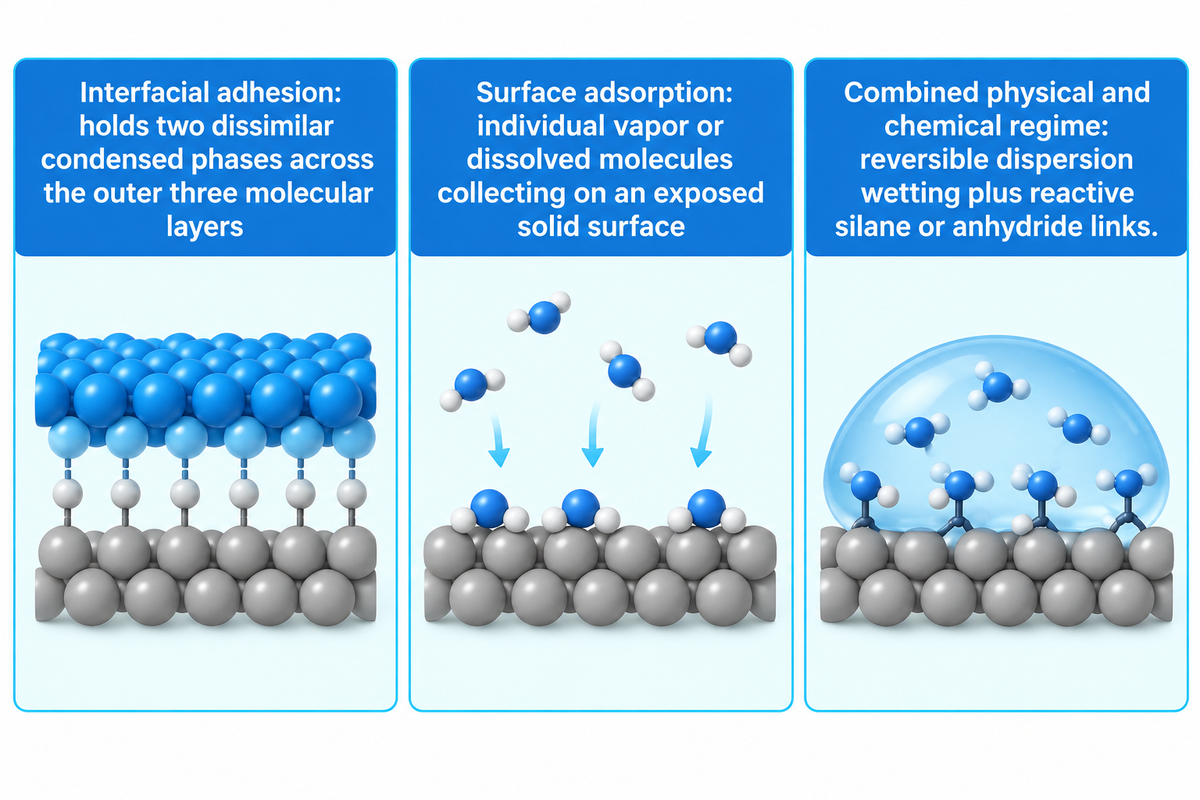
Across surface chemistry, the definition of adhesion refers to two dissimilar condensed phases held across an intimate phase boundary. Interfacial holding acts across a surface zone only about three molecules deep. As per the University of Maine review of seven accepted adhesion mechanisms, engineered joints show reliance on mechanical interlocking, electrostatic transfer, adsorption/wetting, chain diffusion, covalent chemical bonding, acid-base interaction, and weak boundary layers.
Engineers studying the fundamentals of adhesion separate cross-phase holding from gas or solute accumulation. When individual vapor or dissolved molecules collect on solid surfaces, this process is called adsorption. Contact of two solid phases with a liquid coating in between, or of a liquid and a solid substrate, is an adhesion phenomenon. It governs the region of contact. Phase boundary behavior is an extension of surface science fundamentals.
In industrial manufacturing, substances in contact rely on short-range atomic interactions across a clean boundary. Structural laminates, protective coatings, and flexible packaging films depend on the integrity of the outer three molecular layers. Any oil film or loose oxide skin deeper than a few molecules blocks cross-interface attraction.
Is adhesion a physical or chemical property?
Adhesion operates as a combined physical and chemical phenomenon at an interfacial region rather than as a true bulk property. Most unprimed polymer laminates stick together through reversible physical dispersion and polar interactions without modifying molecular identity. When an organosilane primer, isocyanate or a grafted anhydride establishes a primary interfacial link, chemical bonding prevails.
Because both regimes often occur on the same substrate, materials engineers need to consider interfacial chemistry in addition to physical wetting. A molten thermoplastic film first wets a metal oxide surface; chemical locking onto hydroxyl sites occurs only when the formulation contains reactive groups. Treating mechanisms that cause materials to stick as a unified textbook topic obscures the role of heat and moisture.
Molecular Forces Behind Adhesion Force and Why Nanometer Contact Comes First
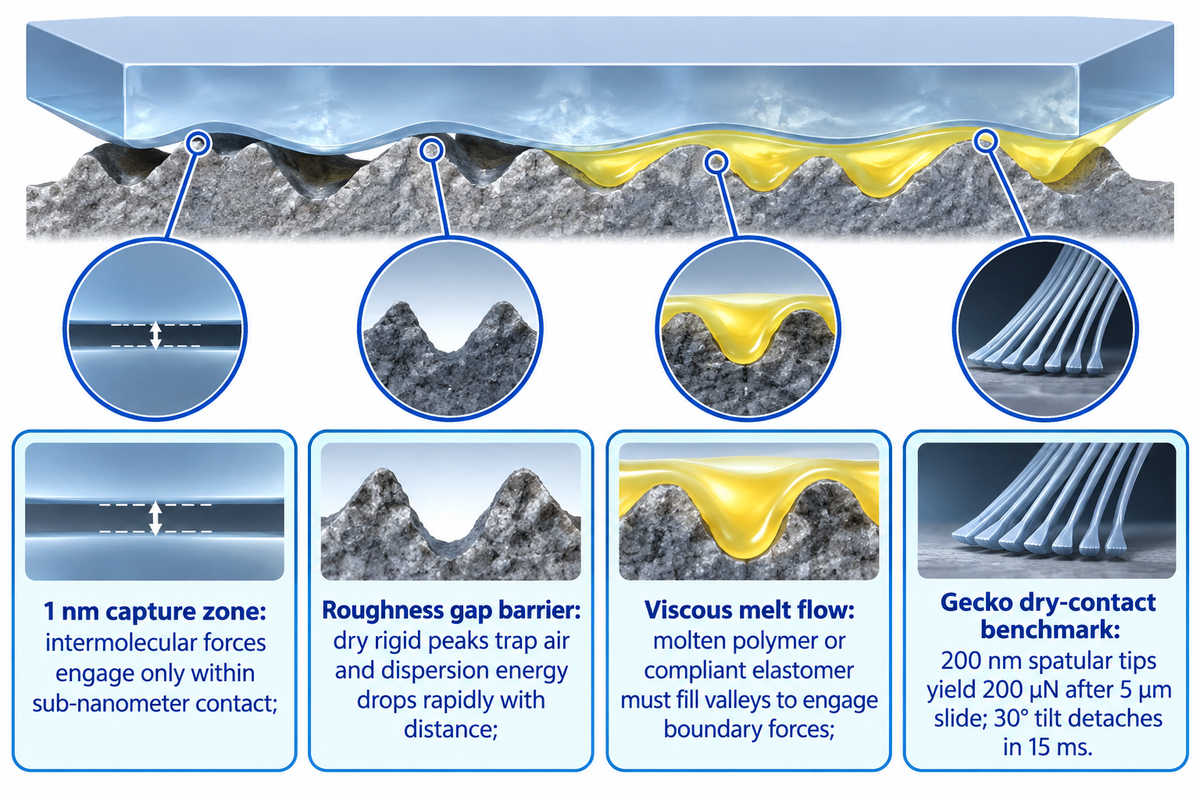
Only when two surfaces are within 1 nm of each other do intermolecular forces generate measurable adhesion force. Otherwise, microscopic surface peaks (micrometer to nanometer range) don’t allow solids to come into contact, and valleys may remain unfilled. For interaction to occur, polymer must fill the gaps, or the peaks may be flexible to bring the tips into contact (on the nanoscale). Under these conditions, attractive forces become significant.
Grouped under van der Waals forces, dispersion and permanent dipole interactions make dispersive adhesion evident for non-polar plastics. The Springer Handbook of Adhesion Technology mentions that a solid polymer must be stressed enough to trigger yield or dissipative flow for strong adhesion to occur.
Because of distance decay effects, two clean steel blocks don’t bond, even under a slight compressive load. Non-bonded dispersion energy decreases with the sixth power of distance. Across flat plates, van der Waals pressure drops with the cube of the gap. Cold welding or adhesive wear of metals can occur at asperities, but dry asperity contact alone does not form a complete structural bond.
Biological dry adhesives confirm that sub-nanometer proximity is the physical prerequisite. As noted in Autumn and Peattie’s integrative biology review of prior gecko studies, each epidermal keratinous seta branches into hundreds of 200 nm wide spatular tips for intimate contact. In the single-seta force-plate experiments reviewed there, combining normal preload with a 5 μm slide yielded 200 μN of dry force per seta, while tilting the shaft to 30° caused detachment in 15 ms.
| Interaction Class | Force Category | Contact Requirement | Industrial Polymer-Substrate Example |
|---|---|---|---|
| London Dispersion (van der Waals forces) | Secondary physical | Sub-nanometer wetting contact | Polyolefin hot melt film wetting untreated polypropylene |
| Permanent Dipole-Dipole | Secondary polar physical | Aligned polar surface contact | Copolyester (PES) film laminated onto polycarbonate sheet |
| Hydrogen Bonding | Directed donor-acceptor | Intimate donor-acceptor proximity | Thermoplastic polyurethane (TPU) or copolyamide (PA) on cotton or nylon fabric |
| Primary Covalent Link | Primary chemical bond | Reactive functional group collision | Maleated polyolefin or silane primer coupled to metal oxide |
| Ionic & Coulomb Charge Transfer | Primary ionic / electrostatic | Across electrical double layer | Carboxylated ionomer or acid-base contact against alkaline metal oxide |
At the molecular level, this force hierarchy creates a boundary for manufacturing. Rigid engineering parts can’t close dry micrometer-scale roughness valleys under gentle lamination pressure. For adhesive forces to engage across the boundary, viscous melt flow or elastic deformation of compliant elastomers needs to occur.
Adhesion vs Cohesion: How Interfacial Attraction and Internal Phase Strength Split the Load
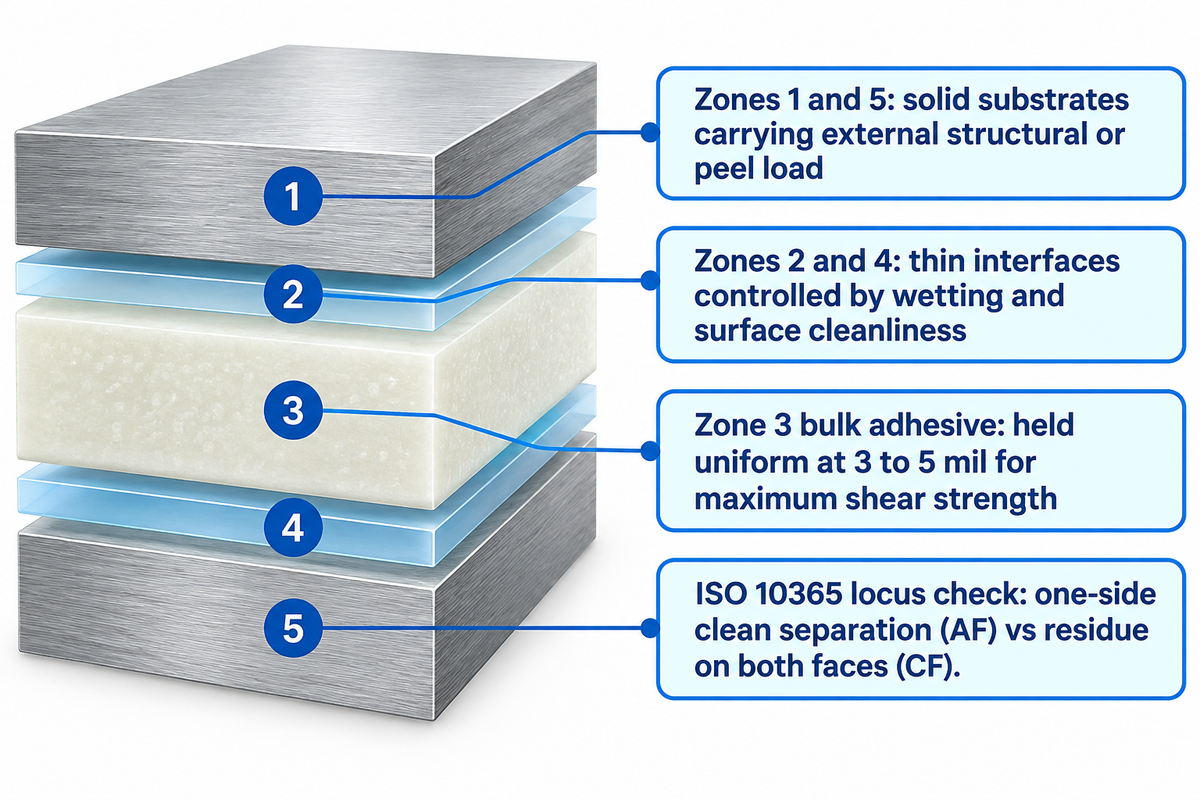
With respect to load zones, adhesion and cohesion occupy distinct domains in every bonded laminate. Adhesion spans the boundary between different materials. However, cohesion is responsible for the binding of polymer chains. As explained by the 5-Zone Joint Load Rule, stress spans across two adherends, two interfaces, and one bulk adhesive layer. Distinguishing internal cohesive forces from boundary attraction prevents erroneous diagnosis of soft polymer chain tearing as surface rejection.
Zones 1 and 5 represent the solid substrates. Zones 2 and 4 are the thin interfaces spanning approximately three molecular layers, controlled by wetting and cleanliness. Zone 3 represents the bulk adhesive bonding layer and is held thin and uniform at about 3 to 5 mil to achieve maximum shear strength.
This contrasting boundary behavior is shown readily by fluid behavior. According to the U.S. Geological Survey Water Science School website, water sticks to and forms a curved meniscus on the inner wall of polar glass apparatus because internal cohesion is less than that of the wall adhesion. On waxy leaf surfaces, internal cohesion pulls water into rounded beads.
How does attraction across an interface differ from cohesion inside the bonding layer when two dissimilar substrates are joined?
When bonding two materials, like aluminum foil and polypropylene film, adhesion acts across the interfaces as asymmetric force pairs, and cohesion acts in the bulk adhesive bonding layer, which is 3 to 5 mil thick. At the aluminum interface, adhesion forms between the polar aluminum oxide surface and the polymer. At the polypropylene side, dispersion forces support adhesion to the non-polar polypropylene. Bulk cohesion inside the adhesive also depends on the operating temperature and tie-chain crystallites of the polymer.
If service heat approaches the polymer softening point, bulk chains slide past one another even when both interfaces stay intact. Sustained thermal loads accelerate polymer creep and stress relaxation inside the bondline. According to Sabreen’s plastics bonding troubleshooter, interfacial failure separates cleanly and leaves adhesive on only one surface. Split polymer remaining on both surfaces confirms cohesive fracture under ISO 10365 rules used in adhesive test report interpretation.
| Comparison Attribute | Interfacial Adhesion (Zones 2 & 4) | Internal Bulk Cohesion (Zone 3) |
|---|---|---|
| Active Spatial Scale | Sub-nanometer contact across top 3 molecular layers | Full adhesive bondline thickness (typically 3 to 5 mil uniform window for maximum shear strength) |
| Interacting Species | Dissimilar substrate atoms vs adhesive functional groups | Entangled polymer chains, crystalline domains, and crosslinks within one formulation |
| Primary Failure Trigger | Low surface energy (<36 dynes/cm), silicone oil, moisture displacement | Elevated temperature creep, excessive bondline thickness, plasticizer softening |
| ISO 10365 Fracture Appearance | Adhesive failure (AF): clean separation at one interface leaving adhesive on the opposite face | Cohesive failure (CF): fracture within the adhesive layer leaving residue on both adherends |
| Corrective Engineering Lever | Degreasing, plasma/corona activation, primer, or polarity-matched film | Higher-melting polymer family (PA or PES), thinner gauge, or peroxide crosslinking |
Five Mechanisms of Adhesion: Mechanical Interlocking, Specific Bonding, and Diffusion
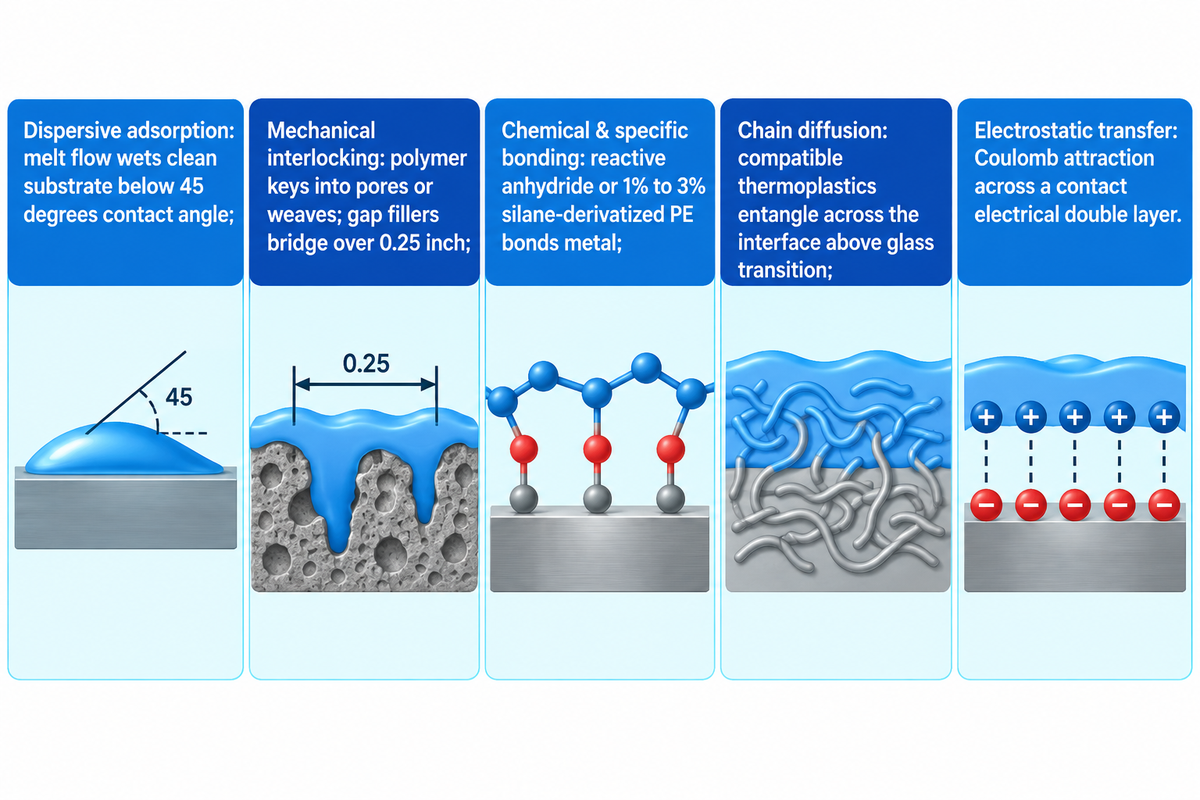
Industrial adhesive bonding rarely resorts to a single model of bonding. The mechanisms grouped under classical types of adhesion and theories of adhesion are referred to as the five core mechanisms, and include dispersive adsorption, mechanical interlocking, chemical bonding, chain diffusion, and electrostatic transfer. Considering polar adsorption, acid-base interactions, elastomeric tack, and weak boundary layers alongside the five core mechanisms points to the nine operational regimes shown in Table 3 from Gardner’s review of adhesion theories at the University of Maine.
In a clean joint, dispersive adsorption can be effective when the melt flows and wets the substrate. Keying, achieved when the molten polymer fills textile weaves, anodized pores, or grit-blasted valleys, is also reliable. Matching surface irregularity to film thickness and melt flow is critical. Very thin transfer tapes require smooth mating surfaces to avoid trapping air, whereas published surface roughness bonding notes show high-viscosity liquid gap-filling adhesive is capable of bridging gaps over 0.25 inch.
Specific adhesion covers polar, acid-base, and primary chemical adhesion across reactive interfaces. Practitioners rotational-lining steel pipe with polyethylene verify maleated PE around the 1800 cm-1 FTIR carbonyl peak at 1% loading, or blend 1% to 3% silane-derivatized PE so a chemical reaction bonds the metal. Diffusive adhesion requires compatible thermoplastic chains heated above their glass transition to cause entanglement across the interface. Electrostatic adhesion transfers charge electrostatically across an electrical double layer via Coulomb attraction.
| Mechanism Type / Regime | Operating Scale | Required Substrate & Process State | Representative Composite or Laminate Pair | Primary Engineering Limitation |
|---|---|---|---|---|
| 1. Dispersive Adsorption (Physical Bonding, Core #1) | Sub-nanometer contact | Clean surface; droplet contact angle below 45 degrees | Polyolefin (PO) hot melt film on polypropylene sheet | Susceptible to solvent swelling and hot-wet moisture creep |
| 2. Polar & Hydrogen Adsorption (Sub-type of #1) | Top 3 molecular layers | Polar functional groups (hydroxyl, urethane, ester, amide) on both sides | TPU or PA film laminated to nylon or cellulosic fabric | Water molecules compete for polar sites under prolonged immersion |
| 3. Mechanical Interlocking (Core #2) | Micropore & weave valleys | Open undercuts or fiber weave; melt viscosity low enough to displace air | EVA or PES hot melt web pressed into non-woven fleece | Very thin transfer films trap air voids on steep unvented roughness |
| 4. Covalent Chemical Adhesion (Core #3) | Atomic bond interface | Reactive silane, anhydride, peroxide, or isocyanate groups + activation heat | Silane-primed glass or aluminum bonded with modified TPU/EVA | Primer shelf life, stoichiometry control, and cure dwell sensitivity |
| 5. Lewis Acid-Base Specific Adhesion (Sub-type of #3) | Donor-acceptor pair zone | Electron-donor sites paired with electron-acceptor oxide or polymer groups | Carboxyl-functionalized film on hydrated aluminum oxide | Blocked immediately by hydrocarbon oil or alkaline rinse residue |
| 6. Diffusive Chain Entanglement (Core #4) | Polymer interphase zone | Thermodynamically compatible amorphous or molten polymers above Tg / Tm | TPU adhesive film heat-sealed onto compatible TPU coated fabric | Zero interdiffusion against metals, ceramics, glass, or thermoset composites |
| 7. Electrostatic Double Layer (Core #5) | Contact double layer | Contact charge transfer across materials with distinct electronic band gaps | Polymer coating peeled rapidly from metallized vacuum film in dry air | Minor contributor in humid environments where surface charge bleeds off |
| 8. Elastomeric Tack Compliance (Rheological Aid) | 3 to 5 mil compliant layer | Low shear modulus enabling instantaneous wetting under light contact pressure | Pressure-sensitive acrylic or rubber tape under light roller pressure | Low creep resistance under elevated static shear load unless crosslinked |
| 9. Weak Boundary Layer (Limiting Condition) | Outermost surface skin | Friable oxide, blooming slip additive, or silicone mold release at surface | Contaminated injection-molded PP or uncleaned mill-scale steel | Causes clean low-load failure regardless of bulk adhesive strength |
A durable composite bond uses at least two mechanisms matched to substrate physics. Strong adhesion on smooth, non-porous films uses dispersive wetting with polar or reactive coupling as compared to mechanical abrasion alone.
Surface Energy, Wetting, and Thermodynamic Work of Adhesion
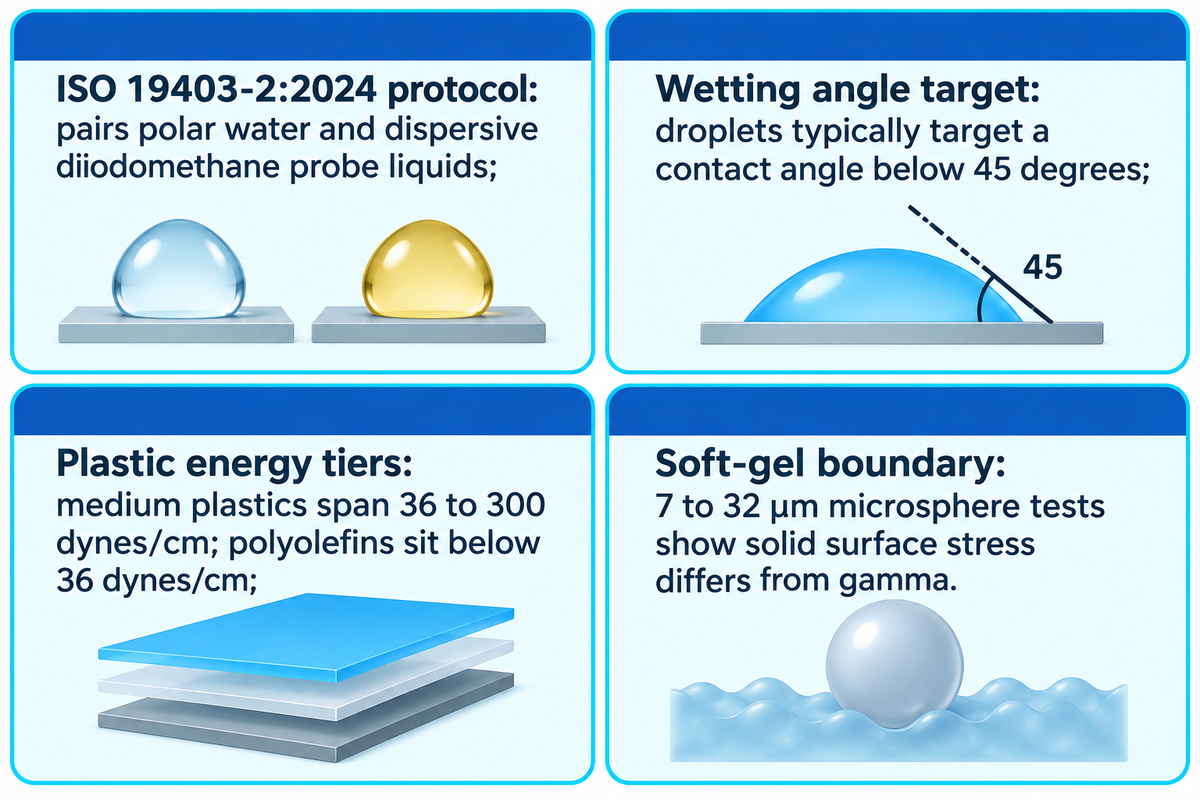
Thermodynamic adhesion work measures the reversible free energy needed to separate a unit interfacial area into two clean surfaces. Through the Young-Dupré equation, WA = γLV × (1 + cos θ), engineers calculate reversible wetting energy from probe-liquid surface tension and equilibrium contact angle. Under ISO 19403-2:2024 wettability standards, solid surface free energy characterization pairs polar and dispersive test liquids.
Spontaneous spreading occurs when interfacial tensions yield a positive spreading coefficient; higher solid surface energy alone doesn’t guarantee complete film wet-out. For optimal bonding, droplets typically target a contact angle below 45 degrees. In 3M’s published plastic surface energy classification, medium-energy plastics span 36 to 300 dynes/cm, while low-surface-energy polyolefins and PTFE sit below 36 dynes/cm. Unit equivalence across mN/m, dynes/cm, and mJ/m2 follows standard surface tension definitions.
Worked Calculation: Young-Dupré Reversible Work of Adhesion at 20 °C
Using deionized water at 20 °C (γ LV = 72.8 mN/m = 72.8 mJ/m 2 ) on smooth, rigid polymer surfaces:
- Case A on plasma-activated polycarbonate (θ = 28°, cos 28° = 0.8829): first 1 + 0.8829 = 1.8829, then W A = 72.8 × 1.8829 = 137.1 mJ/m 2 (0.137 J/m 2 ).
- Case B on an untreated fluoropolymer-polyolefin blend (θ = 110°, cos 110° = -0.3420): first 1 – 0.3420 = 0.6580, then W A = 72.8 × 0.6580 = 47.9 mJ/m 2 (0.048 J/m 2 ).
Two physical boundaries restrict Young-Dupré calculations in factories. First, water mainly probes polar hydrogen bonding, whereas non-polar polyolefin melts wet via dispersion forces. ISO 19403-2:2024 therefore adds dispersive liquids such as diiodomethane under equilibrium contact-angle assumptions. Second, soft-gel contact experiments with 7 to 32 μm microspheres showed solid surface stress differs from surface energy gamma on compliant gels, causing contact-zone phase separation.
Everyday Examples of Adhesion and Where Classroom Analogies Break in Manufacturing
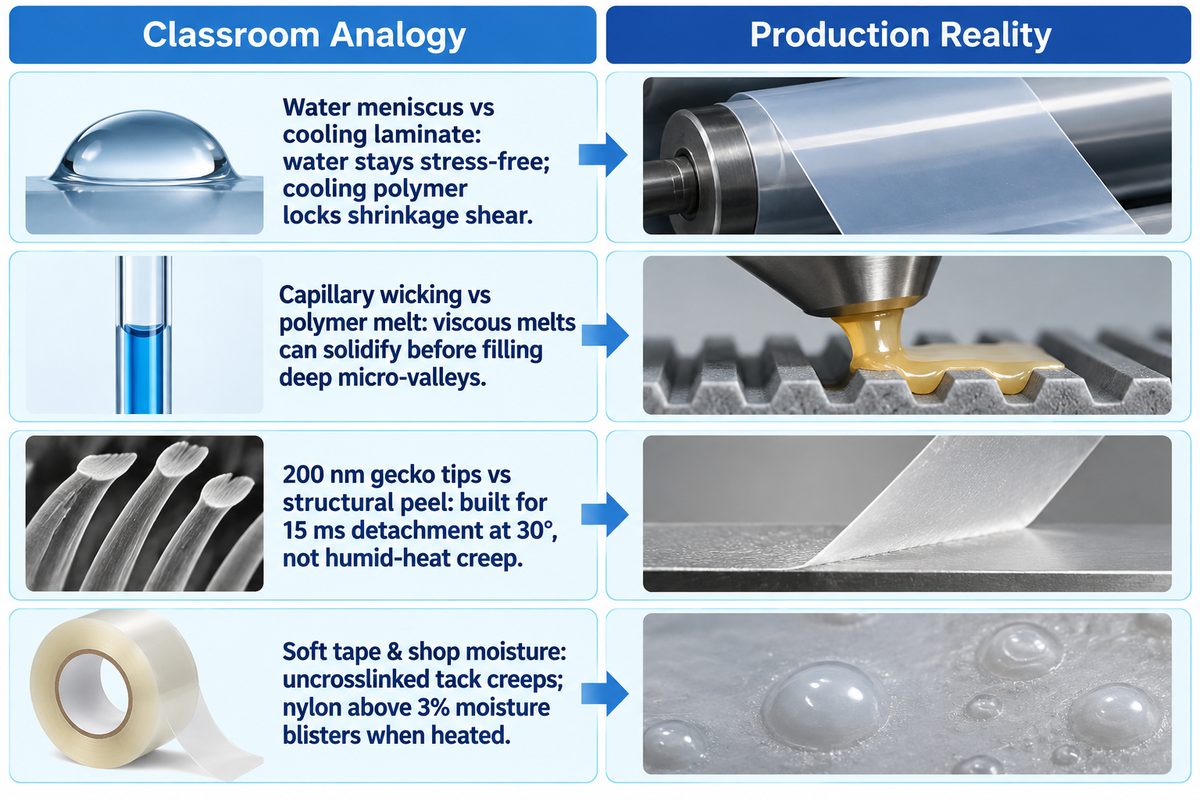
Intermolecular attraction is real, and classroom demonstrations with water climbing glass tubes, sticky tape, or gecko feet show the attraction. However, applying such fluid or biological analogies in a solid state still results in manufacturing failures. Classroom liquids carry zero static shear strength and never experience crystallization shrinkage or steam blistering.
In USGS meniscus observations, liquid water wets clean glass effortlessly because both phases stay stress-free at room temperature. By contrast, a molten metal adhesive or structural sealant cooling from press temperature to ambient air contracts against rigid aluminum and locks boundary shear stress.
Similarly, keratinous gecko setae ending in 200 nm spatular tips use directional compliance built to detach in 15 ms at a 30° shaft angle. Industrial laminates, on the other hand, require isotropic peel resistance. As Assembly Magazine’s low-surface-energy plastics report notes, plastics near 30 dynes/cm resist wetting without activation, while shop failure diagnostics show nylon absorbing more than 3% moisture releases steam blisters when heated.
| Everyday Phenomenon | Valid Molecular Lesson | Where the Analogy Breaks in Production |
|---|---|---|
| Water Meniscus on Glass | Polar hydrogen bonds pull liquid edges upward when adhesion exceeds cohesion | Liquid water has zero shear modulus and no solidification or crystallization shrinkage |
| Capillary Action in Narrow Tubes | High substrate surface energy drives spontaneous wicking into tight gaps | High-viscosity polymer melts can solidify before filling deep micro-valleys when press heat or dwell is insufficient |
| Gecko Foot 200 nm Spatulae | Sub-nanometer dry contact unlocks 200 μN van der Waals force per seta | Engineered for reversible 15 ms detachment at 30°, not humid-heat structural creep |
| Office Pressure-Sensitive Tape | Elastomeric tackiness wets smooth substrates instantly under light pressure | Uncrosslinked soft tack layers creep under static shear or heated wash cycles |
Factors Affecting Adhesion on Real Substrates: Cleanliness, Roughness, and Low Surface Energy
Three shop-floor factors frequently trigger interfacial delamination: weak boundary layers on contaminated skins, low-surface-energy polymer backbones below 36 dynes/cm, and hydrophobic recovery after activation. ISO 1514:2024 and ISO 19403-2:2024 govern standard test-panel preparation and contact-angle surface free energy; neither standard alone verifies shop-floor surface cleanliness before bonding trials.
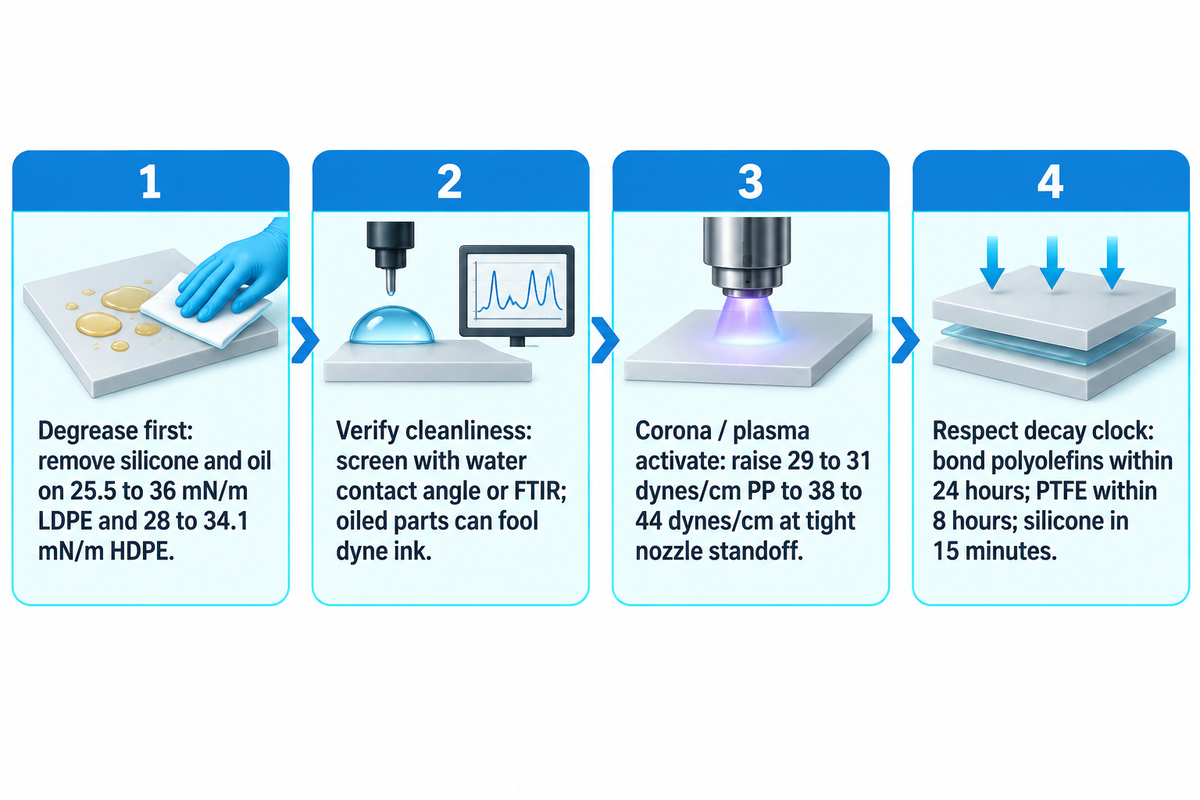
Because the range of the force of attraction is less than 1 nm, trace silicone mold release, stamping oil, or blooming slip agents turn strong substrates into weak boundary layers. In GlobalSpec’s polymer surface reference, untreated LDPE measures 25.5 to 36 mN/m and HDPE measures 28 to 34.1 mN/m. Internal slip additives also bloom outward to prevent film blocking. Worse, Sabreen’s surface failure analysis warns that energizing silicone-contaminated parts oxidizes oil in place.
Prior to any attempt at roughening or oxidation of a material surface, cleaning should be performed. Shops verify clean surfaces using water contact angle gauges or Fourier-transform infrared spectroscopy (FTIR) to spot silicone or hydrocarbons. Only after degreasing should operators apply energetic surface treatment.
Recommended Shop Practice
Degrease polyolefins before plasma or corona activation and hold electrode standoff tight. Laminate treated PP or HDPE within 24 hours before polar groups rotate inward.
Common Production Pitfall
Never plasma-treat over silicone mold release or trust dyne ink alone on oiled parts. Oxidized oil layers pass dyne checks yet peel off cleanly.
What does corona treatment do to improve polymer surface adhesion?
Corona treatment and atmospheric plasma discharge modify non-polar polymer chains with energetic ions and ozone, adding polar groups across the top three molecular layers. Flame, corona, or plasma treatments raise untreated polypropylene from 29 to 31 dynes/cm to the 38 to 44 dynes/cm range, allowing adhesives to wet it. However, Enercon’s Automotive Plastics Plasma Study found that a 40% increase in nozzle gap distance reduced dyne level by 10%.
Surface preparation also has a strict timeline. Treated polyolefin chains lose surface energy mostly in the first 24 hours as mobile polar segments reorient away from air. On fluoropolymers and elastomers, bondability decays even faster, within 8 hours on plasma-treated PTFE and about 15 minutes on silicone rubber. Where parts sit in storage, engineers pair activation with primer or polyolefin hot melt film.
Material Relevance and Measurement Limits: Why Peel Tests Read Both Interface and Bulk Layer
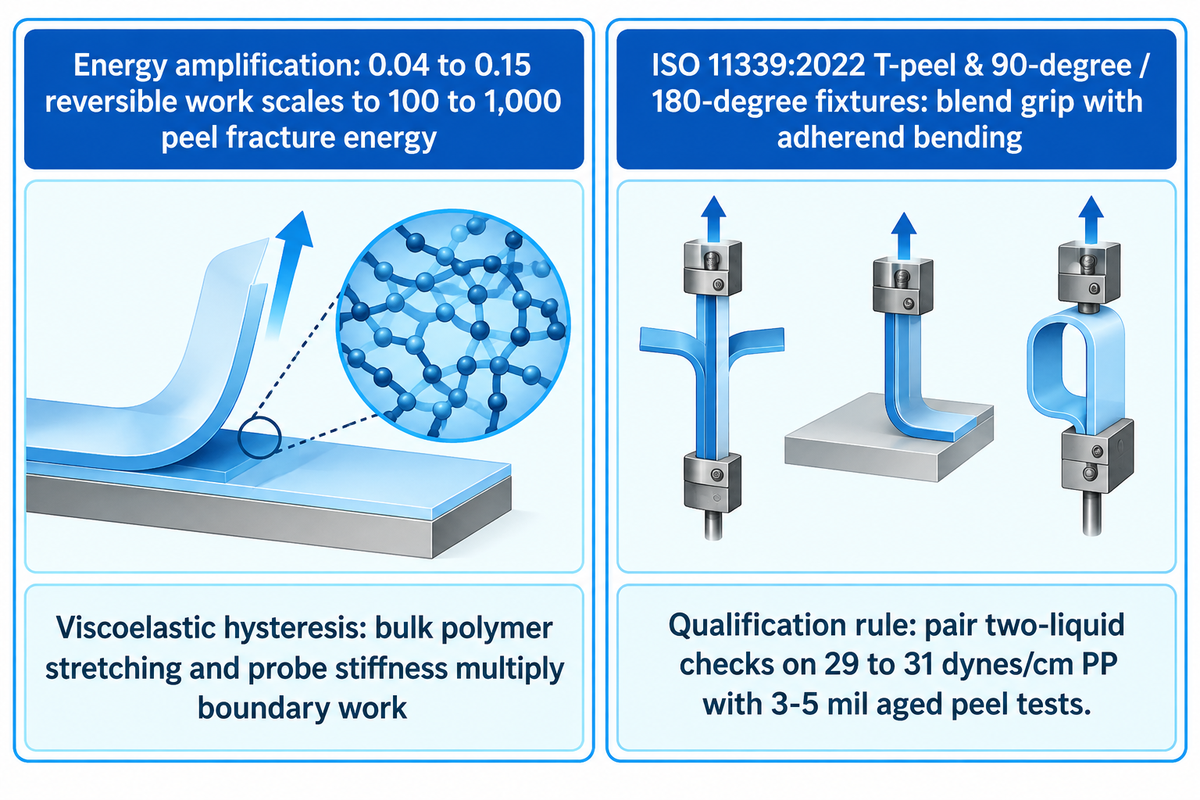
Reversible thermodynamic work of adhesion sits near 0.04 to 0.15 J/m2, yet flexible-laminate peel fracture energies reach 100 to 1,000 J/m2. Viscoelastic stretching inside the polymer bulk multiplies interfacial work by orders of magnitude. Under ISO 11339:2022 T-peel testing rules, measured strength of adhesion blends boundary grip with flexible adherend bending.
“This test procedure does not provide design information.”
Fracture mechanics expresses this amplification through the Gent-Schultz and Andrews-Kinloch relation, Gc = WA × [1 + Φ(v, T)]. Here WA represents the reversible work of cross-boundary separation, and Φ(v, T) describes the rate-dependent and temperature-dependent viscoelastic hysteresis within the polymer zone. As shown by Robert F. Cook in his NIST contact mechanics research, adhesion work also depends on the stiffness of the contacting probes. Resistance to bulk cracking is proportional to polymer toughness across the deforming zone.
Standard peel testing fixtures record initial peak force, average seal force and peel strength per unit width of the specimen over 90-degree, 180-degree and T-peel adhesive joints. Peel angle influences reported force curves over the course of flexible laminate peel testing.
Why can water-on-glass contact angle or peel strength readings not be used alone to choose an industrial polymer film for low-surface-energy substrates?
A water contact angle reflects the combined wetting balance on high-energy silicate glass, so it cannot by itself predict dispersive wetting on 29 to 31 dynes/cm polypropylene or polyethylene. Conversely, a single peel test number reported in a datasheet is a mix of bending stiffness of the adherends, 3-5 mil film gauge, and peel speed, as well as boundary conditions. Reliable film qualification pairs two-liquid surface energy checks with humid-heat aging and fracture-face inspection.
Selecting Thermoplastic Hot Melt Adhesive Film Chemistries and Trial Lead Times
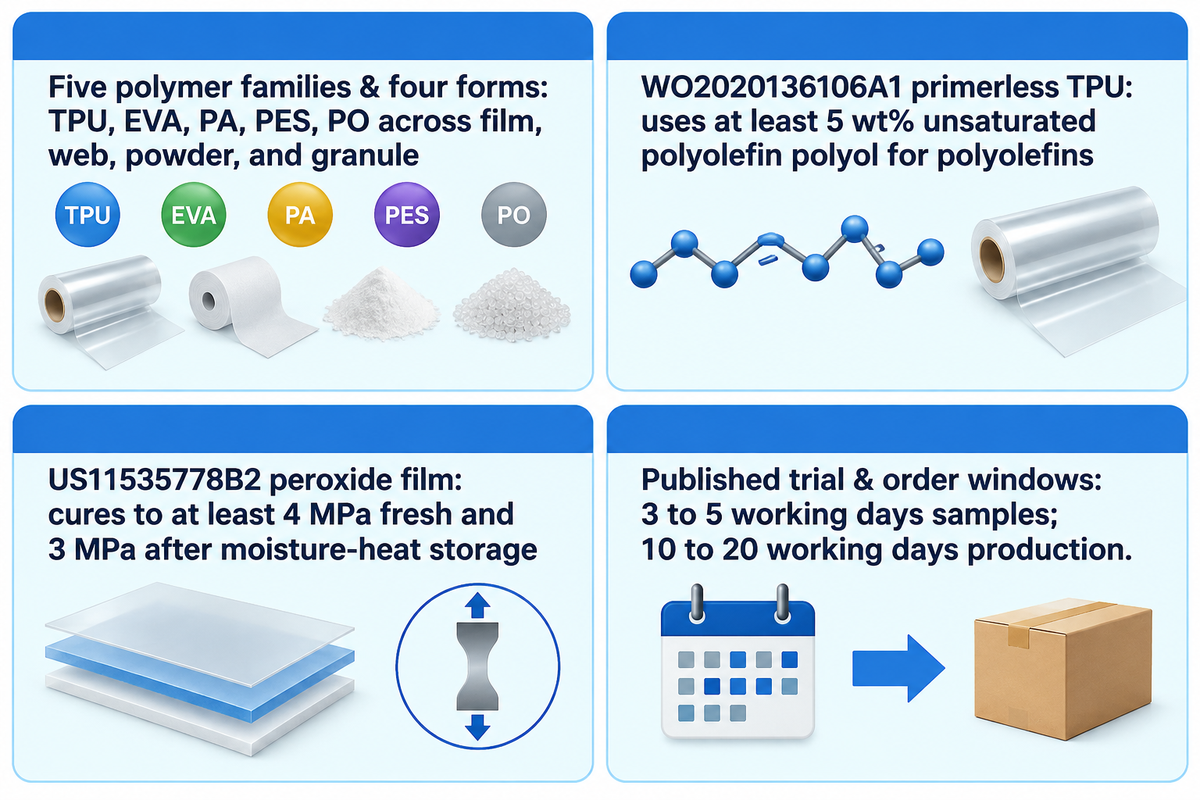
Matching thermoplastic hot melt adhesive film chemistry to substrate polarity, press temperature ceiling, and wash exposure turns adhesion theory into repeatable manufacturing processes. Across industrial lamination lines, five polymer families cover polar textiles, metals, and polyolefins in the 9-Row Substrate-to-Polymer Matrix below: TPU, EVA, PA (copolyamide), PES (copolyester), and PO (polyolefin). For standard grades, Shanghai Tengyang quotes 3 to 5 working days for sample slitting and 10 to 20 working days for confirmed production orders.
Modern formulations close polarity gaps without solvent primers as shown by patent disclosures. In patent publication WO2020136106A1 (BASF SE), polar TPU is reacted from isocyanate, chain extender, and polyol containing at least 5 wt% (preferably 10-15 wt%, based on total polyol weight) unsaturated polyolefin polyol (Mn 450-9,900 g/mol) to achieve primerless polyolefin bonding. For enhanced heat resistance, in patent US11535778B2, thermoplastic adhesive films are disclosed having at least 50% saturated polymer with dicumyl peroxide. In the push-out tests mentioned in the cited patent, the formulation was found to cure up to at least 4 MPa bond strength fresh and at least 3 MPa after the moisture-and-heat storage protocol mentioned in the patent.
Limits on volatile organic compounds continue to expand dry-film adoption. In Grand View Research’s polyester hot-melt adhesives analysis, global PES hot-melt demand reached USD 559.3 million in 2025. Revenue is projected to rise from USD 623.7 million in 2026 to USD 1,324.6 million by 2033 at an 11.4% compound annual growth rate. Physical geometry also governs breathability and gap filling during hot melt adhesive form selection across films, webs, powders, and granules.
| Target Material Pair | Surface Polarity & Prep | Candidate Film Chemistry | Dominant Bonding Mechanism | Key Service Boundary |
|---|---|---|---|---|
| Stretch Nylon / Spandex Apparel | Polar; pre-dry nylon below 3% moisture | TPU (Thermoplastic Polyurethane) | Hydrogen bonding + mechanical weave wetting | Soft elastic hand; check wash temperature ceiling by grade |
| Polyester Woven Fabric & PET Film | Medium surface energy (≥36 dynes/cm); clean dry web | PES (Copolyester) | Dipole-dipole affinity + compatible ester wetting | Strong wash durability; stiffer hand than low-modulus TPU |
| Degreased Aluminum / Steel Foil | High-energy oxide; degrease rolling oils | PA (Copolyamide) or Modified PO | Acid-base / hydrogen bonding or anhydride coupling | PA resists dry-cleaning solvents and oils; guard against wet-heat hydrolysis |
| Untreated PP / PE Non-Wovens & Films | Low surface energy (25.5 to 36 mN/m) | PO (Polyolefin) | Dispersive wetting + polyolefin chain interdiffusion | Bonds polyolefins without solvent primer; verify substrate melt-distortion margin |
| EVA Foam Footwear & Paperboard | Porous / heat-sensitive foam | EVA (Ethylene-Vinyl Acetate) | Low-temperature melt wetting + pore interlocking | Fast low-heat activation protects foam cells; lower upper-heat creep ceiling |
| Corona-Activated PP to Polar Textile | 38 to 44 dynes/cm treated PP (<24 h window) | PO or Polyolefin-Modified TPU | Polar carbonyl wetting + fiber encapsulation | Laminate promptly before hydrophobic chain reorientation degrades wetting |
| Polycarbonate / ABS Electronics Housings | Medium surface energy (≥36 dynes/cm); wipe mold release | TPU or PES Die-Cut Film | Polar dipole attraction across smooth flat land | Match 3 to 5 mil film gauge to housing flatness to avoid trapped air voids |
| Leather & Synthetic PU Uppers | Fibrous / plasticizer-bearing urethane | TPU or PA Film / Web | Urethane interdiffusion + fibrous interlocking | Screen migrating oils or fatliquors via heat-aging peel check |
| Silane-Primed Glass to Polymer Sheet | High-energy silicate + hydrolyzed organosilane | TPU or EVA Interlayer Film | Covalent siloxane bridge + bulk viscoelastic toughness | Required whenever condensation or wet thermal cycling would displace H-bonds |
Choose a converter that has control over film extrusion for the chemistry and format your line requires as opposed to relying on resin trading alone. Shanghai Tengyang New Materials Technology Co., Ltd. researches and manufactures TPU, EVA, PA, PES, and PO across film, web, powder, and granule formats. They can modify the thickness and width of the rolls, melting range, color, and type of release liners.
What sample and production lead times should industrial buyers expect when ordering custom hot melt adhesive film for substrate bonding trials?
For existing TPU, EVA, PA, PES, and PO grades in custom slit widths or gauges, the company publishes a sample lead time of 3 to 5 working days and a confirmed production lead time of 10 to 20 working days. New custom polymer compounds or custom primers don’t have defined catalog products, and quoted turnaround time is based on the project and substrate lab testing.
Buyer Qualification Checklist Before Lamination Trials
Share both substrate datasheets, surface energy or plasma status, press temperature ceiling, and target peel or wash standard. Specify preferred Incoterms (EXW, FOB, or CIF) with Shanghai Tengyang’s standard 30% T/T deposit and 70% pre-shipment terms. Process engineers can then match film chemistry and gauge on your first sample roll.
Frequently Asked Questions
Why do two flat solid blocks not stick together at room temperature without an adhesive?
Microscopic roughness peaks hold rigid solid surfaces apart across tens of nanometers to micrometers of trapped air. That gap sits well outside the sub-nanometer capture zone where van der Waals dispersion forces act to pull neighboring atoms together. In the absence of liquid wetting, polymer melt flow, or soft elastic compliance, true atomic contact is limited to isolated asperity tips across the joint area.
What is the difference between thermodynamic work of adhesion and practical joint fracture energy?
Thermodynamically, the work of adhesion (WA = 40 to 150 mJ/m2) is the reversible work of separation needed to create two clean unit surfaces. This work of separation is accompanied by irreversible viscoelastic dissipation, polymer yielding, and bending of the adherends, which occurs within the bulk of the bondline, during mechanical peeling. This dissipative energy is referred to as fracture energy (Gc = 100 to 1,000 J/m2).
When does an engineer need a silane coupling agent or primer instead of plasma activation alone?
However, diffusing water molecules can displace physical hydrogen bonds over time, whereas hydrolyzed silanes form covalent siloxane bridges that resist wet interfacial stripping. Silane primers achieve stable interfacial adhesion with glass, steel, and aluminum. Initial activation raises the surface energy of these materials, improving melt wetting and adhesion in production.
How does adhesion differ from adsorption in surface chemistry?
Interfacial contact links two dissimilar phases. Adhesion holds those dissimilar phases of matter in contact along a shared line of separation. Adsorption instead describes contact between an exposed interface and individual gas or solute molecules.
How do substrate thickness and backing stiffness change a reported peel adhesion number even when the interface stays identical?
Stiffer or thicker flexible adherends widen the bend radius at the peel front during ISO 11339:2022 or ASTM D903 testing. That wider curvature spreads tensile stress across a larger polymer zone and consumes extra plastic bending energy inside the peel arm itself. Consequently, two laminates sharing identical interfacial chemistry and adhesive coat weight report noticeably different peel forces unless backing gauge, test temperature, and peel angle match.
What is the opposite of adhesion in physics and materials science?
Abhesion is the opposite of adhesion. Silicone-coated release liners create low-energy abhesive surfaces so tacky adhesive films unwind cleanly without unwanted transfer. This allows adhesive films to unwind freely without transfer.
Does higher surface roughness always increase adhesion strength?
Higher surface roughness improves bonding only when melt viscosity, film thickness, and lamination pressure fill every groove completely. If a surface has deep, narrow valleys, and adhesive film is thin, air pockets may become entrapped at the boundary. These trapped air pockets reduce intimate contact during cooling and become points of weakness where adhesion can fail.
References & Sources
- D.J. Gardner, Theories and Mechanisms of Adhesion, University of Maine Advanced Structures & Composites Center, https://composites.umaine.edu/publication/theories-and-mechanisms-of-adhesion/
- R. F. Cook, Mechanics of Adhesion, National Institute of Standards and Technology (NIST), https://www.nist.gov/publications/mechanics-adhesion
- K. Autumn and A.M. Peattie, 2002, “Mechanisms of adhesion in Geckos,” Integrative and Comparative Biology, National Library of Medicine (PubMed) (https://pubmed.ncbi.nlm.nih.gov/21680391/)
- U.S. Geological Survey (USGS) Water Science School, Adhesion and Cohesion of Water, https://www.usgs.gov/water-science-school/science/adhesion-and-cohesion-water
- Jensen, K. E., et al. (2015). Wetting and phase separation in soft adhesion. Proceedings of the National Academy of Sciences (PMC4664338). https://pmc.ncbi.nlm.nih.gov/articles/PMC4664338/
- International Organization for Standardization. ISO 11339:2022, Adhesives: T-peel test for flexible-to-flexible bonded assemblies . https://www.iso.org/standard/52890.html
- International Organization for Standardization. ICS 87.040, ISO 19403-2:2024 Paints and varnishes: Determination of the free surface energy of solid surfaces by measuring the contact angle . https://www.iso.org/ics/87.040.html
- Brogly, M. (2011). Covalent and Van der Waals Forces Involved in Adhesion. In Handbook of Adhesion Technology, Springer. https://link.springer.com/rwe/10.1007/978-3-642-01169-6_3
- GlobalSpec Engineering Reference. Section 3.8: Polymer Surface Properties and Critical Surface Tension. https://www.globalspec.com/reference/50610/203279/3-8-surface-properties
- World Intellectual Property Organization Patent Record. WO2020136106A1, Polyolefin-modified thermoplastic polyurethane hot-melt adhesive. https://patents.google.com/patent/WO2020136106A1/en
- United States Patent Record. US11535778B2, Latent reactive thermoplastic adhesive film. https://patents.google.com/patent/US11535778B2/en
Editorial & Technical Review: Reviewed by the Shanghai Tengyang New Materials Technology Co., Ltd. technical team (No.58, Fumin Branch Road, Hengsha Township, Chongming District, Shanghai, China) for thermoplastic adhesive film chemistry and lamination process accuracy.