Get in touch with Tengyang Company

Energy Dissipation in Polymers: Definition, Mechanical Hysteresis Loops, Loss Factor, and Test Conditions

By DD | Reviewed by the Shanghai Tengyang New Materials Technology Co., Ltd. technical team
In polymer physics and adhesive mechanics, dissipation describes the irreversible conversion of ordered mechanical work into random internal thermal motion. In an ideal Hookean spring, mechanical work is stored as potential energy at a 0° phase angle and is fully recoverable. Viscoelastic polymer chains experience internal molecular friction and lose mechanical work as heat during every load-unload cycle. Qualifying a damping layer or hot-melt bonding film requires separating per-cycle loop energy, dissipated power, and dimensionless loss factor.
Key Engineering Summary
- An ideal viscous dashpot lags applied strain by 90° and completely converts mechanical work into heat.
- Loop loss ΔW (J/m3), dissipated power Pd (W/m3) and the dimensionless loss factor, tan δ (E”/E’), describe the failure mechanisms of joints in various systems.
- ASTM D4065-20 plastic dynamic procedures span −140 °C to polymer softening across 0.01 to 1000 Hz. Commercial polymer damping layers reach E tan δ up to 0.6 GPa, while low-loss TPU formulations hold tan δ ≤ 0.14 at 23 °C.
Dissipation Definition: Everyday English Meaning vs. Polymer Physics Reality
In physics, a definition separates the everyday use of dissipation from measurable mechanical energy loss in viscoelastic solids. In general English, dissipation can describe a broad, gradual dispersal. Related words and synonyms for dissipation imply that the motion gradually scatters or fades away. In thermodynamics, irreversible ordered work converts to random heat, and total energy never vanishes from a closed system.
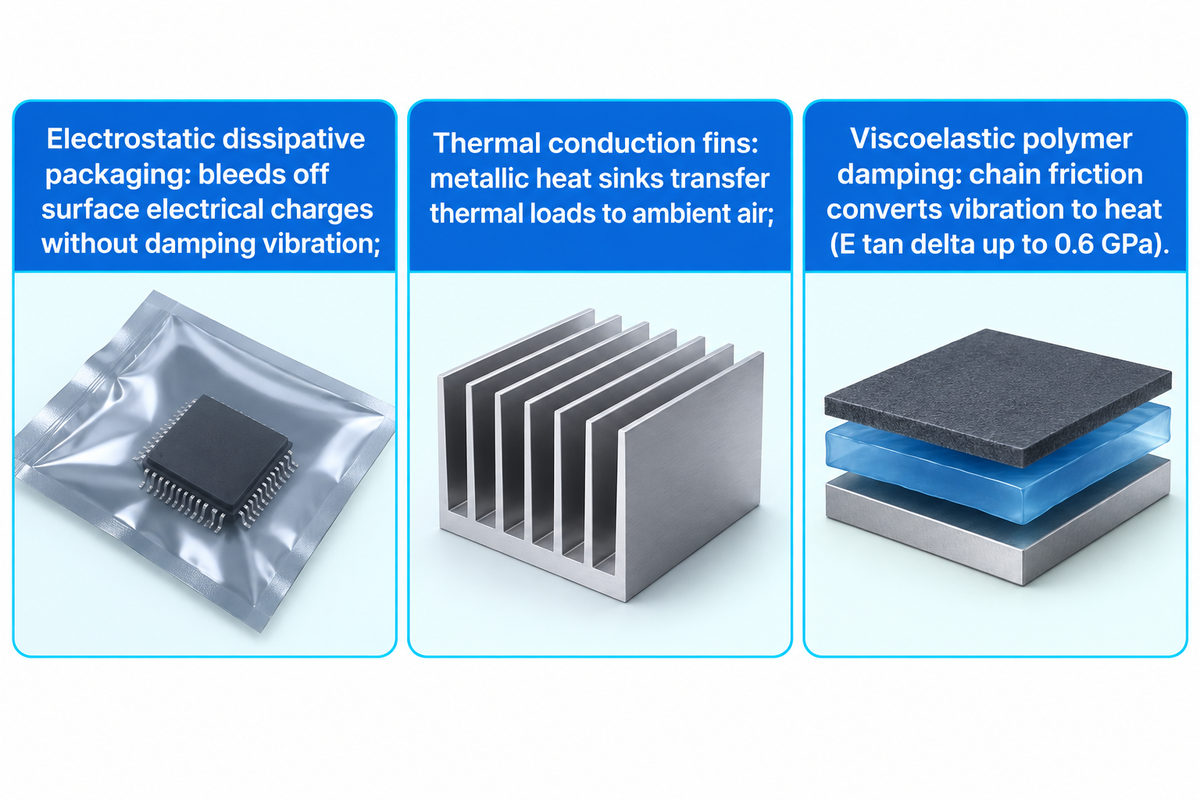
William Thomson defined this thermodynamic baseline in his 1852 paper on mechanical energy conversion published in Philosophical Magazine, p.304. Ordered kinetic work or elastic strain energy eventually degrades into irreversible random molecular thermal motion. Acoustic sound wave attenuation in air and viscoelastic polymer damping follow this exact rule. Researchers in polymer physics for bonding separate static-dissipative packaging films from conductive heat-sink fins and viscoelastic damping films.
Three Distinct Datasheet Mechanisms
- Electrostatic static-dissipative packaging films bleed off surface electrical charges without damping mechanical shock or vibration.
- Heat-sink fins, which are metallic, dissipate thermal loads to the ambient air by means of conduction and convection.
- Viscoelastic damping films absorb mechanical vibration by converting it to internal heat via friction in macromolecular chains.
How Is Energy Dissipated in Damping Materials Under Cyclic Motion?
Damping polymers convert mechanical work by means of free-volume segmental sliding and rearranging in an out-of-phase fashion. When sinusoidal stress stretches a viscoelastic film, coiled macromolecular chains lag behind the applied strain, and stretched covalent backbones store part of the input work elastically. Internal friction between sliding chains converts the rest of the work to heat, hence mechanical energy is lost every cycle. Free volume, side groups, hydrogen bonds, and entangled amorphous segments increase friction in the transition zone.
Biolin Scientific notes describe how elastic metals such as a metal tuning fork oscillate for a long time because low internal dissipation leads to long vibration or oscillation times. Soft gelatin can lose energy quickly as viscous chain flow dissipates energy and turns vibration into heat over a few cycles. Commercial polymer damping layers reach a stiffness-loss figure of merit (E tan δ) up to 0.6 GPa, whereas specialized ZnAl-SiC metal-matrix composites exceed 0.6 GPa under controlled strain.
What Is the Dissipation Factor Across Mechanical DMA and Dielectric Tests?
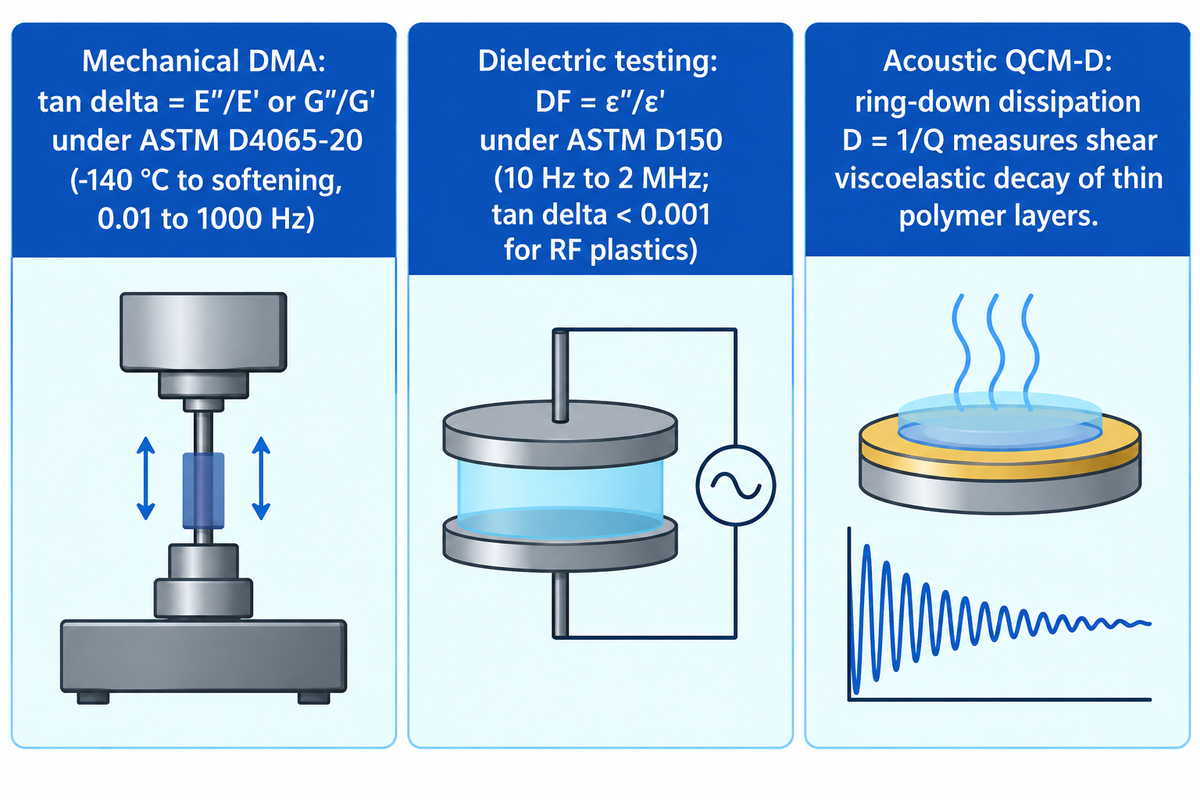
Dissipation factor (tan δ) measures energy loss per cycle, relative to stored elastic energy, in three different test domains. Mechanical dynamic mechanical analysis (DMA) defines tan δ as loss modulus over storage modulus (E”/E’ or G”/G’, with phase angle δ in degrees). In dielectric testing, DF = ε”/ε’, and for QCM-D, D = 1/Q.
ASTM D4065-20 provides standard procedures for solid-plastic dynamic mechanical testing from −140 °C to polymer softening across 0.01 to 1000 Hz. ISO 6721-1 provides separate general principles for dynamic plastic testing. Mechanical tan δ equals E”/E’ in tension or G”/G’ in shear, quantifying elastic and viscous polymer responses. ASTM D150 measures dielectric loss tangent of insulating plastics using electrode arrangements specified for the test method. SpecialChem dielectric guides describe plate-capacitor setups using circular metallic electrodes with flat sheets above 50 mm from 10 Hz to 2 MHz. In radio-frequency plastic components, tan δ below 0.001 indicates low electrical loss. When dielectric tan δ stays below 10%, electrical power factor is approximately equal to tan δ.
Acoustic surface characterization adds a third dissipative metric to quartz crystal microbalance (QCM-D) instruments. According to Biolin Scientific, QCM-D dissipation D is defined as the inverse quality factor (1/Q). This ring-down ratio measures shear viscoelastic decay of thin polymer layers.
| Measurement Domain | Defining Ratio & Symbol | Reference Standard & Method Scope | Specimen Setup & Benchmark |
|---|---|---|---|
| Mechanical Polymer DMA | tan δ = E” / E’ (or G” / G’); phase angle δ in degrees | ASTM D4065-20 (−140 °C to softening, 0.01 to 1000 Hz); ISO 6721-1 provides separate guidance | Solid strips, films, or shear discs; commercial polymer damping layers reach E tan δ up to 0.6 GPa |
| Dielectric Insulator Testing | DF = tan δ = ε” / ε’ | ASTM D150 using method-specified electrode arrangements (plate setups span 10 Hz to 2 MHz) | Electrode geometry follows test method (such as >50 mm flat sheets); tan δ < 0.001 suits RF insulators; approximately equals power factor below 10% |
| Acoustic Surface QCM-D | D = 1 / Q (ring-down decay) | Quartz crystal shear oscillation ring-down protocol | Thin adsorbed polymer layers; contrasts rapid soft-gel decay against low-loss tuning-fork oscillation |
Reading Energy Lost per Cycle from a Mechanical Hysteresis Loop: Formula and Worked Example
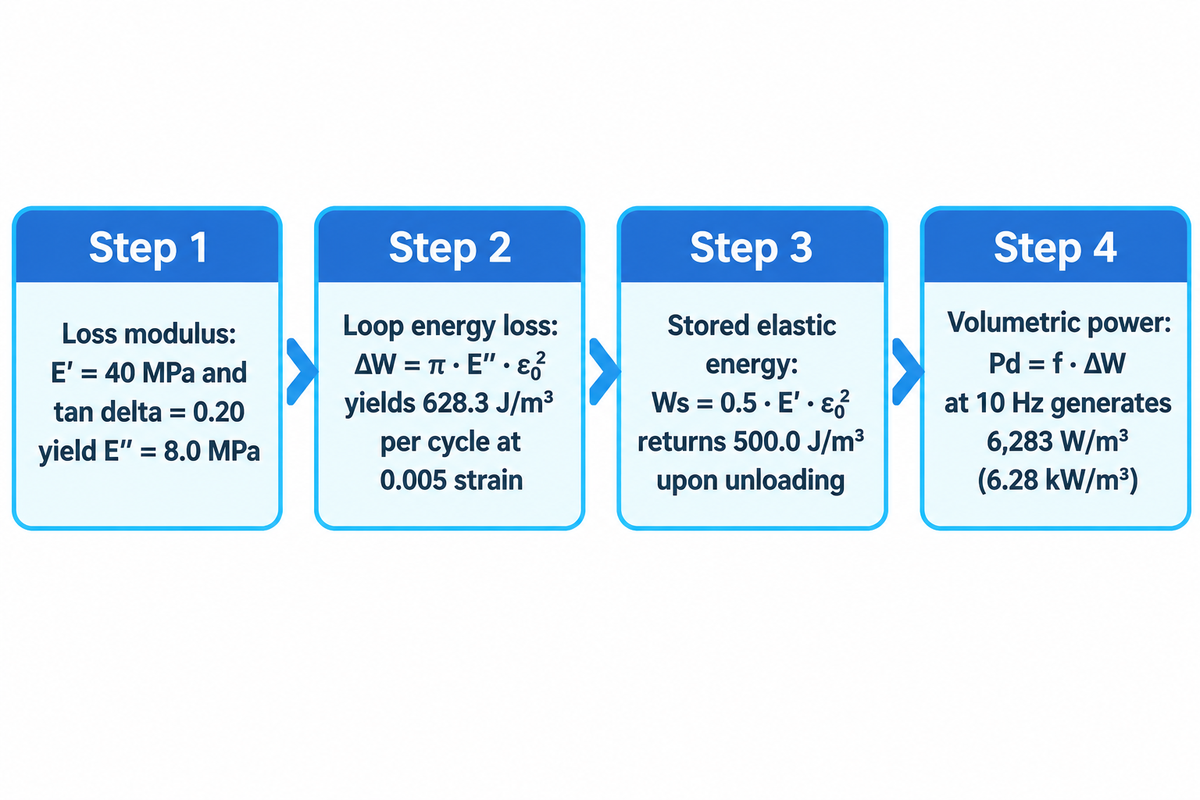
Volumetric energy lost per cycle (ΔW, in J/m3) equals the area enclosed inside a stabilized cyclic stress-strain hysteresis loop. For a cyclic stress-strain path, ΔW = ∮ σ dε. Loading stretches polymer chains along an upper stress path, while unloading returns along a lower path due to internal friction. That enclosed area measures mechanical work converted into heat per unit volume.
Within the small-strain LVR, harmonic strain, ε(t) = ε0 sin(ωt), forms a stress-strain elliptical loop. The notes from NC State’s Advances in Polymer Science DMA state that polymer DMA tests are performed at small strains (≤ 0.5%) to keep within the LVR. ASTM D4065-20 outlines procedures to determine and report dynamic mechanical properties of solid plastics without stating a universal modulus limit. Integration of the linear, elliptical loop gives ΔW = π · E” · ε02 = π · E’ · ε02 · tan δ.
Tensile film loops require two experimental checks before integration. Modern DMA instruments use an automatic tensioning system to eliminate preload errors that artificially increase stiffness. Additionally, the harmonic formula ΔW = π · E” · ε02 applies strictly within the small-strain LVR after discarding unconditioned Mullins softening cycles. Nonlinear large-strain loops require discrete trapezoidal integration of load-unload stabilized coordinates.
Use the Loop-Area-to-Wattage Check worked example below to convert linear DMA moduli into volumetric wattage. Assumed inputs: E’ = 40 MPa, E” = 8 MPa, tan δ = 0.20, sinusoidal strain amplitude ε0 = 0.005, frequency f = 10 Hz.
| Calculation Step | Governing Equation | Substituted Engineering Values | Computed Result & SI Unit |
|---|---|---|---|
| 1. Verify loss modulus E” | E” = E’ · tan δ | 40 MPa × 0.20 | 8.0 MPa (8.0 × 10⁶ Pa) |
| 2. Compute per-cycle loop loss ΔW | ΔW = π · E” · ε02 | 3.1416 × (8.0 × 106 Pa) × (0.005)2 | 628.3 J/m3 per cycle |
| 3. Compute recoverable peak elastic density | Ws = 0.5 · E’ · ε02 | 0.5 × (40 × 106 Pa) × (0.005)2 | 500.0 J/m3 stored & returned |
| 4. Convert to volumetric dissipated power Pd | Pd = f · ΔW | 10 Hz × 628.3 J/m3 | 6,283 W/m3 (6.28 kW/m3) |
Dissipated Energy per Cycle vs. Dissipated Power vs. Tan Delta
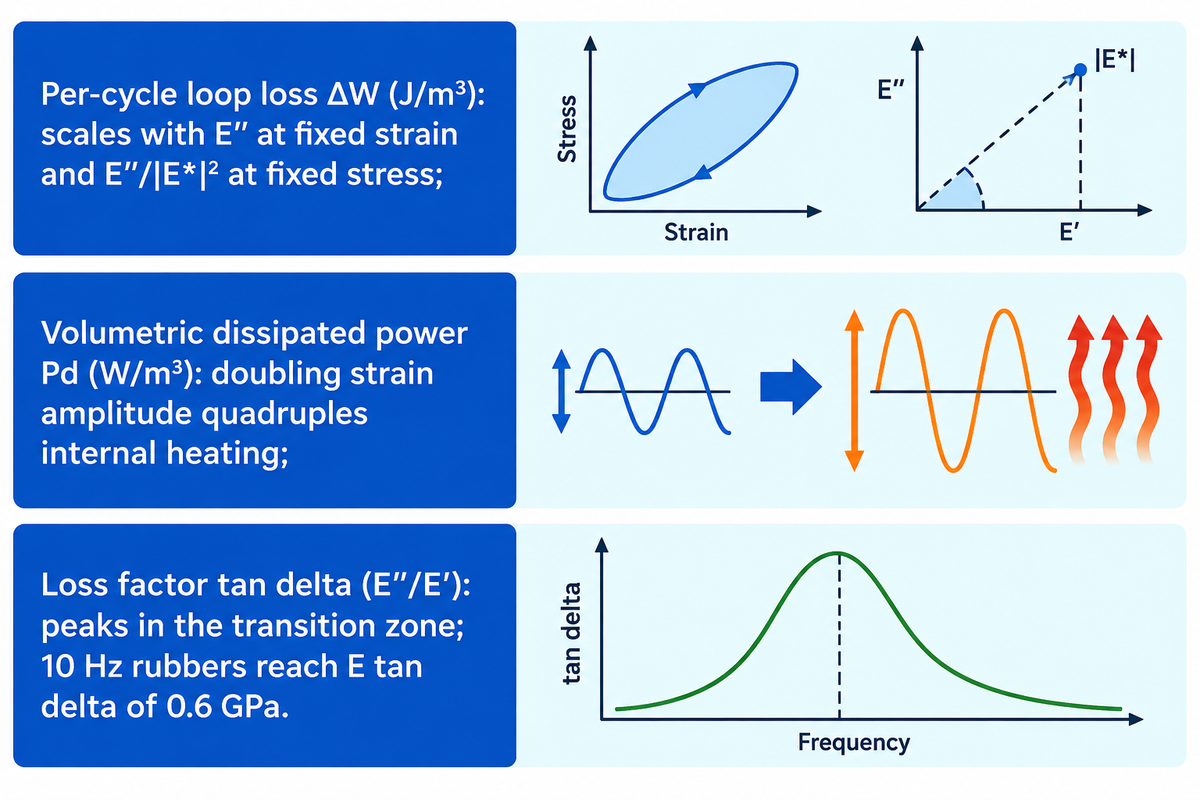
Joint duty defines the governing metric. Use per-cycle energy density (ΔW) for discrete impacts, volumetric dissipated power (Pd) for continuous vibration heating, and loss factor (tan δ) for resonance transmissibility. Ranking films by peak tan δ alone causes design errors. A gel with high tan δ absorbs fewer joules at fixed strain if both E’ and E” are low.
The 3-Quantity Dissipation Split separates these metrics across displacement-controlled and force-controlled boundaries. At fixed strain amplitude ε0, energy loss scales with E” (the product E’ tan δ), enabling efficient constrained-layer vibration damping. At fixed stress amplitude σ0, energy loss scales with E” / |E*|2. At 10 Hz, high-damping rubbers reach a peak E tan δ of 0.6 GPa, while a specialized 5% In metal damping alloy reaches 2.8 GPa.
| Quantity & Symbol | Linear Harmonic Equation | SI Unit | Controlling Modulus Term | Counter-Intuitive Selection Trap |
|---|---|---|---|---|
| Energy Lost per Cycle (ΔW) | ΔW = π · E” · ε02 (fixed ε0) ΔW = π · σ02 · E” / |E*|2 (fixed σ0) |
J/m3 (equal to Pa) | Loss modulus E” at fixed strain; compliance loss E”/|E*|2 at fixed stress | A soft gel with high tan δ absorbs less energy at fixed strain than a stiffer polyurethane film with higher E” |
| Volumetric Dissipated Power (Pd) | Pd = f · ΔW = π · f · E” · ε02 | W/m3 | Frequency f multiplied by E” and squared strain ε02 | Doubling strain amplitude quadruples internal wattage and can cause rapid self-heating in thick pads |
| Loss Factor (tan δ) | tan δ = E” / E’ | Dimensionless | Ratio of viscous loss to elastic storage modulus | Peak tan δ aligns with the transition zone where storage modulus E’ drops sharply across temperature |
What Is the Difference Between Heat Dissipation and Mechanical Power Dissipation?
Mechanical power dissipation generates thermal wattage in a deforming polymer via thermodynamic entropy production, and heat dissipation conducts thermal energy into metal or air. Joint thermal management relies on the thermal conductivity of plastics.
How Temperature, Frequency, and Strain Amplitude Shift DMA Dissipation Readings
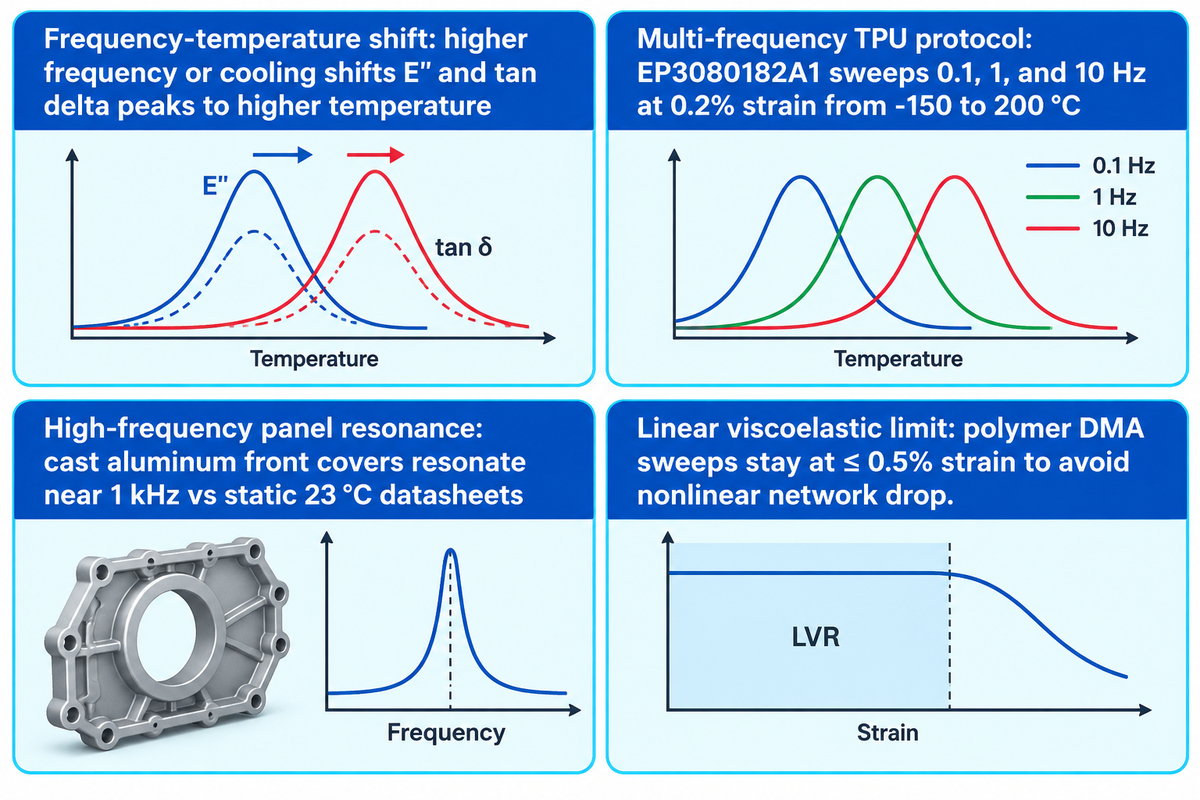
Raising the oscillation frequency or cooling the test chamber restricts polymer chain relaxation and shifts the peaks of E”, tan δ and glassy stiffness to higher temperatures. Conversely, heating the polymer or lowering the frequency allows the polymer chains to relax. Single-point 23 °C datasheet numbers never illustrate dynamic behavior over wide service environments.
Use the product of the stiffness and the loss factor to evaluate structural damping layers.
The product of stiffness and loss factor (E tan δ) helps compare damping-layer and structural-damping performance.
Prof. Roderic Lakes, University of Wisconsin-Madison Viscoelasticity Laboratory
Multi-frequency test protocols quantify this coordinate shift directly. European Patent EP3080182A1 measures thermoplastic polyurethane tan δ at 0.1, 1, and 10 Hz with 0.2% strain and a 1 °C/min ramp from −150 to 200 °C. For UV-curable acrylic adhesives, 25 mm parallel-plate sweeps run at 1 N axial force and 0.1% strain across 0.1 to 100 Hz from −10 to 150 °C. Comparing uncured and UV-cured states (600 s at 5000 mJ/cm2) isolates network crosslinking shifts.
High frequency structural panels require frequency-matched damping data. Automotive damping guides in Adhesives & Sealants Industry cite the example of cast aluminum engine front covers having flat-panel resonances of about 1 kHz. A film chosen from a static differential scanning calorimetry step or slow thermomechanical analysis of polymers can turn glassy at 1 kHz in cool air. Hot under-hood conditions would move that film past its glass transition.
The master curve has strain limits that constrain both its validity and its extrapolation for viscoelastic behavior. Williams-Landel-Ferry (WLF) time-temperature superposition applies only to amorphous segmental relaxations near and above the glass transition with polymer-specific constants. Below the glass transition, relaxation is described by the Arrhenius equation. Polymer DMA sweeps run at low strains such as ≤ 0.5% to stay inside the LVR. Larger strain levels cause nonlinear behavior in filled networks.
Standard Test Protocols (ASTM D4065, ISO 6721, ASTM D5992) and Self-Heating Limits
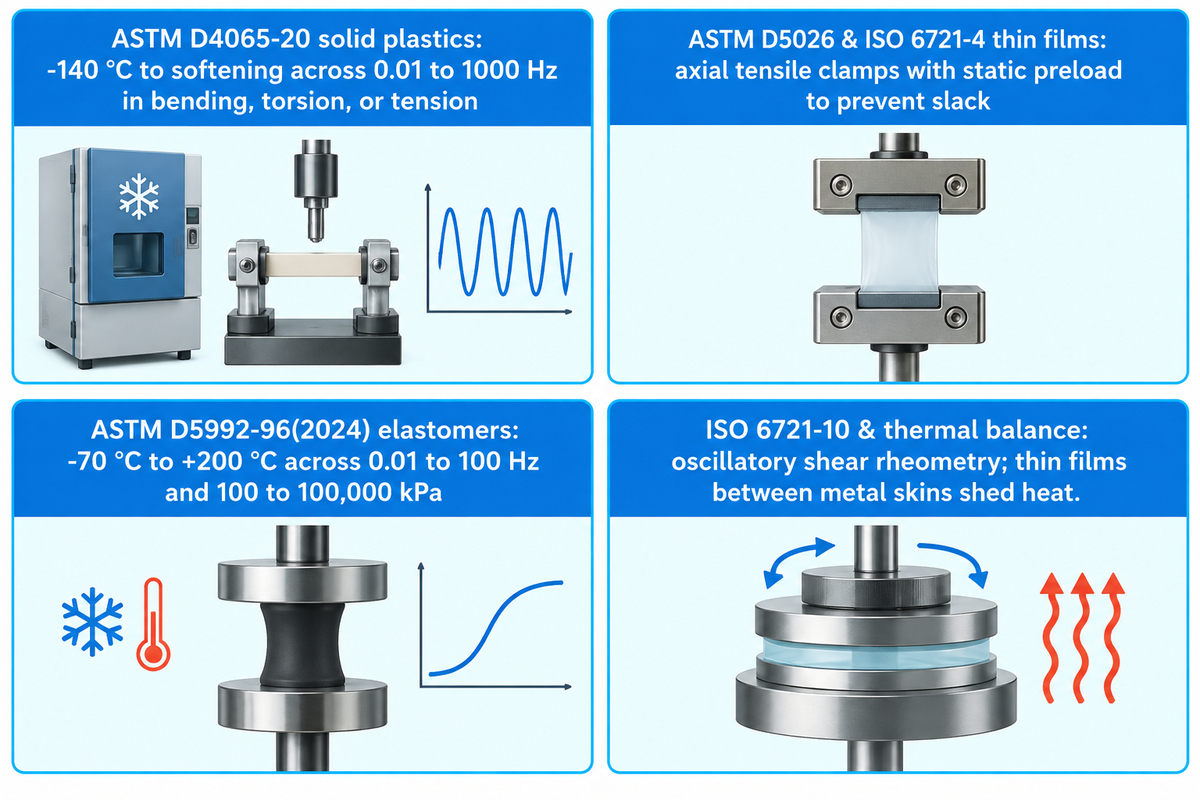
The scope of frequencies and deformation levels defined by the ASTM or ISO dynamic tests enables laboratories to minimize clamping and buckling errors. Axial clamping of thin films requires tension, whereas thick elastomers require compression or shear.
For thin plastic sheets and films, ASTM D5026 covers tensile dynamic mechanical testing, while ISO 6721-4 provides separate tensile method rules. Static tension preload helps reduce film slack according to instrument tension control. For vulcanized rubber and rubber-like elastomers, ASTM D5992-96(2024) guides resonant and forced sinusoidal vibration from −70 °C to +200 °C (−100 °F to +400 °F) across 0.01 to 100 Hz. That standard covers complex moduli from 100 to 100,000 kPa (15 to 15,000 psi) and damping angles from 0 to 90°. ISO 6721-10 describes measuring complex shear properties of plastics using an oscillatory rheometer within setup-specific operating limits.
| Standard Designation | Target Polymer Scope | Fixture Geometry | Published Temperature & Frequency Scope | Modulus / Phase Range |
|---|---|---|---|---|
| ASTM D4065-20 | Solid plastics in linear viscoelastic region | Method-matched bending, torsion, or tension | −140 °C to softening; 0.01 to 1000 Hz | Reports storage modulus, loss modulus, and tan δ across method-matched fixtures |
| ASTM D5026 | Thin plastic sheets and adhesive films | Axial tensile clamp with preload control | Forced non-resonant tensile oscillation within analyzer limits | Tensile storage E’, loss E”, and tan δ under setup-specific preload |
| ASTM D5992-96(2024) | Vulcanized rubber and rubber-like elastomers | Vibratory resonant or forced sinusoidal setup | −70 °C to +200 °C (−100 °F to +400 °F); 0.01 to 100 Hz | Complex modulus 100 to 100,000 kPa (15 to 15,000 psi); damping angle 0 to 90° |
| ISO 6721-10 | Plastics tested in oscillatory shear | Oscillatory shear rheometer geometry per method | Operating frequency and temperature set by instrument method | Determines dynamic complex shear properties of plastics |
When Does Internal Heat Generation Outpace Surface Cooling in Cyclic Polymer Joints?
Internal heat generation exceeds surface cooling when volumetric power (Pd = f · ΔW) multiplied by polymer thickness exceeds conductive transfer into adjacent adherends and air. Thick elastomer blocks cycled at high frequency trap thermal wattage in their low-diffusivity cores. With increasing core temperature, the polymer approaches its transition zone, resulting in the acceleration of bondline softening and fatigue failures as reported in polymer fatigue testing reports. Thin adhesive films sandwiched between metal skins can lose heat rapidly across broad contact areas, reducing heat retention in confined joint spaces.
Bulk Viscoelastic Loss in Peel Testing and TPU Film Selection Boundaries
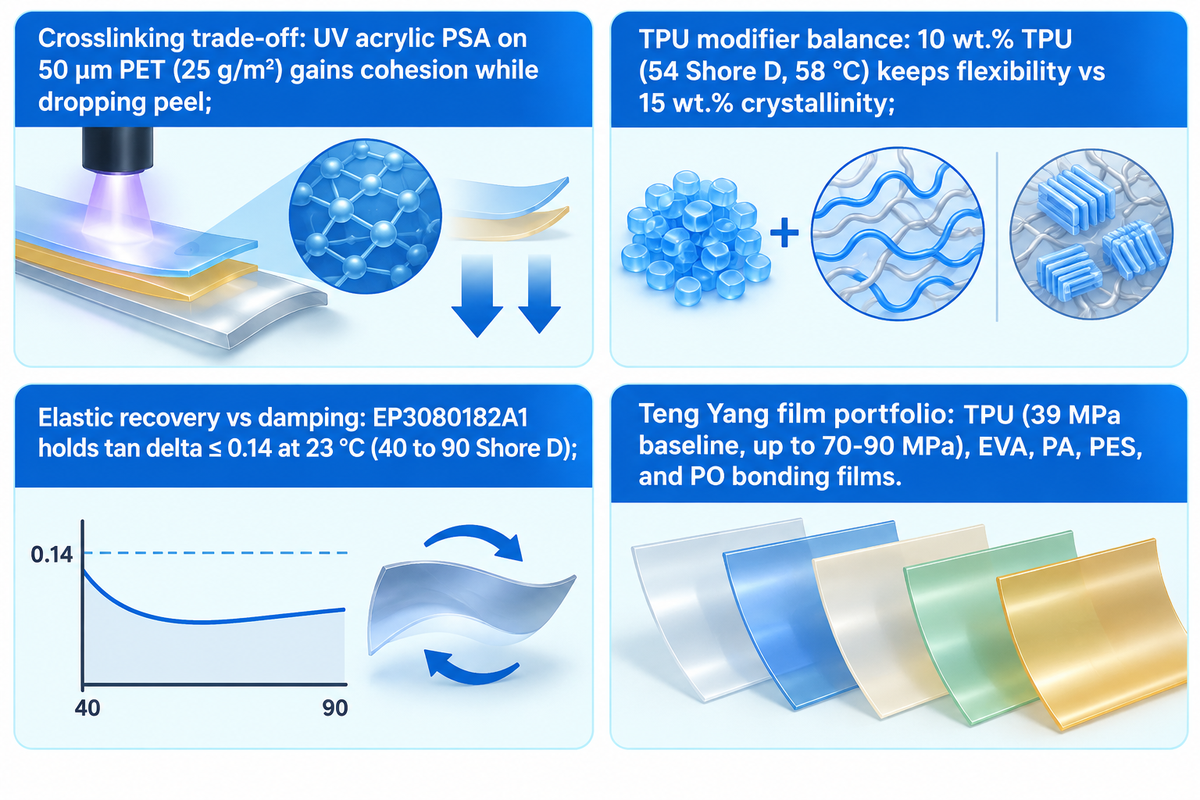
Apparent peel force in a bonded laminate consists of interfacial adhesion work and bulk viscoelastic energy loss in the stretched adhesive as well as bending loss in the peel arm. Reviewing peel strength test geometry and units alongside fracture toughness crack resistance prevents mistaking bulk dissipative stretching for interfacial bond strength.
Controlled crosslinking and formulation studies demonstrate this balance most clearly. On 50 µm PET film coated at 25 g/m2, UV-crosslinked acrylic pressure-sensitive adhesives gained cohesive strength and heat resistance as crosslink density increased. Decreased tack and peel strength resulted from increased crosslink density. In reactive polyurethane hot-melt modification, 10 wt.% TPU (54 Shore D, melting point 58 °C) maximized green strength without losing flexibility. Raising TPU loading to 15 wt.% reduced flexibility through higher crystallinity.
Opposite cyclic duties require opposite thermoplastic polyurethane (TPU) loss targets. For high-snap-back elastic recovery, European Patent EP3080182A1 reports TPU formulations (40 to 90 Shore D, 30 to 50% rebound) holding tan δ ≤ 0.14 at 23 °C across 0.1, 1.0, and 10 Hz. Acoustic damping laminates instead target elevated E” across the operating vibration band. Published commercial baselines for unfilled TPU film report tensile strength near 39 MPa and up to 70–90 MPa on high-strength grades. Accelerated aging baselines test 100 °C dry heat for 7 days and 80 °C water immersion for 7 days. Static tensile datasheets can’t establish cyclic hysteresis behavior when vendor sheets cite ‘dissipation values’ without fixture records. When evaluating a TPU film under cyclic loading, report the loading history and hysteresis evidence before assigning an energy-loss value.
Shanghai Tengyang New Materials Technology Co., Ltd. offers converted TPU, EVA, PA, PES, and PO hot-melt adhesive films and webs, powders and granules. Correlate elastic snap-back, panel resonance, elevated heat, and wet lamination demands with the corresponding polymer chemistries in the following table.
| Duty Category & Application | Viscoelastic Damping Class | Polymer Film Type | Primary Selection Risk | Required Verification Test |
|---|---|---|---|---|
| Condition 1A: Elastic Snap-Back Flexure (0.1 to 10 Hz, 23 °C) | Low-loss elastic recovery class (formulation benchmark tan δ ≤ 0.14 at 23 °C) | Resilient polyether or aliphatic TPU hot-melt film | Permanent set or cyclic heat buildup under repeated stretch | Stabilized multi-cycle tensile hysteresis loops + ASTM D5026 tensile DMA |
| Condition 1B: Reactive Hot-Melt Toughening | Balanced green-strength and flexibility class | Semi-crystalline TPU modifier (such as 10 wt.% vs. 15 wt.% loading) | Excess crystallinity reducing joint flexibility at higher loading | DSC crystallinity check + rate-matched tensile and peel testing |
| Condition 2A: High-Frequency Panel Resonance (near 1 kHz) | High stiffness-loss product class (E’ · tan δ) | Viscoelastic TPU constrained-layer bonding film | Glassy stiffening when 1 Hz lab peaks shift upward at 1 kHz | Multi-frequency DMA sweep (0.1 to 100 Hz) + modal panel damping test |
| Condition 2B: Acoustic Composite & Interior Trim Damping | Moderate-temperature viscoelastic loss class | EVA (ethylene-vinyl acetate) hot-melt adhesive film or web | Modulus drop and creep above low softening temperatures | Temperature-ramp tensile DMA + static shear-creep hold test |
| Condition 3A: Elevated Thermal Cycling (up to 100 °C) | High storage-modulus retention class | PA (polyamide) structural hot-melt adhesive film | Moisture uptake shifting glass transition in unsealed edges | 100 °C 7-day dry-heat aging + conditioned temperature-sweep DMA |
| Condition 3B: Dimensional Stability in Heated Assemblies | Controlled transition stiffness class | PES (copolyester) hot-melt adhesive film or web | Brittle fracture under cold impact below glass transition | Sub-ambient DMA sweep + low-temperature T-peel verification |
| Condition 4A: Humid Outdoor or Washable Lamination | Hydrolysis-resistant cyclic durability class | Polyether TPU hot-melt bonding film | Moisture plasticization shifting tan δ peak during wet duty | 80 °C 7-day water-immersion aging + controlled-humidity DMA |
| Condition 4B: Low-Surface-Energy Polyolefin Bonding | Non-polar substrate wetting and damping class | PO (polyolefin) hot-melt adhesive film | Interfacial slip mistaken for bulk viscoelastic loop loss | Clamp-slip check + stabilized cyclic shear or peel loop integration |
| Condition 4C: Thin Pressure-Sensitive Tape Laminates | Crosslink-tuned shear vs. peel dissipation class | UV-crosslinked acrylic PSA on 50 µm PET backing (25 g/m2) | Over-crosslinking raising cohesion while dropping tack and peel | Parallel-plate G’/G” sweep (0.1 to 100 Hz) paired with 180° peel test |
DMA Testing Cost per Sample and Laboratory RFQ Specifications
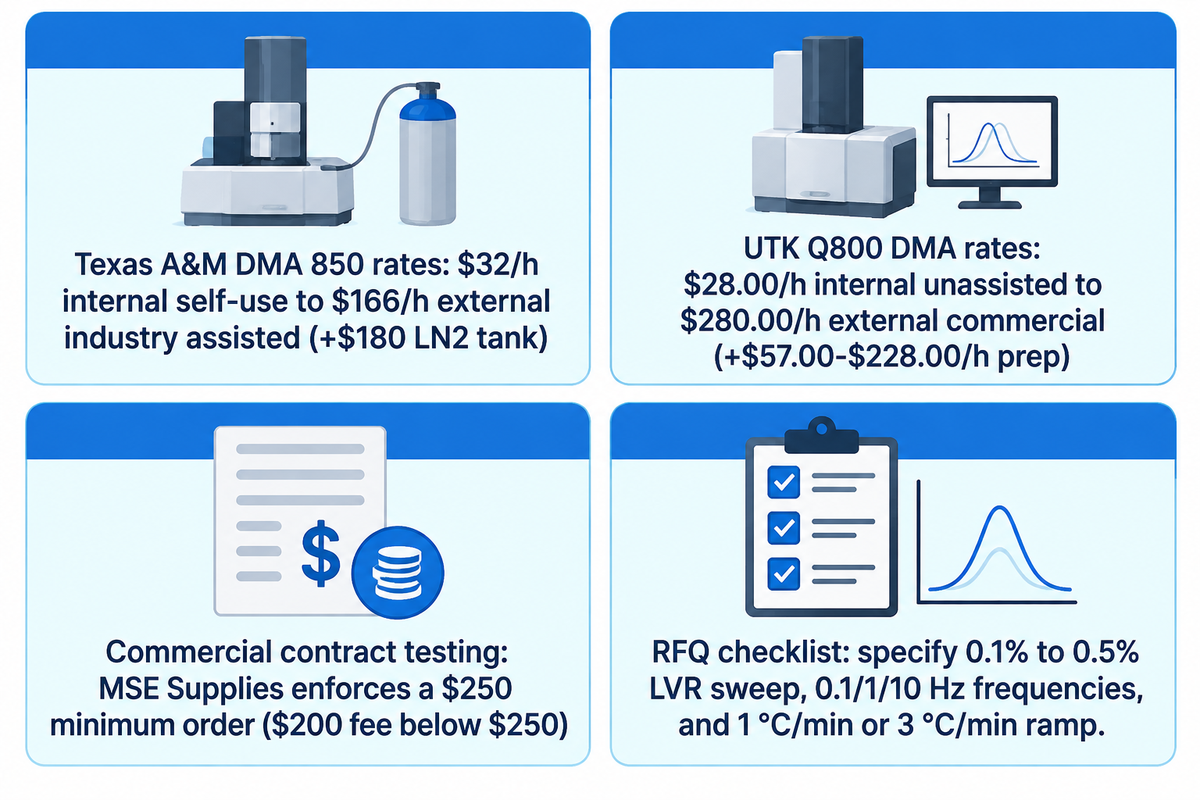
Laboratories rarely publish a universal flat price per DMA specimen because total per-sample cost depends on sweep duration, temperature range, and conditioning steps. Published university shared-facility DMA schedules instead bill per instrument hour, spanning $28.00 to $50/h unassisted up to $166 to $280.00/h for external commercial assisted runs. Commercial contract laboratories quote per test scope under per-order minimums such as $250 per order, so per-sample cost requires summing sweep hours, sample prep, and liquid nitrogen.
University fee schedules break down every surcharge. At the Texas A&M Soft Matter Facility, TA Instruments DMA 850 usage bills at $32/h internal self-use, $87/h assisted, and $72/h training. External academic users pay $43/h self-use ($145/h assisted, $91/h training), while external industry users pay $50/h self-use ($166/h assisted, $112/h training). Cryogenic liquid nitrogen gas adds $180 per tank upon request. At the University of Tennessee Polymer Characterization Lab, TA Q800 DMA rates run $28.00/h unassisted ($50.00/h assisted) for internal academics and $43.00/h ($108.00/h assisted) for external academics. Commercial Q800 rates run $112.00/h ($224.00/h assisted) on campus and $140.00/h unassisted ($280.00/h assisted) for external markets. Sample preparation bills separately from $57.00/h to $228.00/h across those four tiers. For commercial contract testing, MSE Supplies lists a $250 minimum order per submission and adds a $200 handling fee below $250.
| Facility / Provider Tier | Analyzer Platform | Billing Unit & Published Rate Schedule | Separate Surcharges & Order Rules |
|---|---|---|---|
| Texas A&M Soft Matter Facility | TA Instruments DMA 850 | Internal: $32/h self, $87/h assisted ($72/h training) External Industry: $50/h self, $166/h assisted ($112/h training) |
Liquid nitrogen cooling billed at $180 per tank upon request |
| University of Tennessee Polymer Characterization Lab | TA Instruments Q800 | Internal Academic: $28.00/h unassisted, $50.00/h assisted External Commercial: $140.00/h unassisted, $280.00/h assisted |
Sample preparation and lab manager assistance billed at $57.00/h to $228.00/h |
| MSE Supplies Commercial Analytical Service | Contract DMA Service | Quoted per sample and temperature-frequency sweep scope | $250 minimum order requirement; $200 handling fee applied below $250 |
Laboratory DMA Test Request Checklist
- Corresponding Methods: ASTM D5026 provides thin-plastic tensile DMA, ASTM D4065 provides general procedures of plastic DMA, and ASTM D5992 provides vibratory testing of elastomers.
- An isothermal strain-amplitude sweep will help identify the linear viscoelastic strain limit (typically 0.1% to 0.5% strain). This test should always be performed prior to temperature ramp tests.
- Specify discrete oscillation frequencies in Hz (such as 0.1, 1, and 10 Hz) instead of accepting one default 1 Hz curve.
- To avoid thermal lag in thick specimens, lock down start and end temperatures and the heating rate (e.g. 1 °C/min or 3 °C/min).
- Explain static preload and auto-tension to eliminate hot melt film buckling upon unloading and film creep during softening.
- Explain how many initial Mullins conditioning cycles are ignored before stable ΔW on large-strain hysteresis loops is integrated.
- Request raw CSV exports of E’ (MPa), E” (MPa), tan δ, phase angle δ (°), static force (N), strain (%), temperature (°C), and humidity ( % RH).
DMA Dissipation Analyzers and Viscoelastic Polymer Film Suppliers
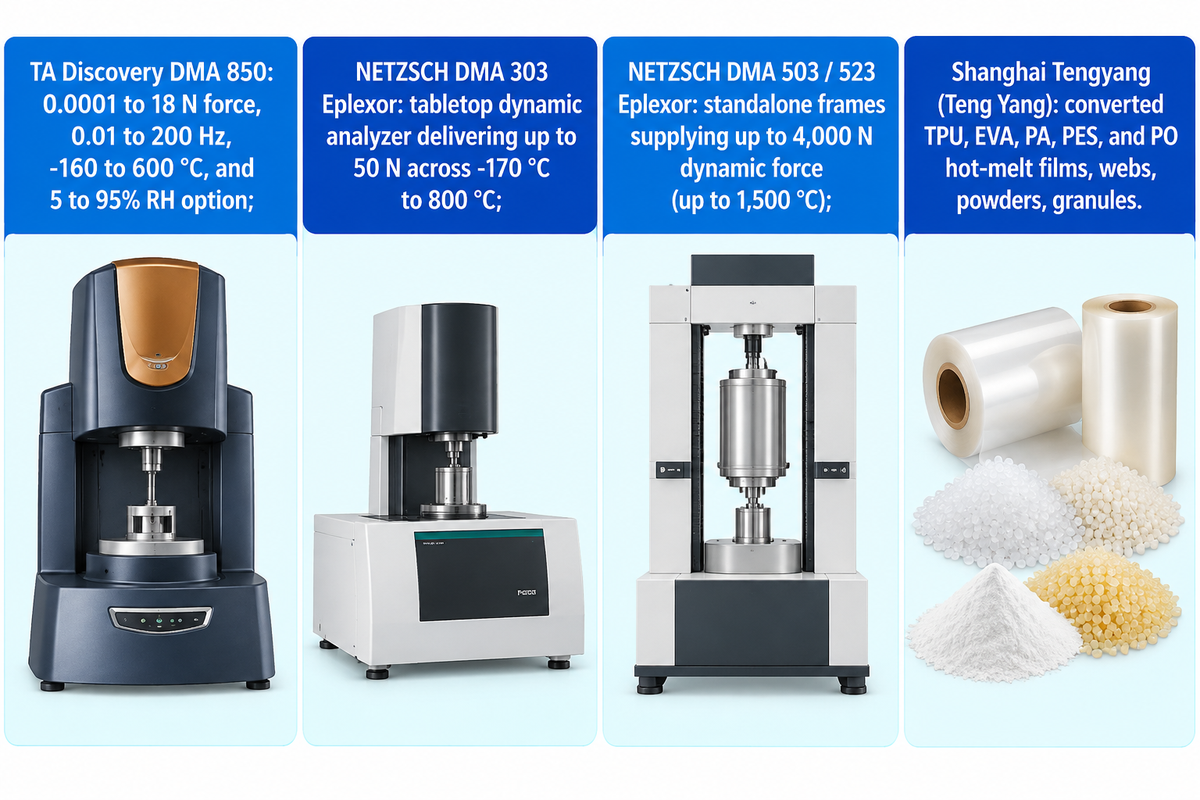
Differences in hardware qualification distinguish low-force benchtop thin-film DMA analyzers (up to 18 to 50 N) from high-force, standalone, dynamic testers (up to 4,000 N). Additionally, differences in supplier sourcing distinguish base elastomer resin producers from converted hot-melt adhesive film producers.
For thin adhesive films, fibers, and hydrogels, the TA Instruments Discovery DMA 850 specification provides a 0.0001 to 18 N force range and a 0.01 to 200 Hz frequency span. Its standard furnace covers −160 to 600 °C, with an optional 5 to 95% RH humidity chamber. For higher benchtop loads, NETZSCH specifications show the tabletop DMA 303 Eplexor delivers up to 50 N across −170 °C to 800 °C. Standalone NETZSCH DMA 503 and 523 Eplexor frames supply up to 4,000 N dynamic force (and up to 1,500 °C in high-temperature furnaces) for thick mounts.
| Equipment or Supply Category | Verified Platform or Manufacturer | Published Capability / Product Scope | Primary Engineering Application |
|---|---|---|---|
| Low-Force Benchtop Film DMA | TA Instruments Discovery DMA 850 | 0.0001 to 18 N force; 0.01 to 200 Hz; −160 to 600 °C; 5 to 95% RH option | ASTM D5026 tensile sweeps on thin TPU, EVA, PA, PES, and PO bonding films |
| Tabletop 50 N Dynamic Analyzer | NETZSCH DMA 303 Eplexor | Precise static and dynamic forces up to 50 N; −170 °C to 800 °C furnace | Semi-rigid plastics, cured structural adhesives, and medium-stiffness laminates |
| High-Force Standalone Dynamic Testers | NETZSCH DMA 503 / 523 Eplexor | Dynamic force up to 4,000 N; high-temperature furnace option up to 1,500 °C | Full-scale filled elastomer mounts, vibration isolators, and thick composite parts |
| Converted Hot-Melt Adhesive Film Manufacturer | Shanghai Tengyang New Materials Technology Co., Ltd. (Teng Yang) | Converted TPU, EVA, PA, PES, and PO hot-melt adhesive films, webs, powders, and granules | Roll-to-roll thermal bonding of automotive interiors, textiles, electronics, and composites |
Industry Outlook: Broadband Damping Networks and Multi-Frequency Characterization
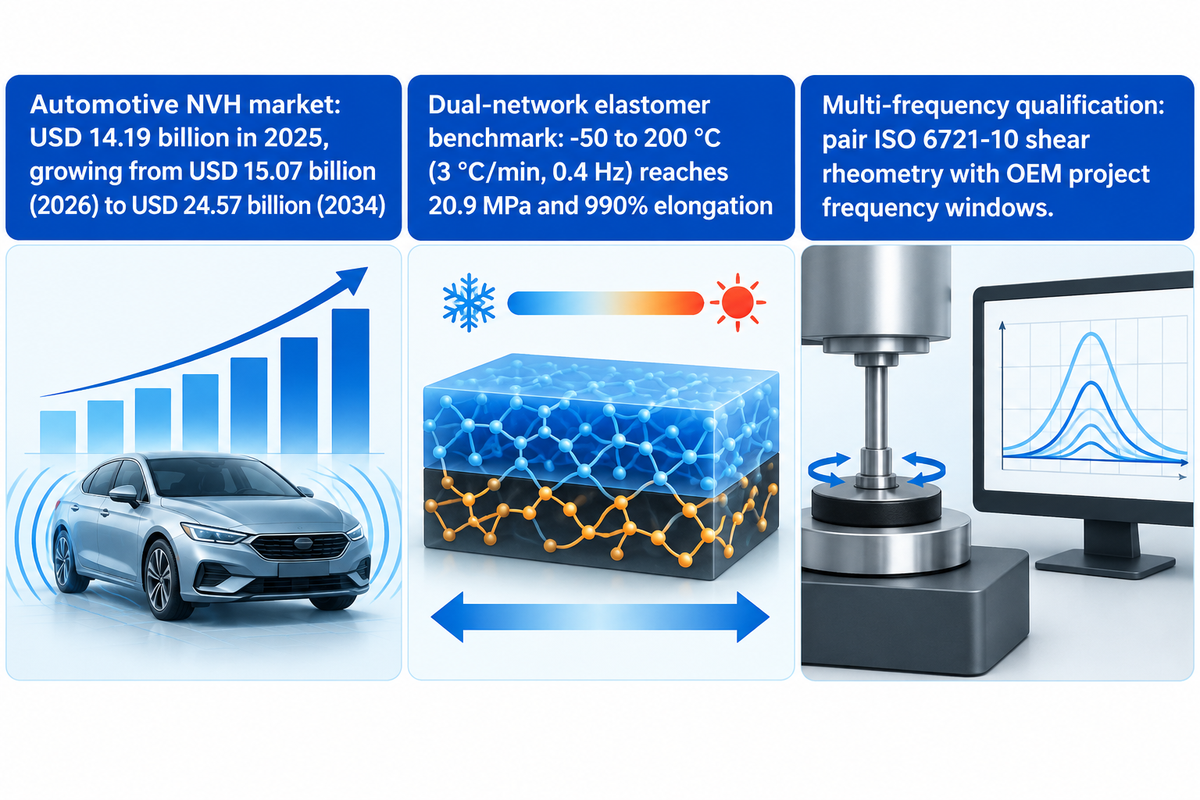
Electric vehicle acoustic designs and compact electronics are driving damping specifications toward dual-network elastomers that sustain broad temperature-frequency vibration loss. Quiet electric powertrains expose high-frequency gear whine and panel vibrations across sub-zero winters and warm battery enclosures. Fortune Business Insights values the global automotive NVH materials market at USD 14.19 billion in 2025. That market is projected to grow from USD 15.07 billion in 2026 to USD 24.57 billion by 2034 (6.4% CAGR).
Peak count, peak width, and loss in the rubbery region vary with polymer formulation and phase morphology, and are sensitive to temperature and frequency of oscillation. Interpenetrating and hybrid networks broaden the active temperature span where tan δ exceeds 0.3. Thermal-UV cured thiol-ene/polyurethane dual networks scanned from −50 to 200 °C (3 °C/min, 0.4 Hz) reached 20.9 MPa tensile strength and 990% elongation across a wide tan δ > 0.3 window. ISO 6721-10 addresses oscillatory complex-shear testing of plastics, whereas individual OEM qualification programs define project-specific frequency windows and hysteresis reporting.
Frequently Asked Questions
What does the word dissipation mean in physics compared with everyday English?
In physics, thermodynamic dissipation refers to the irreversible conversion of ordered mechanical, electrical, or acoustic work to random internal thermal motion. William Thomson formalized this type of entropy-producing energy conversion in 1852. In everyday speech, English instead uses the term broadly to refer to scattering, waste, or gradual dispersal, without keeping track of strict energy conservation across closed physical boundaries or viscoelastic polymer load cycles.
How do you measure the dissipation factor of a capacitor versus a polymer film?
Capacitor dielectric testing includes applying an alternating voltage across specimen electrodes and calculating the dielectric loss tangent (ε”/ε’) under defined test conditions (ASTM D150). Polymer mechanical testing involves oscillating a solid strip or film on a dynamic mechanical analyzer under conditions such as ASTM D4065-20. The instrument divides loss modulus by storage modulus to provide a dimensionless mechanical tan δ.
What is the difference between conservative elastic forces and dissipative viscous forces?
Conservative elastic forces rely on the instantaneous level of deformation and return mechanical work upon unloading at a 0° phase angle. Viscous forces rely on the rate of deformation and lag behind the applied strain at a phase angle of approximately 90°. With each loading cycle of a polymer, viscous effects in the material dissipate mechanical energy and convert it to heat.
What does static dissipative mean on polymer packaging films?
In electronics packaging, static dissipative materials protect against ESD by shedding a surface charge. Packaging materials with this ESD protection feature don’t provide mechanical damping.
Why is controlled energy dissipation necessary in automotive clutches, brakes, and NVH mounts?
Brakes and clutches transform vehicle kinetic energy into friction heat. To prevent lining fade and resin charring, heat must conduct and convect rapidly. Automotive Noise, Vibration, Harshness (NVH) management relies on bulk viscoelastic hysteresis of polyurethane and rubber (including constrained-layer treatment) at or near 1 kHz. Engineers balance loss modulus against conductive cooling so mounts damp structural resonance without overheating.
How do you pronounce dissipation in technical English, and what are its main synonyms?
The noun is pronounced dis-ih-PAY-shuhn. In polymer testing reports, engineers define hysteresis, internal friction, and the loss factor, dependent on the standard being employed.
How does bulk viscoelastic energy loss differ from creep and stress relaxation in adhesive bonds?
Cyclic viscoelastic energy loss is the irreversible work converted to heat per oscillation cycle (ΔW, in J/m3), measured as the area inside a stabilized stress-strain hysteresis loop. Creep measures strain drift under a static stress over hours or days. Stress relaxation pertains to the decay of the force while strain stays fixed. Static creep curves cannot substitute for oscillatory dynamic mechanical curves when qualifying vibrating bonded joints. Polymer physics pertains to heat and time as well as mechanical load.
References & Sources
- ASTM International. ASTM D4065-20: Standard Practice for Plastics: Dynamic Mechanical Properties: Determination and Report of Procedures. West Conshohocken, PA.
- ASTM International. ASTM D5026: Standard Test Method for Plastics: Dynamic Mechanical Properties: In Tension. West Conshohocken, PA.
- ASTM International. ASTM D5992-96(2024): Standard Guide for Dynamic Testing of Vulcanized Rubber and Rubber-Like Materials Using Vibratory Methods. West Conshohocken, PA.
- International Organization for Standardization. (2025). ISO 6721-10:2025 Plastics: Determination of Dynamic Mechanical Properties, Part 10: Complex Shear Viscosity Using a Parallel-Plate or a Cone-and-Plate Oscillatory Rheometer.
- Lakes, R. S. Viscoelasticity and High-Damping Materials. University of Wisconsin-Madison Viscoelasticity Laboratory.
- National Center for Biotechnology Information (PMC). Viscoelastic and Adhesive Balancing of UV-Crosslinked Acrylic Pressure-Sensitive Adhesives.
- National Center for Biotechnology Information (PMC). Thermoplastic Polyurethane Modification in Bio-Based Reactive Polyurethane Hot-Melt Adhesives.
- National Center for Biotechnology Information (PMC). Dual-Network Thiol-Ene/Polyurethane Elastomers for Broadband Damping Performance.
- European Patent Office / Google Patents. EP3080182A1: Thermoplastic Polyurethane Compositions Having Low Tan Delta and High Elastic Snap-Back.
- Texas A&M University Soft Matter Facility (SoMF). Published Instrument Usage Fee Schedule (DMA 850 & Cryogenic LN2).
- Texas A&M University Soft Matter Facility (SoMF). TA Instruments Discovery DMA 850 Technical Specifications.
- University of Tennessee Institute for Advanced Materials & Manufacturing. Polymer Characterization Lab TA Q800 DMA Rate Table.
- Wikipedia Contributors. Dissipation (Thermodynamics and Irreversible Processes, citing W. Thomson 1852)
ABOUT TENGYANG
Industrial hot melt adhesive materials for bonding routes
Shanghai Tengyang New Materials Technology Co., Ltd. supports material discussions for production teams working with bonded products.
Available forms: hot melt adhesive film, web, powder and granules. Material families: TPU, EVA, PA, PES and PO.
CONTACT PROFILE
Betty Fang
Contact for material inquiries.