Get in touch with Tengyang Company

Surface Energy for Adhesive Bonding: A Practical Qualification Guide

Practical guide for process, quality, and sourcing teams
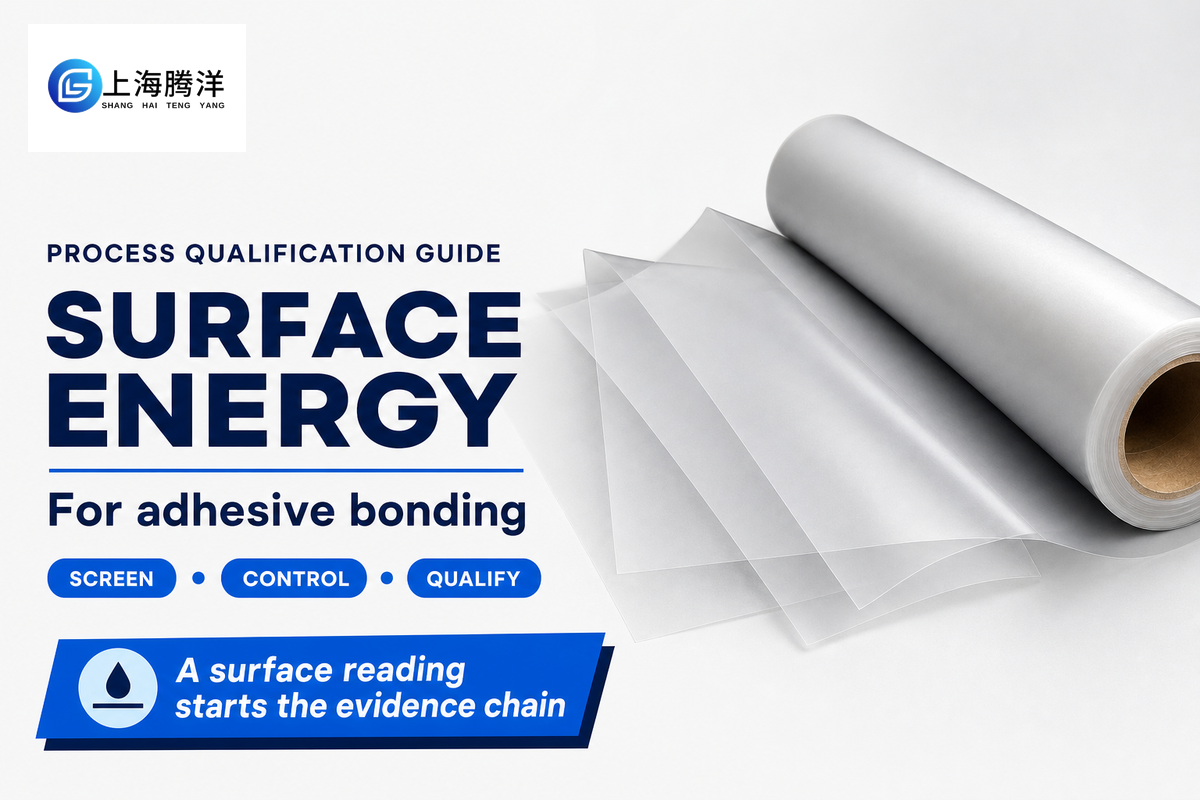
Surface energy for adhesive bonding is a way to screen how readily an adhesive may wet a substrate; it doesn’t prove an adhesive will form a strong, long lasting bond. Surface energy is commonly expressed as energy per area: the work associated with creating a new surface under specified conditions. As such, the surface energy of a material can only be a part of the specification process, and further surface analysis and controlled testing will help provide a complete assessment.
What Does Surface Energy Tell You About Adhesive Bonding?
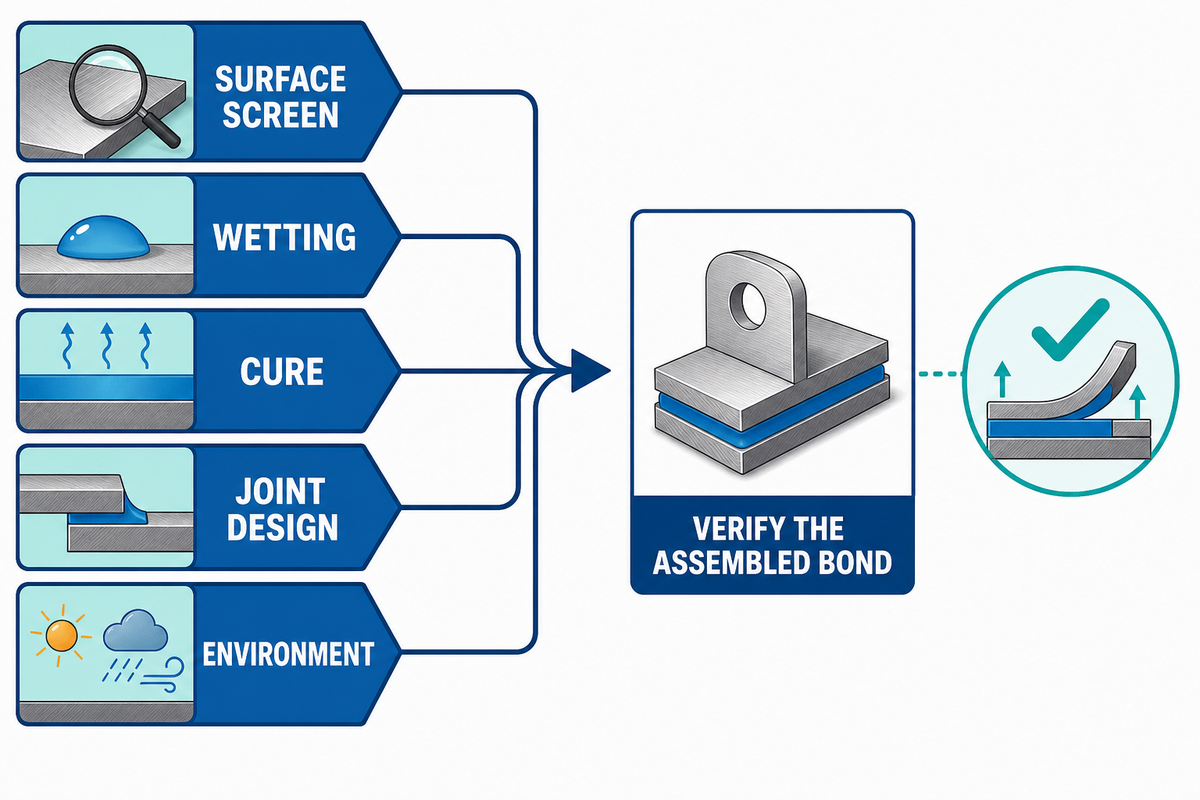
Short answer: surface energy has value in describing wetting behavior. If a liquid adhesive beads up then such a liquid is unlikely to result in intimate contact. Spreading of the liquid adhesive indicates passing of one of the many necessary conditions. Contamination, weak boundary layers, the chemistry of the adhesive, cure, joint design, and environmental exposure can still lead to failure of the bond.
Tengyang’s surface energy guide provides a lot of background information for understanding surface energy and adhesion science, and provides guidance on adhesion and contact angles. This document builds upon that with pragmatic industrial considerations and the above cited evidence, without guaranteeing a successful outcome from a single reading.
That distinction is consistent with ISO 8296:2003. The standard covers wetting tension for plastic film and sheeting, yet its scope warns that the result is not a completely acceptable measure of adhesion. In other words, a surface test can help screen a process; the bonded assembly still needs its own evidence.
Surface energy and adhesion: keep the thermodynamic and mechanical questions separate
At the surface of a material, the intermolecular environment differs from the bulk; the resulting excess energy explains why creating more surface requires work. In an ideal reversible description, surface free energy is the energy required to increase surface area per unit area under specified conditions. That thermodynamic description is not the mechanical energy measured when a real bonded specimen peels or fractures.
Measuring surface energy: three outputs that are not interchangeable
In industry, “surface energy” is a blanket term, but shop-floor and lab testing methods often measure different operable quantities:
- Wetting tension from test liquids or dyne pens is a practical threshold observation under stated test conditions. It is fast, but liquid condition, operator technique, dwell time, and the substrate’s chemical response matter.
- Contact angle describes the geometry of a selected probe-liquid droplet in contact with a surface. Advancing and receding angles can differ, and one liquid doesn’t describe an entire surface.
- The calculated surface free energy is based on contact-angle data and a selected model and probe liquid set. The values obtained from various models or liquid sets are not automatically comparable. For a surface energy measurement on a solid surface, record how the selected model handles the polar component and dispersive component; a test ink observation instead screens wetting tension.
ASTM D7334, within the scope of the associated standard method, makes the same point: contact-angle measurements will not give a value of surface tension for a solid. Record the method with the result. A number lacking its liquid, procedure, time, and model cannot be used as an acceptance criterion.
Map the Actual Substrate Before Testing It
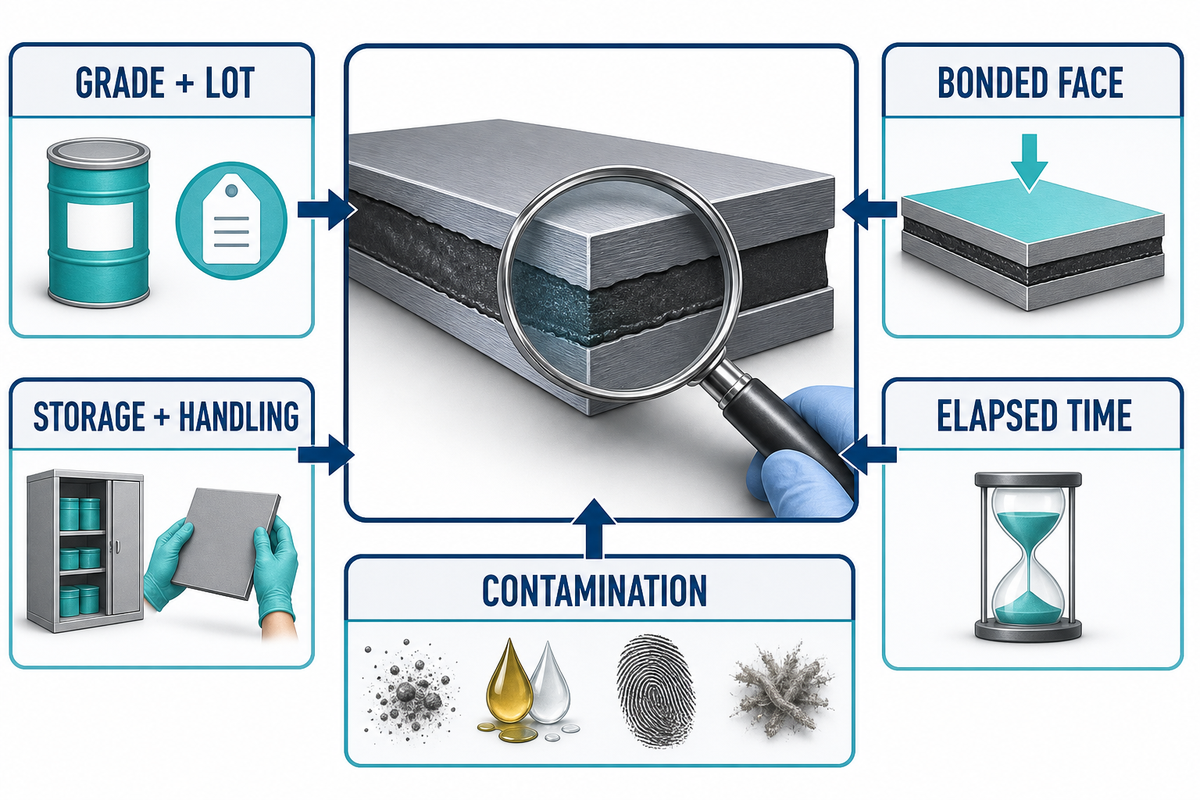
Published material summaries describe nominal families of common materials. Your production surface can also contain slip additives, mold release, oxidation, printing primers, oils, dust, or recycled materials. The “same” polymer grade can arrive at your location with a different history. Therefore, the first qualification step is to identify the material to be bonded rather than immediately measure it.
Compare different materials before selecting the first adhesive
Use material families to choose trials, not acceptance limits. Metals and glass are common high surface energy materials, while many engineering plastics sit in a medium surface energy group and polypropylene and polyethylene are low surface energy materials. Even surfaces with high surface energies can carry contamination; plastics with low surface energies may need a matched adhesive or preparation route. A joint between two materials needs a record of both bonded faces, because the two surfaces can have different histories.
Build a substrate record that answers:
- What’s the exact grade, construction, finish, and supplier lot?
- Which face will be bonded, and is that face coated, treated, or laminated?
- How was the material stored, cleaned, handled, and conditioned?
- How much time passed between manufacturing, treating, testing, and bonding?
- What visible or chemical contamination can exist in the work area?
2024 research on one polyamide grade shows the importance of this subject. In the reported studies, surface energy/contact angle measurements weren’t able to reliably differentiate dry or moisture-conditioned specimens, but their bonded performances showed significant differences. This isn’t a universal conversion factor; it demonstrates that a nominal material identity and favorable surface can mask a critical bonding factor.
Hidden material condition creates a release risk. When you receive the construction, qualify it against the written acceptance criteria and name any ASTM or ISO method used. Lot, face, storage, and conditioning should accompany the result because of traceability.
Release rule: do not approve an incoming lot from a handbook value. Use the table to form a hypothesis, then verify the surface and the assembled bond under your controlled conditions.
Choose a Surface Test for the Decision You Need to Make
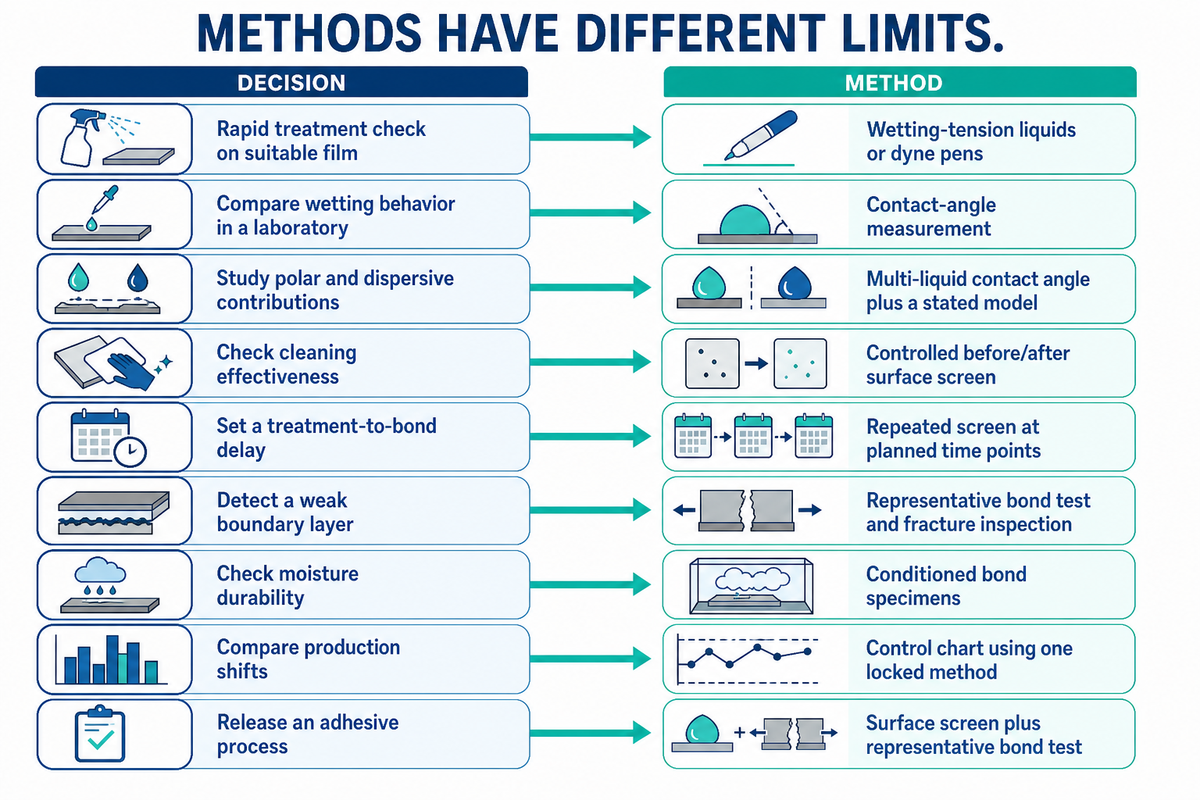
The best test isn’t the one that produces the most precise-looking number. It’s the one whose scope, repeatability, and speed match the process decision.
Record substrate surface energy with the measurement conditions
When surface energy is measured indirectly from contact angles, test the actual surface of a solid rather than inferring its condition from a resin name. Contact-angle analysis is a common method, but a lower contact angle indicates better wetting only for the stated liquid and comparable test conditions. Record the material’s surface energy with its model and units, such as millijoules per square metre or dynes per centimetre, and keep the droplet image with the result.
| Decision | Useful method | What to record | Main limitation |
|---|---|---|---|
| Rapid treatment check on suitable film | Wetting-tension liquids or dyne pens | Method, liquid level, lot/expiry, operator, time after treatment | Threshold observation; operator and surface chemistry can affect it |
| Compare wetting behavior in a laboratory | Contact-angle measurement | Probe liquid, drop protocol, advancing/receding/static mode, temperature | One angle is not a universal material constant |
| Study polar and dispersive contributions | Multi-liquid contact angle plus a stated model | Liquids, model, fitting procedure, uncertainty | Model- and liquid-dependent; cross-method values can differ |
| Check cleaning effectiveness | Controlled before/after surface screen | Contaminant, cleaner, drying, timing, baseline | Shows a process change, not the chemistry of every residue |
| Set a treatment-to-bond delay | Repeated screen at planned time points | Storage, packaging, temperature, humidity, elapsed time | Must be correlated with bond results |
| Detect a weak boundary layer | Representative bond test and fracture inspection | Preparation, cure, load data, photos, failure location | A wetting result alone cannot locate the fracture path |
| Check moisture durability | Conditioned bond specimens | Exposure, duration, temperature, post-aging test | Initial wetting cannot predict every service exposure |
| Compare production shifts | Control chart using one locked method | Instrument or liquid, operator, timing, lot, reaction limits | Mixed methods cannot share one trend line |
| Release an adhesive process | Surface screen plus representative bond test | All surface data and the complete assembly/test record | Requires more time, but answers the actual performance question |
ASTM D2578-23 is specifically framed for polyethylene and polypropylene films. If you use a similar procedure on another substrate, treat it as an internally validated method, not as automatic compliance with the standard’s stated scope.
Define the window from your own bond evidence
Build a practical control window from repeated results across normal process variation. Include multiple lots, operators or shifts where relevant, the expected treatment-to-bond delay, and realistic conditioning. Compare the surface signal with the response that matters: peel, shear, cleavage, environmental aging, or another fit-for-purpose test.
There’s no single “adhesive must be a fixed number above the substrate” rule. Adhesive rheology, open time, pressure, cure, bond-line thickness, joint geometry, and the service environment all affect the result. Application-specific limits need support from qualification testing.
A lower surface energy can be a screening issue, not a diagnosis. An adequate surface treatment can increase the wetting range. Only qualification can confirm that the production assembly satisfies the criteria for acceptance.
Match wettability for adhesive bonding to the adhesive formulation
Pressure-sensitive adhesives (PSAs) and reactive structural adhesives offer different routes for LSE plastics; some acrylic adhesives are formulated for low-energy substrates. For plastics such as polypropylene, compare a suitable adhesive formulation with the proposed preparation route instead of assuming plasma is mandatory. Plastics such as polyethylene and PTFE also need material-specific trials. An adhesive may form bonds on one polymer and fail on another; with medium and low surface energy substrates, evidence of a better adhesive bond still means a strong bond after relevant conditioning.
Method ambiguity is a process risk since it allows dissimilar results to appear comparable. A qualified control plan must stipulate the ASTM or ISO standard, the specific method, the acceptance criteria, and supporting bond data.
Control Surface Preparation, Treatment Dose, and Time
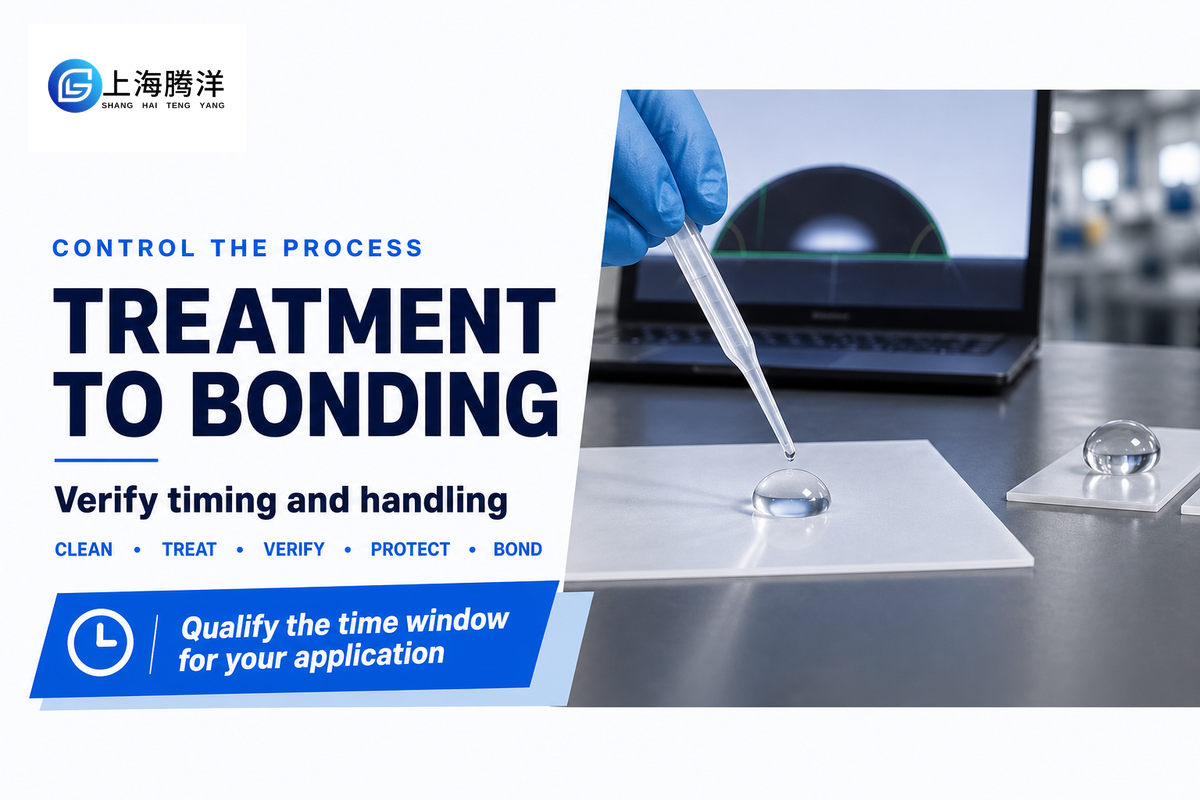
Surface preparation methods should distinguish cleaning from treatment. Cleaning involves the removal of undesired material. Surface modifications, e.g. corona, plasma, flame, abrasion, chemical etching, or the use of primers, are performed in several different ways. Specifying a sequence is important, and “surface treated” isn’t sufficiently precise to define a repeatable process.
- Remove the right contaminant. Select a cleaning method appropriate to the substrate and the adhesive. A cleaning solvent that only translocates the contamination shouldn’t be considered a controlled process.
- Apply a defined surface treatment. Capture the process settings (equipment, line speed/dwell, gap, electrode or nozzle conditions, and the treated surface).
- Verify at a defined time. Surface activation can change with aging after treatment. Implement a maximum allowed time from surface treatment to testing and from surface treatment to bonding based on empirical data.
- Surface protection should be provided. Control should include use of gloves, interleafing, packaging, and control of dust and humidity as well as contact with rollers or fixtures.
- Bonding and curing should be done within the validated time. Protection of the surface is only a part of a process.
A 2023 review of plasma-treated polyethylene reports hydrophobic recovery and shows that temperature and storage conditions can affect aging. This supports time-window control, but it does not justify copying one published decay rate to every polymer or plasma system.
The duration of control is important because an aging surface can drift outside the qualified state. The maximum interval, along with its acceptance criteria, should be in the work instruction. The surface treatment method referenced in ASTM or ISO should be given separately from the performance of the bond.
Why “more treatment” is not automatically safer when increasing surface energy
Some plasma systems can be over-treated. A favorable contact angle can occur alongside low-molecular-weight residues or another weak boundary layer. In that case, the interface can delaminate in the treated surface rather than in the sound bulk. Use a treatment-response study that includes bond performance; do not tune the process only for the lowest angle or highest dyne observation.
Higher wettability is not moisture-aged durability
Polar, high-energy surfaces can interact strongly with water. Water can affect both the adhesive and its interface, so a surface that wets well on day one can still lose fracture resistance in wet service. If humidity, immersion, condensation, or cleaning fluids are credible service exposures, include conditioned specimens and post-aging failure analysis in qualification.
Qualify the Assembled Bond, Not Just the Surface
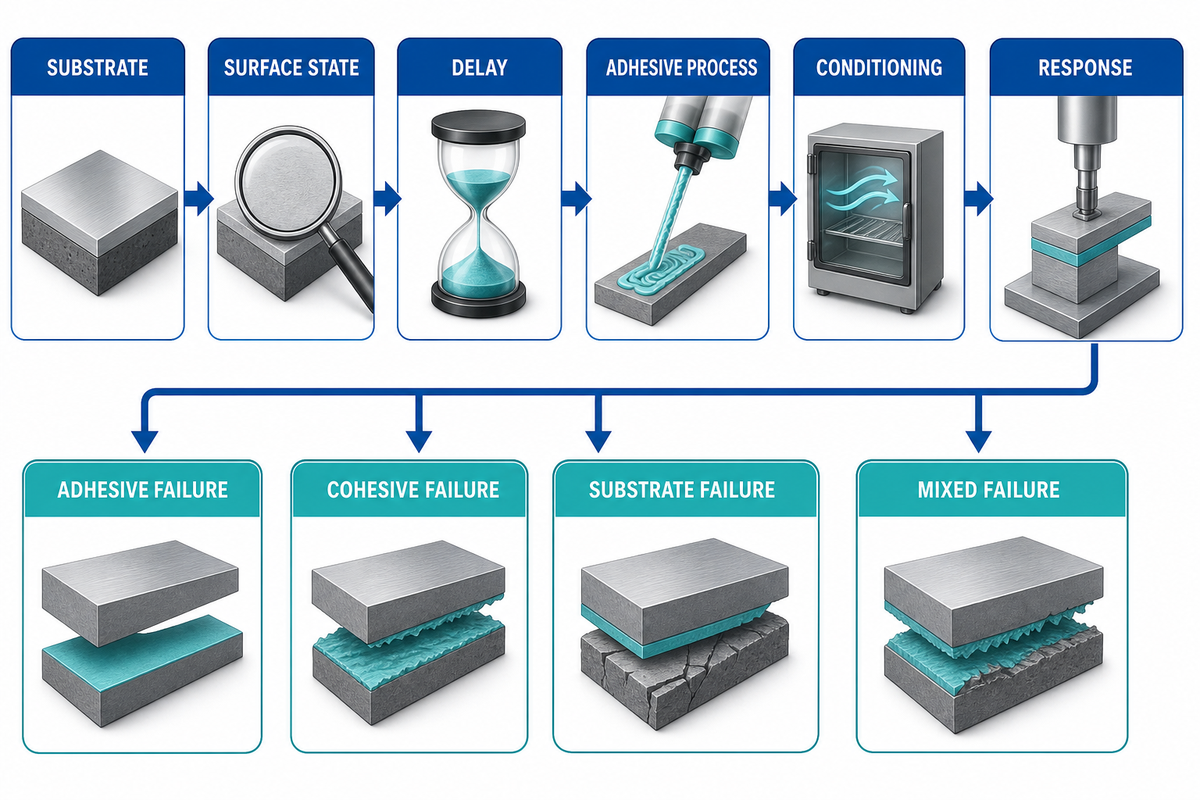
Representative adhesive trials connect the screening measurement to the product decision. The experiment should be simple enough to perform, but should also contain enough detail to allow interactions to be identified.
A useful trial matrix
- Substrate: at least the expected grades and finished surfaces and reasonable lot variations.
- Surface state: as received, cleaned surfaces, and all processing levels.
- Delay: the shortest and longest credible treatment-to-bond interval.
- Adhesive process: application, open time, pressure, bond-line control, and cure.
- Conditioning: baseline temperature, humidity, exposure to water, chemical exposure, and aging.
- Response: strength or peel value, variability, and failure location.
The 2025 review of adhesive-bond reliability treats surface preparation, adhesive cure, aging, and adhesive/cohesive/substrate failure as distinct variables. This is why a peak number alone is incomplete. Two specimens can report similar loads and fail in different places, and those failure sites can indicate different process failures.
Qualification reduces this risk because it links an ISO, ASTM, or internal test method to predeclared acceptance criteria. Keep the raw results beside the final pass/fail decision so later investigations can see the distribution. Record surface cleanliness and surface contamination before testing, then relate the surface energy of the substrate to bond failure observations from a peel test or another specified bond test.
Read the fracture surface
- Interfacial or adhesive failure leaves the adhesive mainly on one side and suggests either poor wetting, contamination, weak boundary layers, or interfacial chemistry.
- Cohesive failure occurs in the adhesive. It can indicate good interfacial bonding, but adhesive thickness and service conditions also affect the result.
- Substrate failure means the substrate broke or tore first. This can be desirable in some designs, but it is not a complete durability result by itself.
- Mixed failure should be noted and not forced into a single failure mode. Photographs and estimated area fractions support later comparisons.
Prior to evaluating a result, set acceptance criteria. Describe the statistic, the minimum sample count, the conditioning or treatments involved, the valid failure modes, and the retest policy. Otherwise, a team can unconsciously move the goalposts after seeing a favorable average.
The Surface Readiness Release Ladder
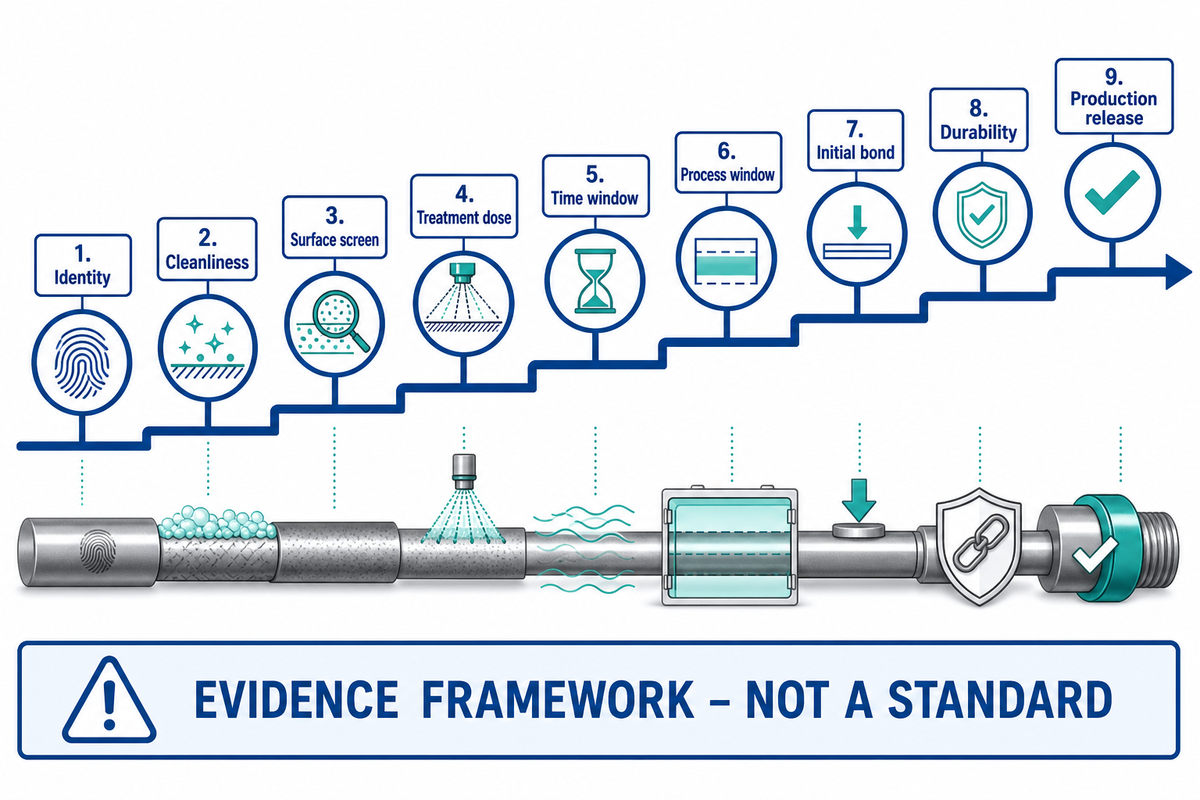
The Surface Readiness Release Ladder is a practical way to organize evidence. The Surface Readiness Release Ladder is useful for evidence organization, but it is not an industry standard, certification, or substitute for an application-specific test plan.
| Evidence category | Question answered | Minimum evidence | Release meaning |
|---|---|---|---|
| 1. Identity | Are we testing the intended surface? | Grade, face, finish, lot, storage, contamination review | Material is traceable; no bonding approval yet |
| 2. Cleanliness | Is removable contamination controlled? | Defined cleaning materials, sequence, drying, and handling | Surface is ready for treatment or direct bonding trials |
| 3. Surface screen | Can the adhesive plausibly wet this surface? | Defined method, controlled timing, repeatable result | Surface is eligible for trials |
| 4. Treatment dose | Is the selected treatment inside a useful range? | Equipment settings plus a treatment-response bond study | Under-treatment and over-treatment limits are bounded |
| 5. Time window | Does readiness survive the expected delay? | Verification across the shortest and longest production delays | Treatment-to-bond interval can be controlled |
| 6. Process window | Is preparation reproducible? | Treatment settings, delay limits, handling controls | Preparation recipe can be controlled |
| 7. Initial bond | Does the assembled joint meet baseline requirements? | Representative specimens, cure, strength, variability, and failure mode | Assembly is eligible for durability testing |
| 8. Durability | Does the joint survive relevant exposure? | Conditioned specimens and post-aging failure analysis | Application-specific process is qualified |
| 9. Production release | Is the current run inside the qualified window? | Traceable records and defined reaction plan | Lot or run is released under the approved plan |
The ladder avoids a common category error: promoting a surface reading directly into production release. If a surface screen passes but the bond trial fails, investigate the whole chain rather than arguing with the surface number.
Every promotion requires supporting evidence. Jumping a level transfers hidden risk to the next step. A qualified record should state ASTM or ISO method and the acceptance criteria.
What belongs in a qualification and release record?
Record the substrate grade and lot, bonded face, storage and conditioning, cleaning materials, treatment equipment and settings, verification method, probe liquid or calculation model, timestamps, adhesive lot, application amount, open time, pressure, cure, specimen geometry, test method, environment, individual results, variability, and failure location. Add photographs where fracture interpretation matters.
Production records can be brief compared to qualification reports, but should note the variables required for demonstrating that the run was within the validated window. Additionally, they should document the action that’s taken when a check fails. Treating surfaces repeatedly, without a defined limit, can mask a deteriorating process and can damage the surface.
Questions to Ask an Adhesive or Film Supplier
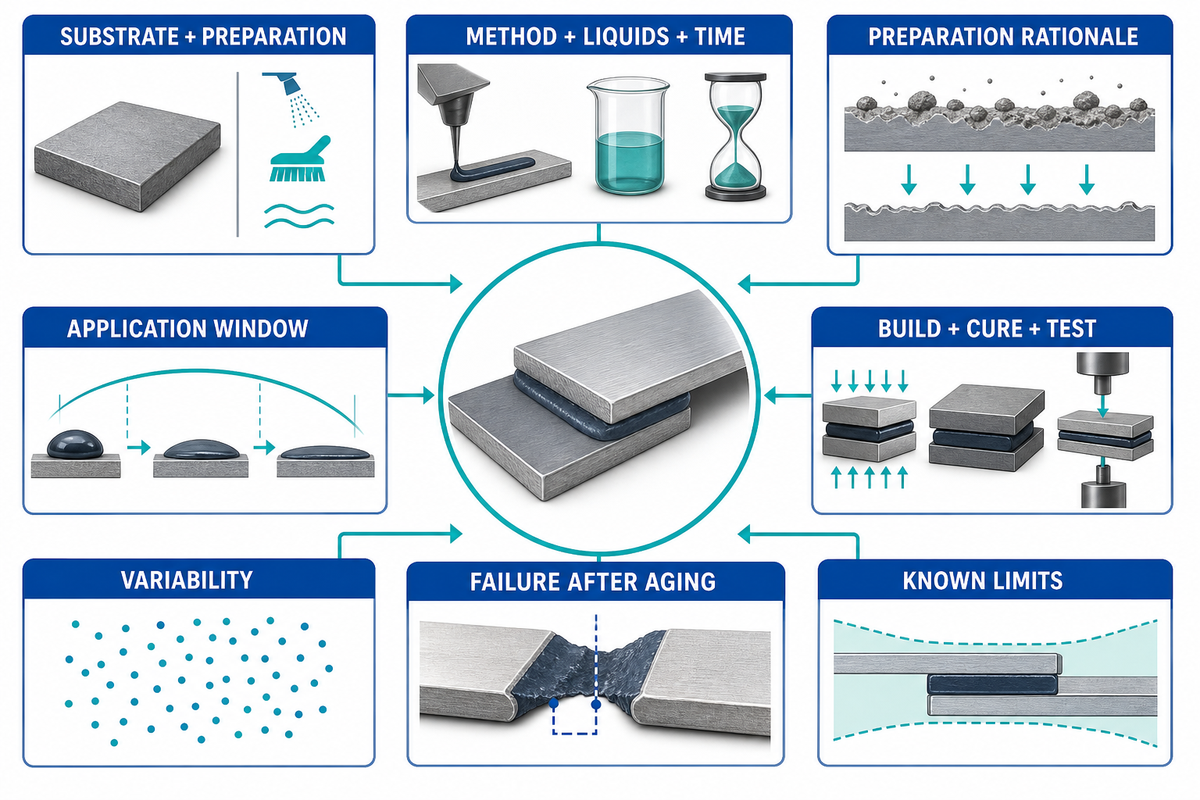
Supplier data is the most useful in a testing context where the test conditions are clear. The following data is required:
- the grade and surface preparation of the substrate underlying a specific recommendation;
- how the supplier knows the surface energy of the bonded face: the method, liquids, calculation model, and test time;
- whether preparation is required and the rationale when “no preparation” is recommended;
- the treatment-to-bond or application window and how it was measured;
- the adhesive application, pressure, and cure; the conditioning of the specimen and the speed of the test;
- individual or variability data, not only a best-case average;
- failure-mode observations before and after relevant aging;
- the presence of limits where moisture, plasticizers, recycled content, coatings, and slip additives are known.
ISO 10364:2024 notes that different methods for determining the working life of multi-component adhesives do not necessarily produce identical results. This is a useful statement beyond pot life; ask what a quoted window means and how it was measured.
There is no need to demand the same treatment in every application. ISO 17212:2012 provides guidelines for preparing metal and plastic surfaces before adhesive bonding. The defensible position is to document the chosen preparation and verify bond performance under the intended process and service conditions.
Supplier figures without qualified methods and conditioning can create procurement risk because those differences can mask a mismatch. Ask which ISO, ASTM, or internal procedure supports the acceptance criteria and request enough detail to reproduce it.
Common Qualification Mistakes
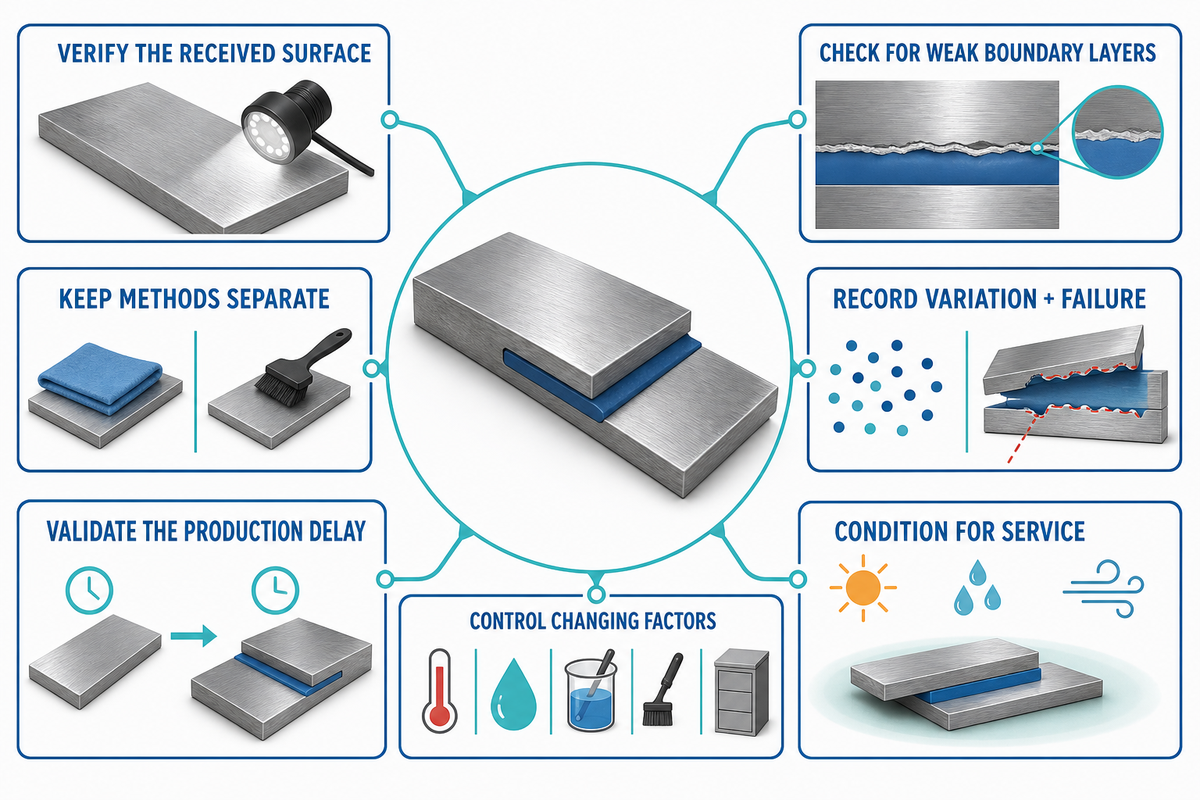
These mistakes create release risk because they separate the number from the method/cause or acceptance criteria. An ISO or ASTM reference is useful only if the stated scope and method align with the qualified application.
- Copying a handbook value into a control plan. A generic value cannot define the received surface condition.
- Mixing methods in one trend chart. Treat a dyne observation and a model-derived surface free energy value as different data types.
- Testing first and bonding later. The validation window must cover the production delay.
- Optimizing treatment to the highest reading can result in a favorable screen for adhesion, but a weak boundary layer can be present.
- Reporting only an average strength. Variation, and the location of failure, can reveal a hidden brittle process.
- Skipping conditioning for service exposure. Initial wetting doesn’t provide wet, hot, cold, chemical, or fatigue durability.
- Changing multiple factors without control. If cleaning, treatment, cure, adhesive, and geometry change, the result can’t identify the controlling factor.
Frequently Asked Questions
Is higher surface energy always better for adhesion?
For adhesive selection, compare the surface result with assembled-bond evidence that includes the actual preparation, treatment dose, production delay, cure, failure location, and relevant moisture exposure, because an initially wettable surface can still give poor durability.
No. Better wetting is helpful, but it does not establish durable adhesion. For adhesive selection, compare the surface result with assembled-bond evidence that includes the actual preparation, treatment dose, production delay, cure, failure location, and relevant moisture exposure, because an initially wettable surface can still give poor durability.
Can a dyne pen value be used as a bond-strength specification?
Use a dyne test as a production control only after correlation to bond results in normal material lots, with realistic treatment-to-bond delays and relevant conditioning.
Not solely. A dyne test is a rapid process screen only in the right circumstances. The procedure must be under control and designed for the appropriate material. For a bond strength specification, the assembled specimens must be subjected to defined conditions and tested.
Use a dyne test as a production control only after correlation to bond results in normal material lots, with realistic treatment-to-bond delays and relevant conditioning. Maintain the identity of the liquid, the procedure, the operator, the observation time, and the reaction plan with the specification.
What is the difference between contact angle and surface free energy?
Contact angle is the observed angle of a given liquid and a given protocol. The surface free energy is determined by contact angle measurements for selected probe liquids along with a mathematical model.
Contact angle is the observed angle of a given liquid and a given protocol. The surface free energy is determined by contact angle measurements for selected probe liquids along with a mathematical model. Since the result depends on those choices, a calculated value must always be accompanied by its method.
Static, advancing, and receding contact angles provide answers to different questions. Reports must identify which one was used. Cross-site comparison isn’t valid when laboratories use different liquids, temperature control, drop timing, fitting rules, or calculation models.
How soon after corona or plasma treatment should bonding occur?
There is no universal safe interval. Establish the maximum delay with the substrate, adhesive, handling conditions, and bond test, then control the production timestamp rather than copying another process’s interval.
There is no universal safe interval. Polymer, formulation, treatment dose, storage conditions, packaging, and contamination exposure can affect recovery. Establish the maximum delay with the substrate, adhesive, handling conditions, and bond test, then control the production timestamp rather than copying another process’s interval.
Does a low-energy plastic always require plasma or corona treatment?
Some adhesive systems are formulated for difficult-to-bond low-energy surfaces, and some noncritical joints can meet requirements without treatment. The correct choice varies with the substrate, load, environment, geometry, and adhesive.
No. Some adhesive systems are formulated for difficult-to-bond low-energy surfaces, and some noncritical joints can meet requirements without treatment. The correct choice varies with the substrate, load, environment, geometry, and adhesive. Evaluate all qualified process options rather than assuming every joint must undergo the same treatment.
Why can a bond fail after a surface test passes?
The test confirms only immediate wetting behavior. Cleaning, weak boundary layers, application amount, pressure, open time, cure, joint design, aging, and service exposure also affect bond performance.
The test confirms only immediate wetting behavior. Cleaning, weak boundary layers, application amount, pressure, open time, cure, joint design, aging, and service exposure also affect bond performance. Examine the fracture surface and the full process record before changing the surface limit.
What should be monitored in production?
Monitor the control variables of the qualified process: material ID, surface preparation, screen for surface treatment, bond delay, adhesive lot and application, pressure or bond line control, cure, and scheduled bond confirmation.
Monitor the control variables of the qualified process: material ID, surface preparation, screen for surface treatment, bond delay, adhesive lot and application, pressure or bond line control, cure, and scheduled bond confirmation. Employ a corrective action plan for out-of-spec results.
Turn a Surface Reading Into a Defensible Bonding Decision
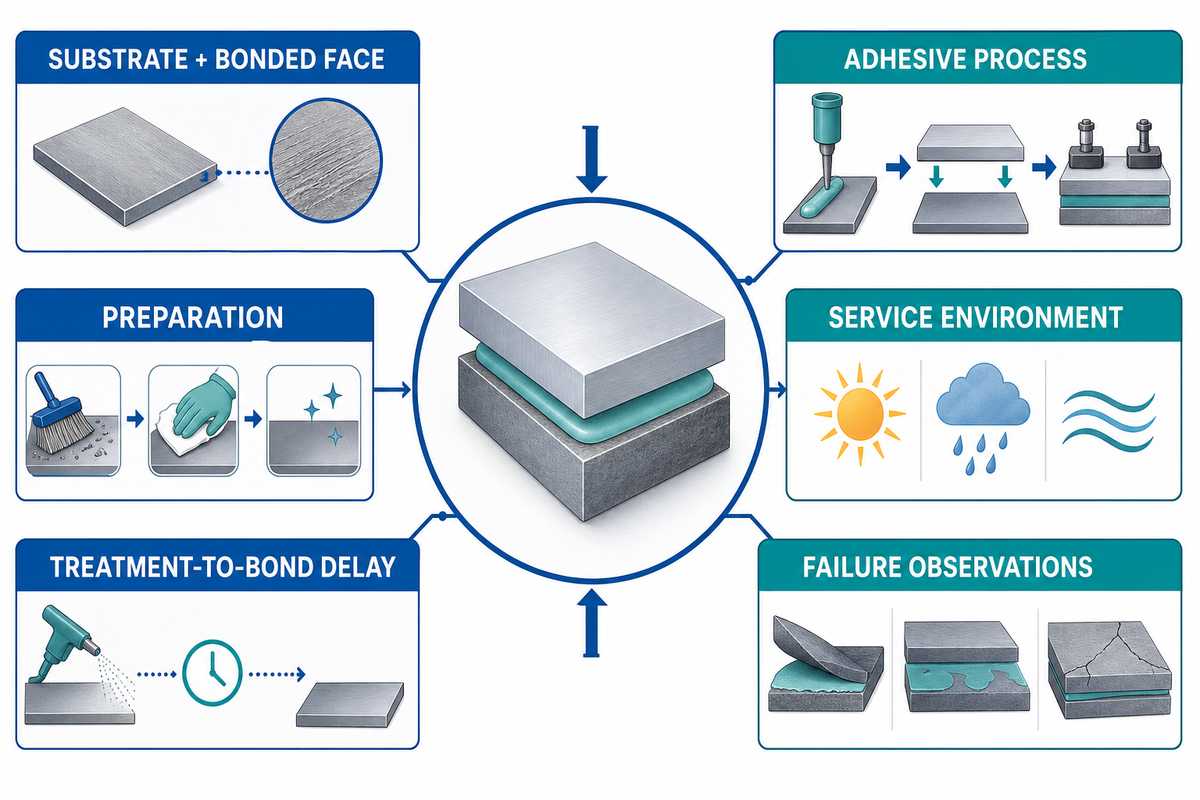
The main risk is false certainty. As surface screening addresses only part of the overall considerations, the qualified acceptance criteria must connect the selected ASTM, ISO, or in-house methodology to the evidence of the bond.
Start with the decision, not the instrument. Identify the actual substrate, choose a method with an appropriate scope, preserve timing and handling, and then test the assembled bond under relevant conditions. When the surface reading is complete, testing can continue; assembled-bond qualification still remains.
When comparing adhesives or films, describe the substrate grade and bonded face, current preparation, treatment-to-bond delay, adhesive process, service environment, and failure observations. That brief gives a supplier a better starting point than a standalone dyne or contact-angle value.
References & Sources
- ASTM D2578-23, Standard Test Method for Wetting Tension of Polyethylene and Polypropylene Films
- ISO 8296:2003, Plastics, Film and sheeting, Determination of wetting tension
- ASTM D7334, Standard Practice for Surface Wettability by Advancing Contact Angle Measurement
- Mozetič, Surface Modification to Improve Properties of Materials, Polymers (2023)
- Peer-reviewed 2024 study of moisture condition, plasma treatment, and bonding performance in polyamide
- Review of factors influencing adhesive-bond reliability, Materials (2025)
- Review evidence on plasma treatment, wettability, and weak surface fragments (2024)
- NIST, Assessing and Improving Bonding in Wet Conditions
- ISO 10364:2024, Structural adhesives, Determination of the pot life
- ISO 17194:2022, Structural adhesives, Standard database of properties
- ISO 17212:2012, Structural adhesives, Guidelines for the surface preparation of metals and plastics prior to adhesive bonding
- KRÜSS, Custom-made models: from contact angle to surface free energy, Technical Note TN315
- KRÜSS, Contact angle: definition and wetting interpretation
- 3M, Categorizing surface energy
- 3M, Bonding low surface energy plastics
- Avery Dennison, Surface energy and the choice of adhesive
- Permabond, What is surface energy?
ABOUT TENGYANG
Industrial hot melt adhesive materials for bonding routes
Shanghai Tengyang New Materials Technology Co., Ltd. supports material discussions for production teams working with bonded products.
Available forms: hot melt adhesive film, web, powder and granules. Material families: TPU, EVA, PA, PES and PO.
CONTACT PROFILE
Betty Fang
Contact for material inquiries.