Get in touch with Tengyang Company

Corona Treatment: Surface Activation and Aging

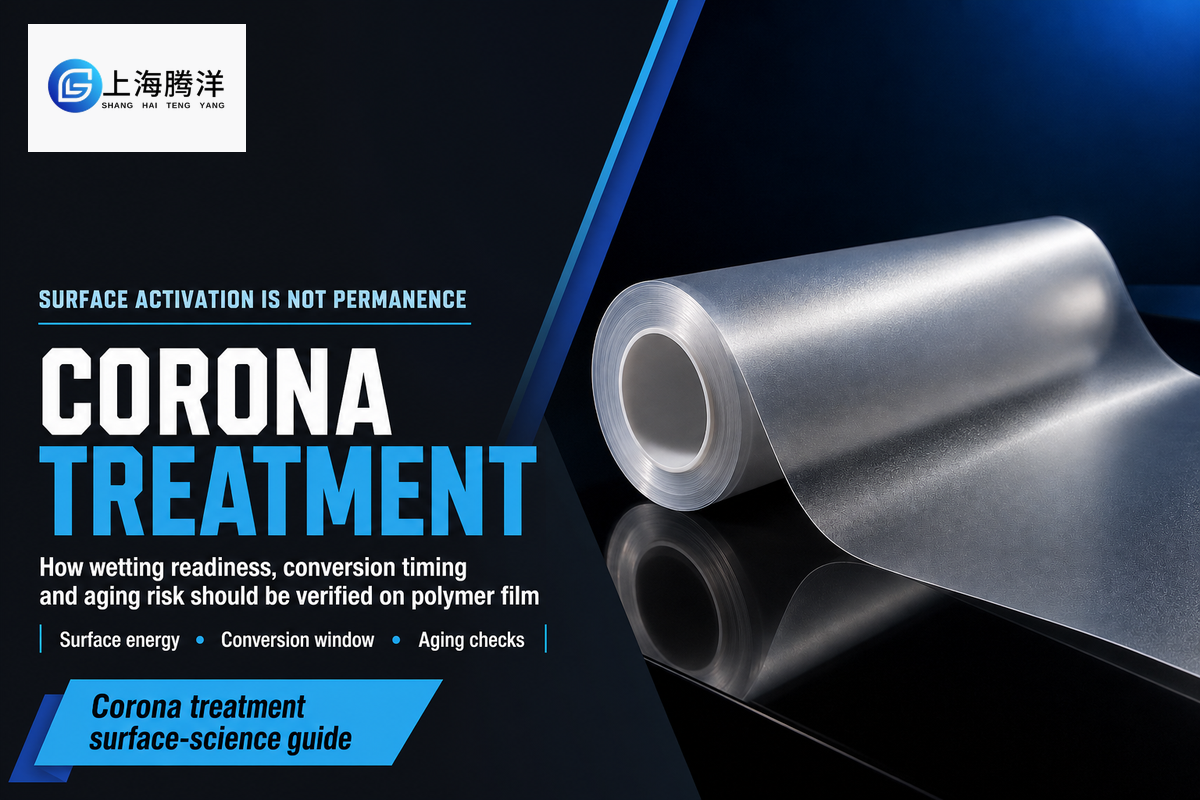
September 2026 Update Industrial polymer and film processing guide
Corona treatment is an atmospheric-pressure electrical-discharge process for polymer and film surfaces; in this article, it does not mean COVID-19 medicine. It has nothing to do with COVID-19 medication. The treatment changes the surface to allow inks and other agents, coatings and adhesives, to wet and attach to the surface. It doesn’t affect the bulk of the polymer, ensure a bond, or shorten the shelf life.
It’s important to understand the differences between converters for things like treatment settings, storage claims, and numbers. “surface energies” can be used for comparison. However, there are converters that are numerically inferior to a given number, yet still convert that number. An adequate decision regarding treatment is made based on the polymer, dose, line speed, time, and the result of a conversion test. In general, activation and conversion to a given number aren’t always permanent. The practical rule is simple: Therefore, a converter number isn’t always guaranteed.
What Corona Treatment Means in Polymer Processing
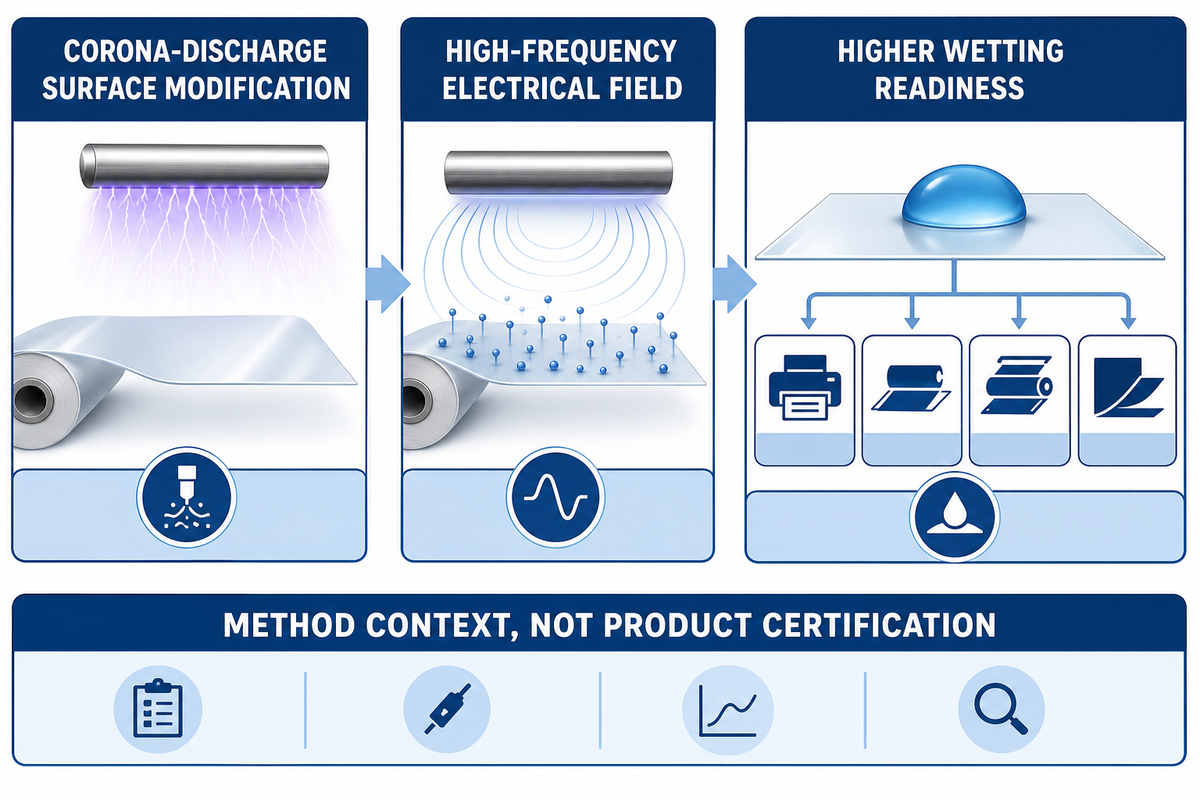
Corona treatment is a corona-discharge surface modification for polymer film. A high-frequency electrical field ionizes air across a controlled gap and activates the near-surface layer. The intended result is higher wetting readiness for printing, coating, lamination or adhesive bonding. ASTM D5946 is a measurement method, not a product-performance certificate. Keep method context in the record. Tie the result to the film and conversion test.
Search-intent collision can occur with the word “corona.” Processing film involves consideration of surface energy, wettability, uniformity of treatment and timing of conversion. Relevant results of a process are results of a trial, a record of which is coupled with a substrate and/or application. Irrelevant results of a process are medical results and/ or ranking of suppliers. In practice, searchers may ask about corona treatment on plastic film, corona treatment for printing, or corona treatment aging; a production-line application still needs a measured substrate, conversion window and test report. Keep the conversion record with the lot. Because a screening number is only a proxy, retain the ASTM D5946 or ISO 8296 context with the application record.
Answer first: corona treatment prepares a polymer surface for better wetting and interfacial contact. It is a controlled process step that still needs application-specific verification.
How Corona Discharge Changes a Low-Energy Plastic Surface
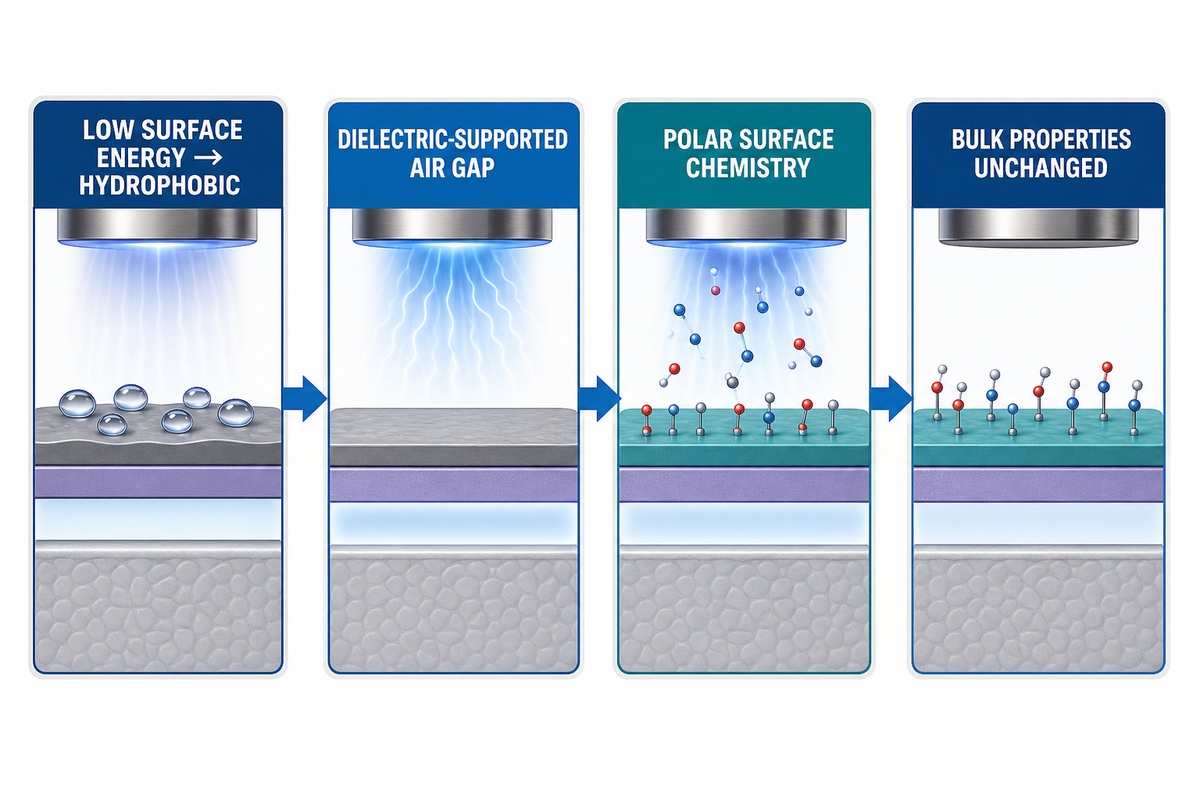
A surface treated with a low surface energy tends to be hydrophobic. Inks and other liquids tend to retreat or leave pinholes and weak bonds. The addition of a surface treatment can change the surface chemistry to have a more polar nature. This can also impact the interfacial tension of the polymer, without altering the bulk properties.
In a standard corona treatment system, a corona treater demonstrates the use of high-frequency voltage to apply a dielectric-supported air gap. The metal electrode energizes oxygen molecules and ions in the air, while the dielectric and web path determine where the discharge reaches the film. The decomposition may happen before, during, or after extrusion. This process may also occur on a converted substrate. “treater” is therefore a process-related term and doesn’t always indicate that a treatment system results in the same surface state.
More treatment isn’t always better. Over-treatment can lead to many issues, including: reduced temperature tolerance, increased brittleness, and a loss of insulating properties. What works to treat one type of polyethylene film may not work on others, such as polypropylene, which is a coated web. An example provided in Enercon’s industrial overview describes changes in surface tension of films; this shouldn’t be used as evidence to set process conditions for Tengyang films, or for any other films for that matter.
- Identify the treated side and the polymer/additive system.
- Set a bounded treatment trial with line speed and electrode geometry recorded.
- Screen wetting at defined points, then run the real ink, coating or adhesive test.
This leads to surface activation, not true bulk-property modification. When a production-line application shows contamination risk, compare an ASTM D5946 screen with ISO 8296 context before changing the corona treater setting. Keep the baseline sample with the treater record. Because the screen is only a proxy, retain the ASTM D5946 or ISO 8296 context with the process record. If the reaction isn’t as desired, look for other process-related problems (i.e. contamination, transfer, or cohesive failure) before altering process parameters (i.e. increasing power). Don’t blindly trust a low surface reading and assume you must use the maximum dose.
Surface Energy, Wetting and Dyne Level, What the Measurement Really Says
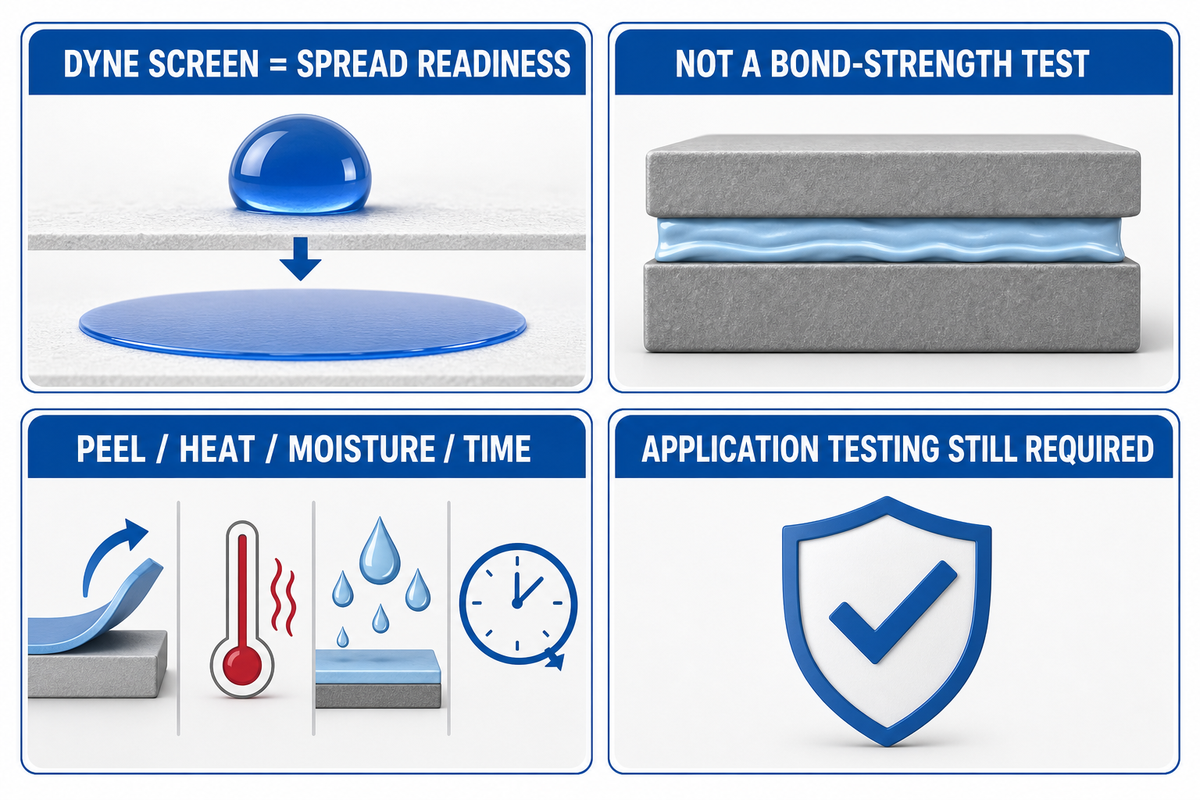
A dyne pen or fluid test is a type of screen to evaluate the readiness of a liquid to spread. It is not a bond-strength test. Fluid test behavior can help determine if a liquid will spread under that particular test condition. Fluid tests, however, don’t address if a given adhesive will withstand peel, heat, moisture and other environmental and time related degradation on that joint. Surface energy helps describe these broader concepts, and can be found in surface energy. As the authors indicate, these concepts shouldn’t be confused with application testing.
| Screen result | It can support | It cannot prove |
|---|---|---|
| Ink remains continuous for the method’s observation window | Comparable wetting readiness at sampled points | Durable ink adhesion after cure, flexing or humidity |
| Contact angle or wetting tension changes after treatment | Evidence that the surface state changed | A universal bond-strength threshold across chemistries |
| Similar readings on two films | A reason to run the same application screen | Equivalent roughness, additives, cohesive strength or aging |
The public ASTM page states that contact angle alone is not a completely acceptable measure of ink, coating or adhesive adhesion and points to multiple measurements and capability studies for each film and treatment. ISO 8296 similarly frames wetting tension as experience-correlated. As an operational example, a dyne fluid guide uses a three-second continuity observation; that timing is a method condition, not a universal adhesion threshold. Sample the web across width and machine direction, record temperature and contamination controls, and compare the screen with a real print, coating or adhesion result. Two films can show similar dyne values yet produce different adhesion because formulation, surface morphology and adhesive chemistry differ. Comparing surface energies is therefore a screening exercise under stated conditions, not a ranking of all films in all applications. Surface energies should also be recorded with the polymer, treatment condition and conversion test. Use the paired application result as the decision record.
Which Plastics and Films Respond, and Why Recipes Are Substrate-Specific
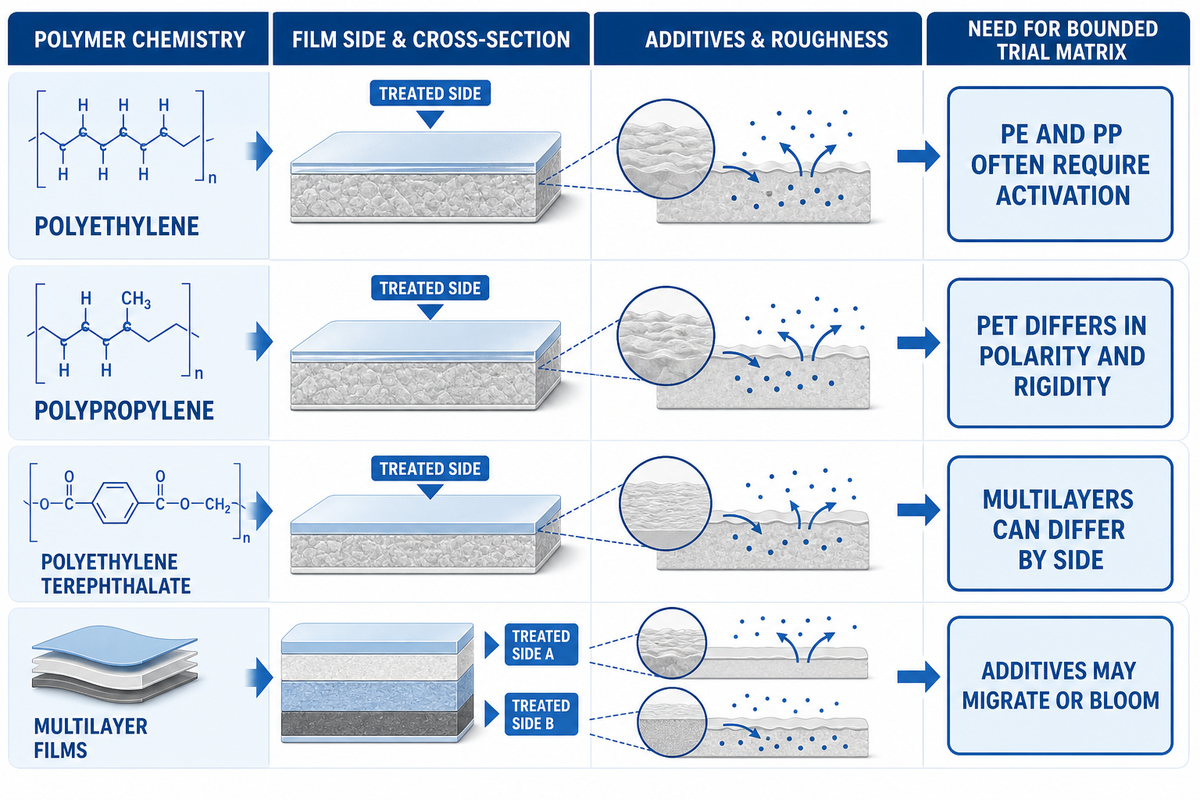
Polyethylene and polypropylene often require activation. Many inks and adhesives cannot wet untreated PE film surfaces. PET differs in polarity and rigidity. Multilayers can carry different chemistry on each side. Additives may migrate or bloom. Roughness can change wetting interpretation. Label the tested film and treated side. Cite ASTM D5946 or ISO 8296 where applicable. Record the supplier test report with the application result.
| Category / variable | Record before trial | Why it changes the answer |
|---|---|---|
| Polymer and structure | PE, PP, PET, multilayer; thickness and coating | Surface chemistry and heat response differ |
| Film thickness | Nominal thickness and gauge variation | Heat transfer and discharge exposure can shift |
| Surface condition | Treated side, additives, contamination, storage age | Migration and contamination can mask treatment |
| Additive package | Slip, antiblock, plasticizer or coating information | Migration can change wetting after treatment |
| Process window | Line speed, electrode gap, power and web tension | Dose and uniformity are process-specific |
| Discharge geometry | Electrode, dielectric, air gap and web path | Access and local dose change across the web |
| Conversion timing | Delay to print, coat, laminate or bond | Aging can narrow the useful window |
| Conversion chemistry | Ink, coating, adhesive and cure conditions | Wetting and adhesion are chemistry-dependent |
| Acceptance test | Screen plus print, coating or adhesion metric | Separates wetting readiness from application proof |
Use a controlled comparison instead of a universal recipe. Set one thing and sample many, leaving one thing as is, and comparing all to an untreated control. A good screen on plastic film justifies further study on the substrate. It doesn’t warrant transferring the screen setting to another substrate. Because substrate response creates risk, keep the ASTM D5946 or ISO 8296 context with the comparison record.
Where Corona Treatment Earns Its Place: Ink, Coating, Adhesive and Lamination
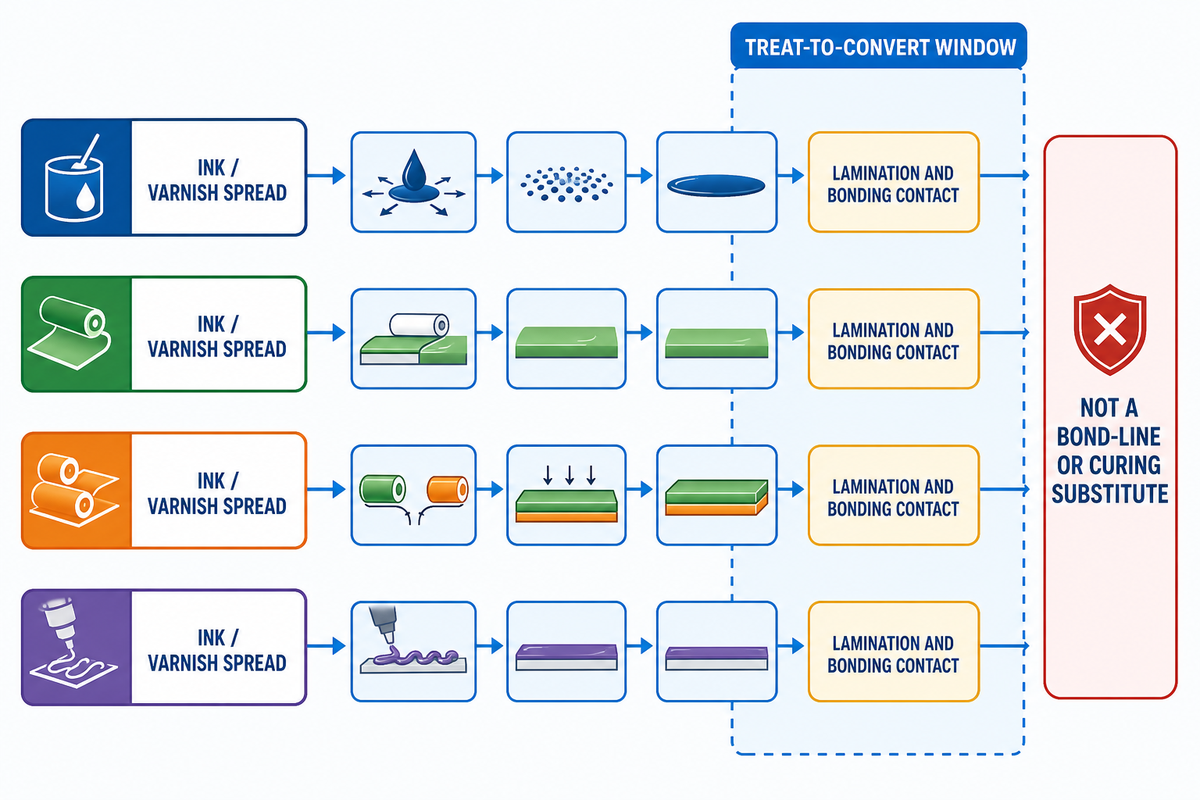
Corona treatment can improve the spread of liquid coatings, such as ink or varnish. It’s reported to decrease dewetting in coating. It also improves the contact of adhesive in both lamination and bonding. However, corona treatment doesn’t replace the need for a proper bond-line, curing conditions, and a failure analysis. ASTM D5946 and ISO 8296 frame the measurement context. Use the coating test to confirm the result.
Instead of allowing a flexible time window after treatment to represent a “freshly treated” surface, precisely specify the time window during which the conversion is to occur. Record the environment to which the treated surface is exposed (i.e. storage temperature and conditions, pack aging, and time between treatment and conversion). If the conversion doesn’t occur immediately after treatment, contamination or adhesive aging may be involved; check for polymer relaxations (i.e. chain relaxations) before assigning a single cause. Because recovery risk is condition-dependent, retain the ASTM D5946 or ISO 8296 context with the test report.
Practical boundary: this guide explains how to frame a trial. It does not quote equipment, price a service or claim a Tengyang product grade.
Aging After Treatment, Hydrophobic Recovery, Storage and Shelf Life
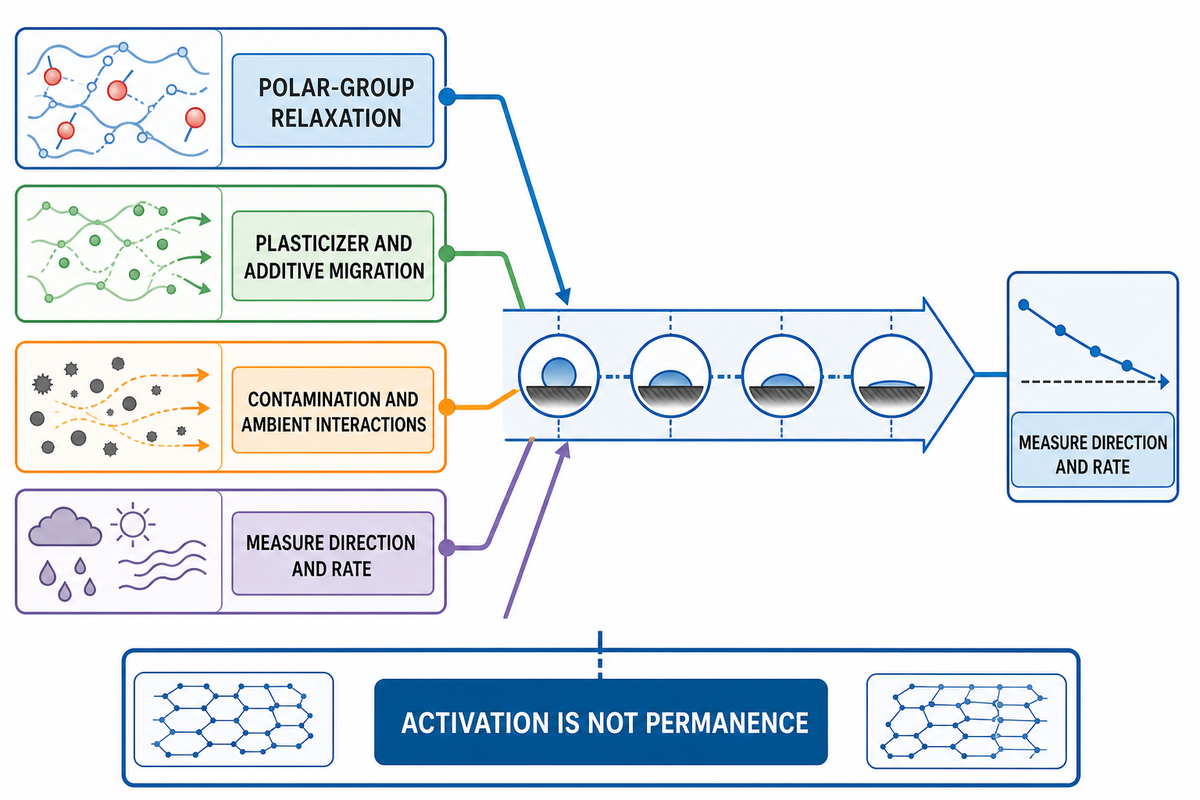
corona treatment can age due to numerous reasons including the relaxation of polar groups, migration of plasticizers and additives, accumulation of contaminants, and interactions between the treated surface and the ambient conditions. The wettability of the surface is material- and condition-specific; measure its direction and rate rather than treating it as an unsuitable standalone process-control aid.
“Activation Is Not Permanence” means the effects of aging can change over time; therefore, a conversion window for a polyethylene film must be measured rather than assumed. One peer-reviewed study links recovery of plasma-activated polyethylene to movement or diffusion of functional groups and reports that recovery rate depends on temperature. Because temperature affects recovery rate, the study supports measuring a time window for conversion rather than setting a universal deadline. Since the evidence points to a time constraint, the proper question is “What time-to-conversion window applies to this film and situation?” Use the ASTM D5946 or ISO 8296 context when the conversion window is recorded. Drifting can occur during storage, and therefore, the stored roll should be evaluated using the same criteria as the product being converted on the production line.
Illustrative sampling schedule: provided only as an example. Illustrative sampling schedule, not a shelf-life promise: record the treated surface at 0 hr, 1 hr, 4 hr, 8 hr, 24 hr, 2 days, 3 days, 7 days, 14 days and 30 days, then pair each point with the application test. Surface sample pairing should be made with the application test. Modifications should be made to the sampling schedule based on the requirements of the service, packaging and/or the environment.
Illustrative log placeholders only, not recommended settings: a worksheet may leave fields for 23 °C, 50% relative humidity, 1 mm and 2 mm film thickness, 0.5 kW and 1.0 kW dose proxies, 10 kHz frequency, and 2 hr or 4 hr storage checks. Values from the substrate and treater and results from application trials will dictate the actual settings.
- Measure at the treatment point and after defined storage intervals.
- Sample across the web; don’t let one convenient edge reading represent the roll.
- Run the intended ink, coating or adhesive test at each interval.
- Retain control pieces and record packaging, temperature and humidity.
Customers may inquire whether a particular corona treatment is “good for” or “expires” and expect an answer based on a trial and acceptance basis. Typically, we evaluate a dyne value by considering the trial design and acceptance rule. Although the adhesive may change (e.g. structure, roughness, contaminants), the conclusion of the application test may indicate that the joint is still acceptable. Conversely, a loss of wetting may not indicate failure of the joint.
How to Verify Treatment on a Production Line
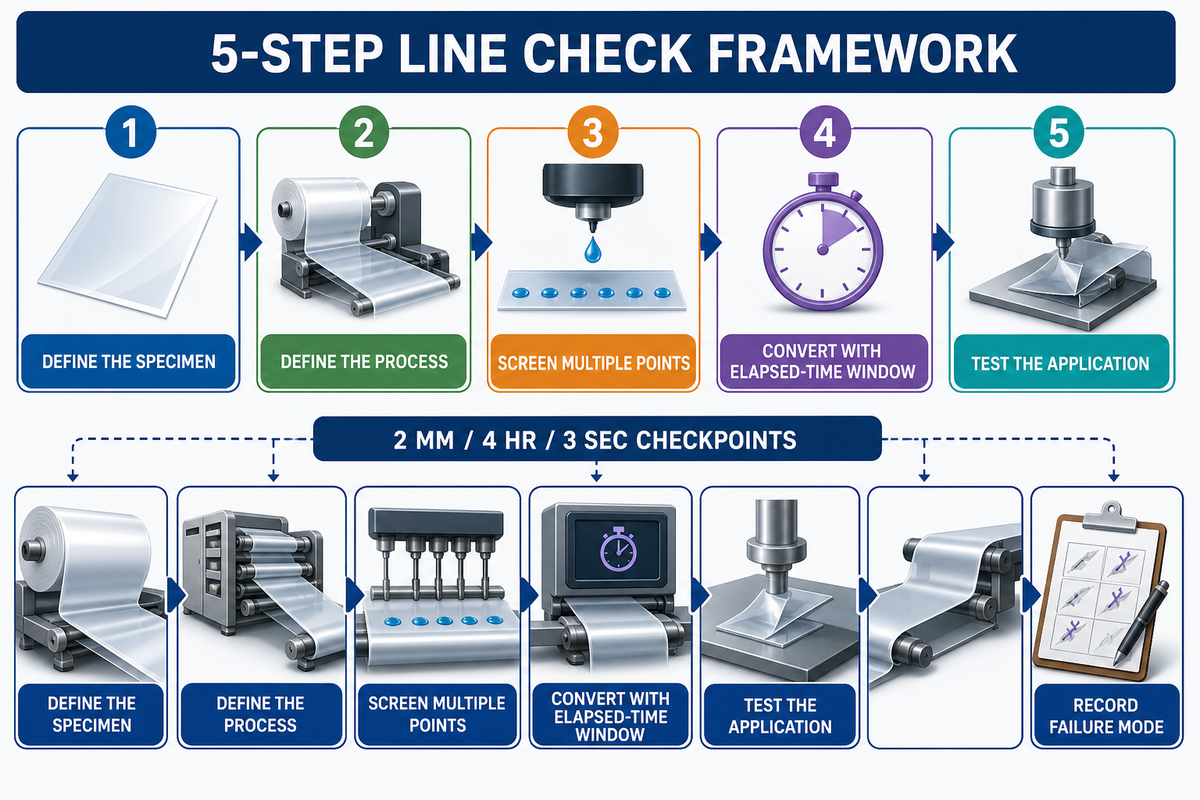
Use the 5-Step Line Check Framework to treat and then verify. A definitive instruction to produce a record of a surface test and application should be given. Because screening risk is application-specific, pair the record with ASTM D5946 or ISO 8296 context. For an approved trial, log 2 mm, 4 hr and 3 sec checkpoints only when specified. A 1 mm witness strip is optional only when the approved method specifies it.
- Define the specimen: polymer, thickness, treated side, roll or lot, additives and baseline condition.
- Define the process: line speed, electrode geometry, gap, power or dose proxy, web tension and operator.
- Screen: dyne fluid or contact angle at multiple points, with temperature and contamination controls.
- Convert: print, coat, laminate or bond within a recorded elapsed-time window.
- Test the application: inspect coverage and measure the selected adhesion or print metric.
- Record failure mode: adhesive, cohesive, interfacial, transfer, pinhole or contamination observation.
| Record field | What to capture | Why it matters |
|---|---|---|
| Roll or lot | Identifier and material state | Connects the result to the actual film |
| Treated side | Side, width position and machine direction | Prevents side-to-side confusion |
| Electrode setup | Geometry, dielectric and air-gap record | Supports repeatability |
| Line conditions | Speed, tension and dose proxy | Explains local variation |
| Screen method | Dyne or contact-angle method and operator | Defines what the number means |
| Elapsed time | Treatment-to-conversion delay | Captures aging exposure |
| Application result | Print, coating or adhesion observation | Connects screening to use |
| Failure location | Interface, adhesive, coating or film | Guides corrective action |
| Retained control | Untreated or baseline sample and storage note | Separates process drift from material drift |
The Controlled Bonding Trial Matrix published by the site may be of benefit to devise an alternate plan. Continuous processes may be monitored by retaining samples from the beginning, middle, and end. For a fixed trial, keep the three-second continuity observation and record three across-web positions; these are protocol fields, not universal adhesion limits. A worksheet may compare 2 mm and 4 hr checkpoints when those values are specified by the approved trial matrix; they are not universal settings.
Corona vs Plasma Treatment: A Practical Boundary
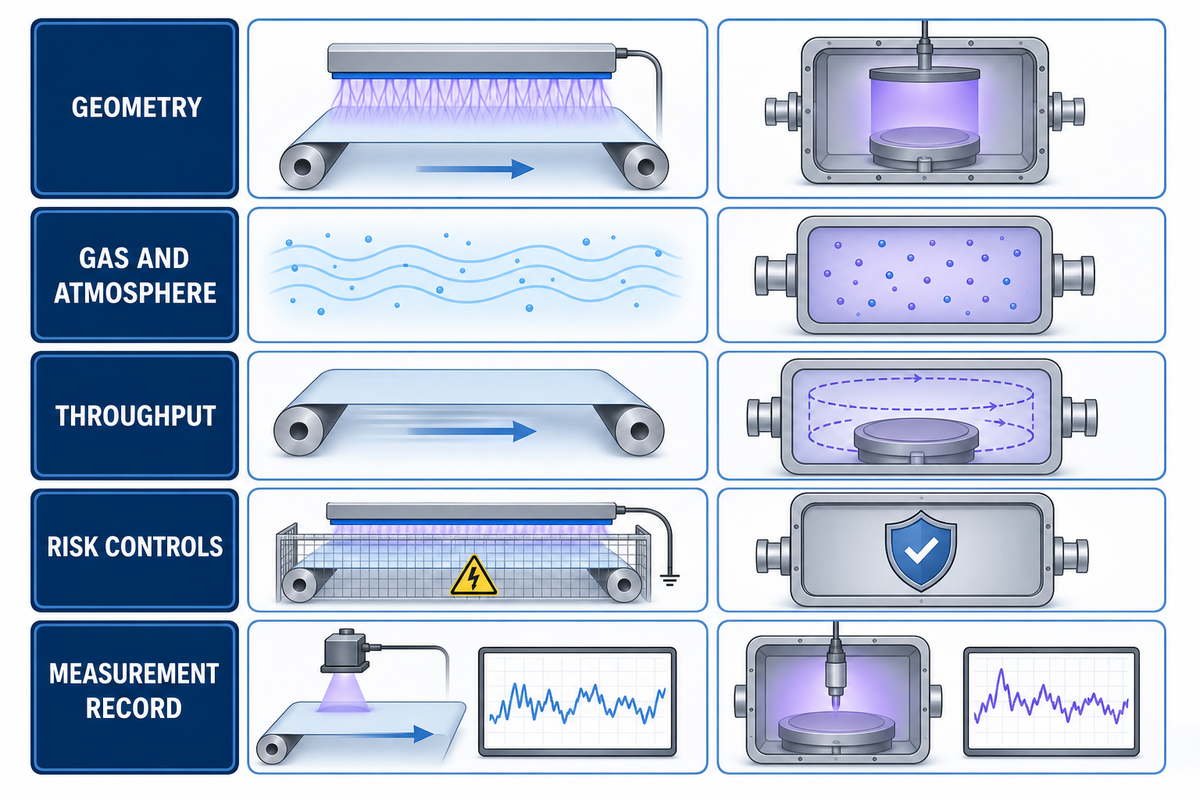
As compared to other plasma regimes, Corona may be more appropriate to consider for a process window. Evaluate the process window and compare the electrode, Line Speed, Thermal Load, ESD risk, and the extent to which the treated zone is controlled.
| Dimension | Corona on a moving web | Other atmospheric or controlled plasma setup |
|---|---|---|
| Geometry | Strong fit for flat, continuous film and web paths | May fit 3D or recessed surfaces when the electrode/plume can reach them |
| Gas and atmosphere | Often uses ambient air and a defined air gap | May add gas control or enclosure for a targeted chemistry |
| Throughput | Designed around continuous converting speeds | Can be better for batch, localized or complex-part treatment |
| Risk controls | Manage heat, ozone, sparks and electrostatic discharge | Manage the same risks plus gas and enclosure controls where applicable |
When comparing vendors, consider factors such as geometry and throughput of systems. For process control and uniformity of treatment, compare cases in which a similar acceptance criteria has been specified. For equipment selection, compare the production-line application and retain an ASTM D5946 or ISO 8296 measurement record. Because geometry changes discharge reach, keep the measurement record with the selected setup.
A Buyer’s Decision Framework for Activation-and-Aging Risk
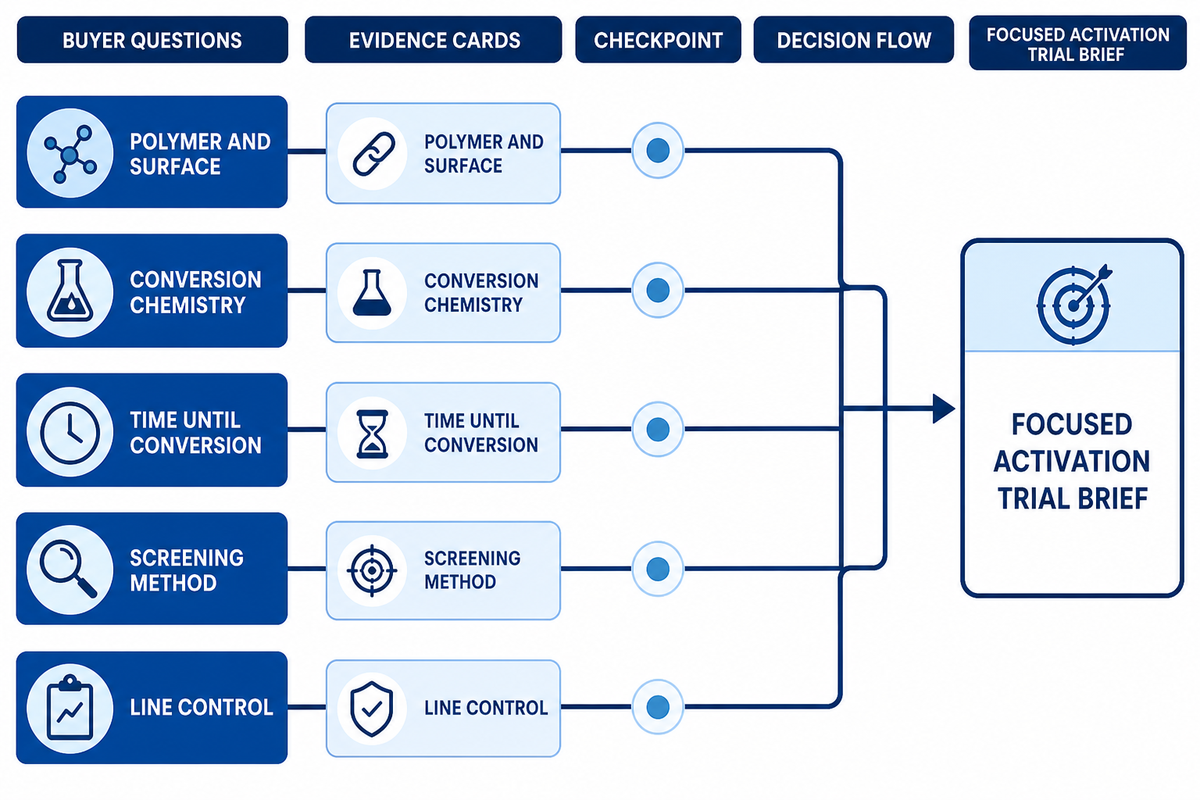
Five-Question Activation Window: Prior to procuring process equipment and services, answer the following: what’s the scope of the process to be controlled, what are the variations expected, what’s the scope of the process equipment to be used, what’s the duration of control to be achieved. These should be answered prior to specifying process equipment and services.
| Question | Evidence to collect | Decision it enables |
|---|---|---|
| 1. What polymer and surface? | Grade, additives, thickness, treated side and contamination controls | Choose the correct specimen and baseline |
| 2. What conversion? | Ink, coating, adhesive or lamination chemistry and cure | Set the application test |
| 3. How long until conversion? | Line delay, storage interval, temperature and packaging | Define the measured conversion window |
| 4. How will success be screened? | Multiple-point dyne/contact-angle plan plus application metric | Separate wetting gate from adhesion proof |
| 5. How will the line be controlled? | Geometry, speed, dose proxy, sampling, retained controls and failure codes | Make the result repeatable and auditable |
If you don’t know the answer to a question, the best option is to request a focused trial or data. Are there corona treatment system with the appropriate treater geometry and control? Don’t speculate or make a universal representation in time, copy another’s setting or imply validation. Ask the supplier for a test report tied to the production application and the ASTM D5946 or ISO 8296 measurement context. Keep the source and lot identifiers together. Because supplier settings are not universal, preserve the report with the lot and its aging risk.
Frequently Asked Questions
What does corona treatment do?
Atmospheric-pressure plasma, or electrical discharge, can improve contact between ink, coating or adhesive and a polymer or substrate surface. Plasma treatment doesn’t ensure or prove a strong, long-lasting bond. Polymer type, additives, contamination, line speed, time to convert, plasma power and dwell time all affect the result. For reliable conclusions, pair contact-angle or coating measurements with the relevant adhesive or lamination test.
How long does corona treatment last on plastic?
There’s no defined number of hours or days for all plastic. Recovery and drift can occur by multiple mechanisms. Measure the film at defined intervals and locations. Use representative samples for the intended application. Document the conversion window and conditions. Without this evidence, don’t promise shelf life.
What is the difference between corona treatment and plasma treatment?
Labels for corona and plasma discharges can be ambiguous. Compare electrode geometry, web speed, thermal load, humidity and electrical-potential control. Corona generally suits continuous production of flat, thin films. Other plasma approaches may be more effective for thick or irregular films and three-dimensional objects.
What is corona treatment used for in films?
Before printing, converters apply corona treatment to the film surface. Coating, lamination and adhesive bonding still require an application-specific test. Note which side of the corona treatment you treat as additives can alter behavior. A final screening determines if the bond is successful. Buyers may compare corona treatment plastic options, a corona treatment machine, or corona treatment polypropylene trials, but the acceptance test remains application-specific. Use the same acceptance rule across the comparison.
Does a higher dyne level guarantee stronger adhesion?
No. Dyne level and contact angle indicate wetting readiness, but they do not by themselves prove adhesion. Factors affecting adhesion include, but aren’t limited to, the ink, adhesive, contaminants, substrate, joint geometry, cohesion, and time. Films can fail in several ways, and similar films can contain different defects. It’s advisable to test for failing the chosen failure mode and to understand the effects of aging. Record the failure mode and storage condition. Use the same storage note for each comparison.
References and Sources
The sources provide evidence of academic aging and scope, and provide info from a third-party in a bounded fashion. The sources don’t provide evidence of Shanghai Tengyang New Materials Technology Co., Ltd. product grading, certification, or accreditation of their laboratory. The observations provided by the sources are limited to the conditions and materials described in the sources.
- ASTM D5946 public method page (corona-treated polymer-film contact-angle scope and adhesion boundary; the page also identifies the current revision).
- ISO 8296:2003 Plastics—Film and sheeting—Determination of wetting tension (official catalogue scope).
- Aging of Plasma-Activated Polyethylene and Hydrophobic Recovery (peer-reviewed review of time- and condition-dependent recovery).
- Enercon corona-treating overview (industrial context only).
- Tantec dyne testing guide (operational screening context only).
- Surfx atmospheric plasma versus corona comparison (directional vendor context on geometry and process window).
- US5972176A, Corona treatment of polymers (third-party patent terminology; not attributed to Tengyang).
Discuss a Surface-Activation Trial
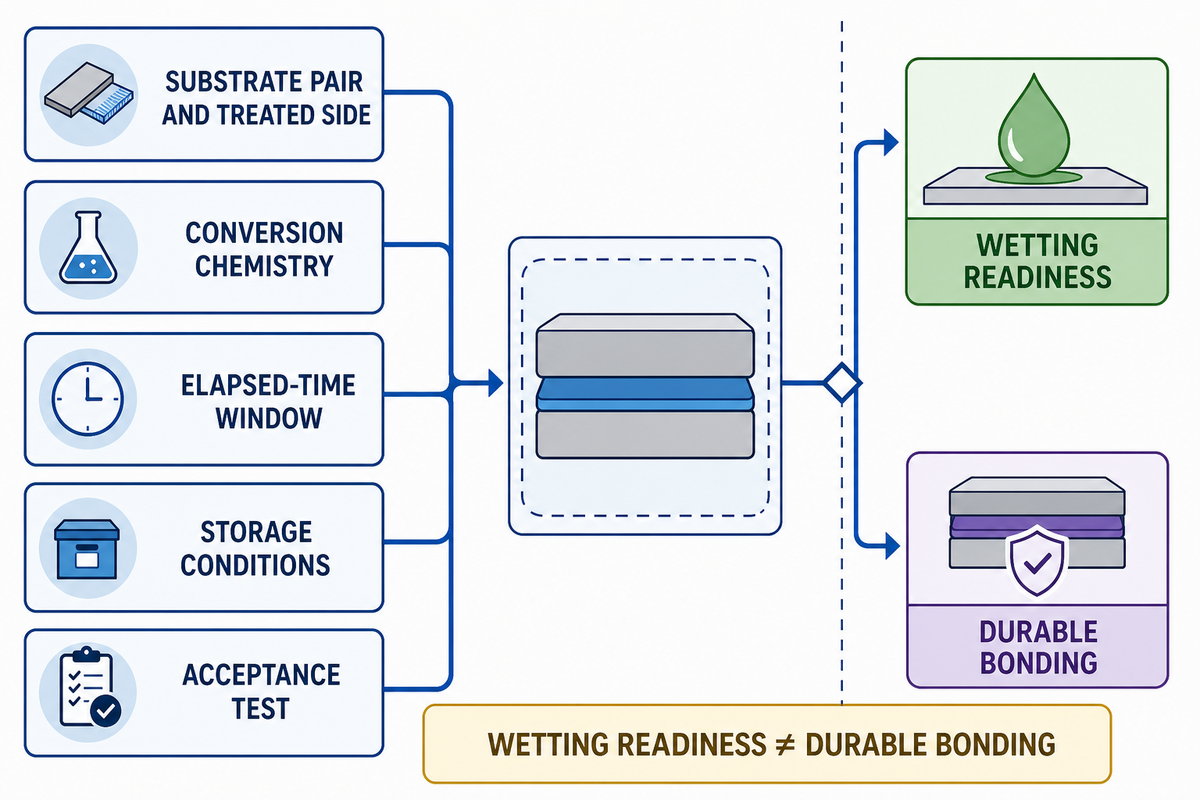
Bring the substrate pair, treated side, conversion chemistry, elapsed-time window, storage conditions and acceptance test. The trial can then separate wetting readiness from durable bonding evidence. A production release should retain an application test report and the ASTM D5946 or ISO 8296 measurement context so aging risk is visible. Keep the acceptance rule explicit. Because aging risk can shift wetting, retain the ASTM D5946 or ISO 8296 context with the trial report.
ABOUT TENGYANG
Industrial hot melt adhesive materials for bonding routes
Shanghai Tengyang New Materials Technology Co., Ltd. supports material discussions for production teams working with bonded products.
Available forms: hot melt adhesive film, web, powder and granules. Material families: TPU, EVA, PA, PES and PO.
CONTACT PROFILE
Betty Fang
Contact for material inquiries.