Get in touch with Tengyang Company
Adhesive Surface Science: A Learning Path for Hot Melt Bonding
Connection of adhesive surface science with surface reading and bonding selection is possible using this pathway. This pathway moves towards interfacial mechanisms and via preparation, test selection, and laminate trials to help the formulating team decide the measurements to be taken prior to settlement on hot melt format or a change in process.
- Understand the interface and the complete joint.
- Choose a measurement that answers your production question.
- Carry material and process details into a sample review.
SURFACE ENERGY DIAGRAM
CLICK TO SWAP

SAMPLES AND QUOTATION
Ordering Tengyang Materials and Application Support
Film formats
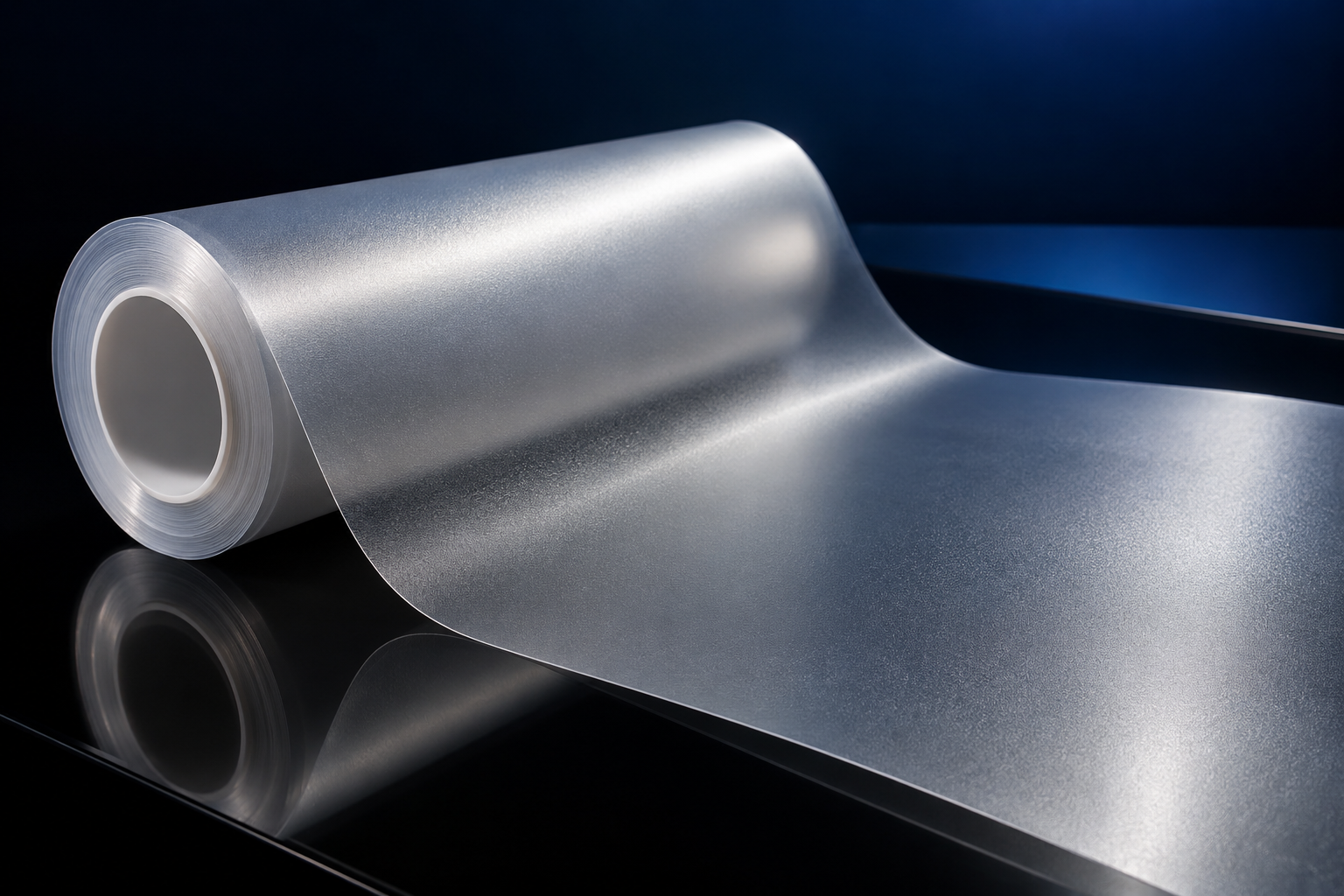
We supply hot melt adhesive films, including TPU, EVA, PA, PES and PO families.
Additional formats
We supply hot melt adhesive webs, hot melt adhesive powders and hot melt adhesive granules.
Custom specifications
We customize thickness, width, melting point, color and application-specific formulations.
Application review
We provide material selection and application support for industrial bonding.
OEM support
We support OEM projects across garment accessories, footwear, leather lamination and automotive interiors.
Sample-first selection
We provide free samples before volume orders; MOQ is quoted against your actual specification.
Adhesion Science Fundamentals for Hot Melt Lamination
A laminate may fail at an interface, split within the bonding layer or even tear a substrate. Each of these cases requires different considerations and adjustments: replacing the adhesive before locating the failure may leave the root cause unexplained.
DATA VISUALIZATION // REF-01
From molecular contact to a load-bearing joint
The science of adhesion describes the distinction of attraction of dissimilar surfaces versus cohesion within a material. Molten adhesive must wet the bonding surface prior to cooling; sufficient contact is essential for the development of joint strength while the adhesive contact area, surface chemistry, and strength come into play.
Wetting is a starting measurement
Surface energy describes the solid surface, while surface tension describes the liquid. Contact angle captures their interaction under a stated condition; a model of interfacial attraction cannot replace a mechanical test of the bonded joint, as the KRÜSS adhesion discussion explains. Useful examples from adhesion include a clear interface, a weak coating and a joint failure due to separation of fabric backing. A lower contact angle is not necessarily an indication of acceptable adhesion; locating the failure defines the question for the preparation review.
Mechanisms to consider at an adhesive interface
Mechanism
What happens
Implication for a laminate trial
Intermolecular attraction
Van der Waals forces and other polar interactions act between surface molecules in close contact.
Check cleanliness and wetting; a contaminant can become the surface the adhesive actually contacts.
Mechanical adhesion
Material enters accessible surface features and forms a mechanical interlock.
Inspect penetration and the integrity of the textured layer; roughness alone does not establish effective contact.
Diffusion and entanglement
Mobile, compatible polymer chains can intermingle and entangle.
Consider material compatibility and the available time for chain movement; do not assume every polymer pair interdiffuses.
Chemical bonding
A chemical bond forms through a suitable interfacial reaction.
Identify reactive functionality before invoking chemisorption; ordinary thermoplastic cooling does not establish a new covalent bond.
Surface Science Learning Modules
Begin with understanding the measured value and then how that was achieved. Both surface energy and adhesion connect via the specific liquid, surface, and bonding process; the value in the absence of these is limited for choosing commercial adhesive.
Surface Energy: Meaning, Units and Bonding Relevance
Use this module to understand solid-surface free energy, liquid surface tension and the role of low surface energy plastic in material selection.
- Keep units separate from the meaning of the measurement.
- Connect surface chemistry with preparation options.
- Link surface observations to a joint-test record.
Contact Angle: Meaning, Measurement and Interpretation
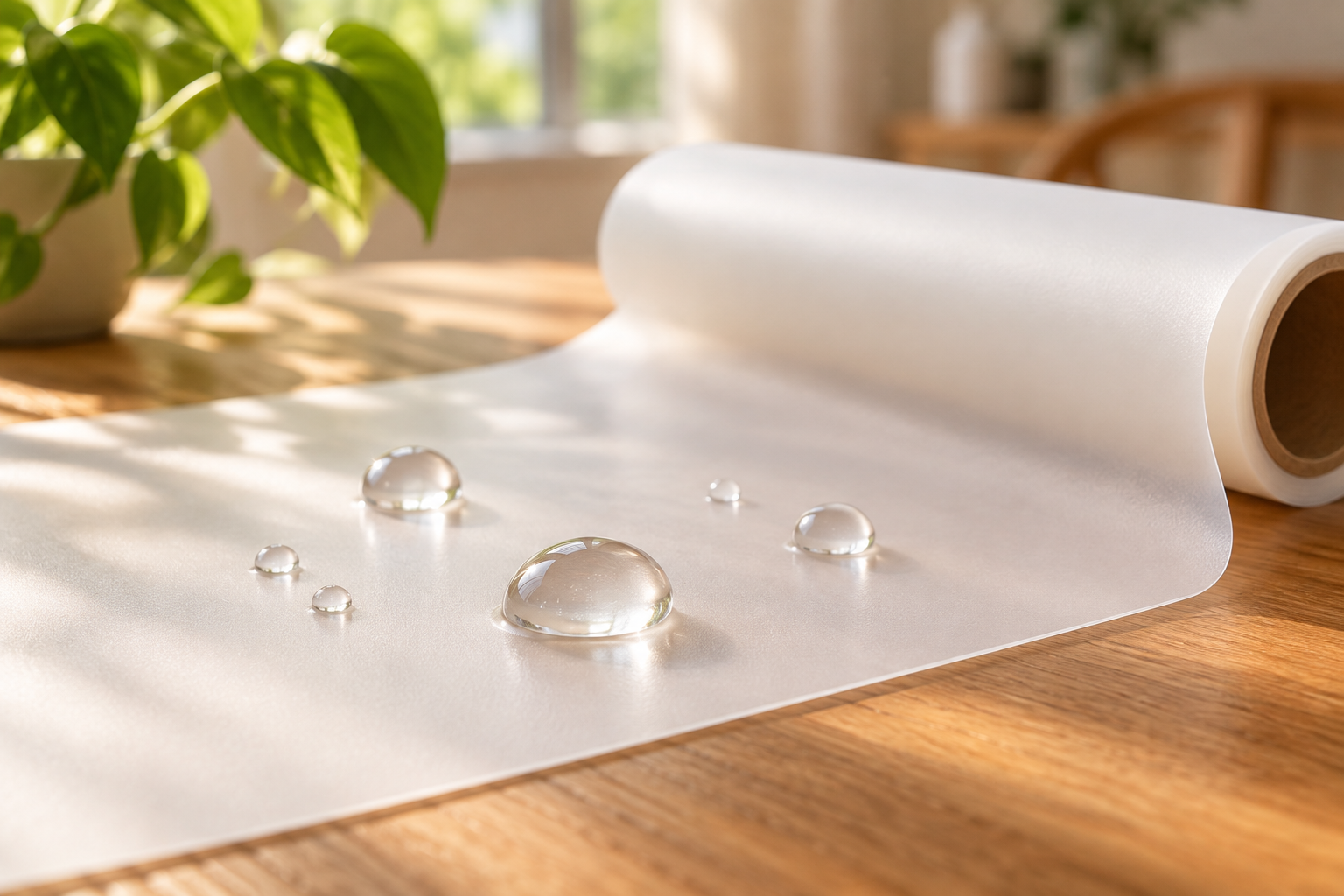
Use contact-angle measurements to describe how a specified liquid meets a substrate surface, with the liquid and test conditions attached to the result.
- Distinguish static, advancing and receding readings.
- Record sampling location and measurement conditions.
- Compare wetting observations with actual joint performance.
Substrate Surface Preparation and Treatment Before Adhesive Bonding
Adhesive surface preparation begins with the actual bonding face, including coatings, finishes, and handling residues. A treatment that improves the surface energy of the substrate must leave a stable surface layer and retain the material’s functionality.
Preparation routes and trial checks
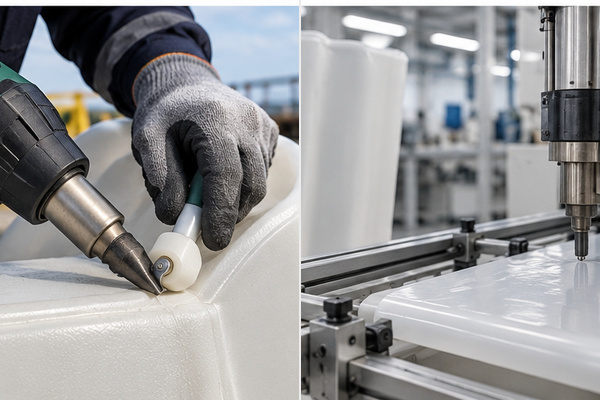
The Adhesive and Sealant Council distinguishes preparation, surface treatment, and means of maintaining the treated state. Use that distinction to analyze surface preparation techniques for adhesive bonding, without treating cleaning, abrasion, and activation as equivalent steps.

SYS.Q // QUESTION IT ADDRESSES
Is removable contamination masking the underlying surface?
SYS.CHK // CHECK BEFORE PRODUCTION
Match the cleaning method to the finish; inspect residues and allow the specified drying stage.
SYS.Q // QUESTION IT ADDRESSES
Is a weak surface layer or inaccessible texture limiting contact?
SYS.CHK // CHECK BEFORE PRODUCTION
Remove loose debris and inspect damage; thin films, coatings and fabrics need particular care.
SYS.Q // QUESTION IT ADDRESSES
Can a suitable film surface be activated for the intended bonding operation?
SYS.CHK // CHECK BEFORE PRODUCTION
Record treated side, settings, sampling positions and elapsed time before lamination.
SYS.Q // QUESTION IT ADDRESSES
Can controlled treatment improve contact on the selected material geometry?
SYS.CHK // CHECK BEFORE PRODUCTION
Check exposure consistency, surface condition and the actual joint after treatment.
SYS.Q // QUESTION IT ADDRESSES
Is the material and process suited to a controlled thermal activation route?
SYS.CHK // CHECK BEFORE PRODUCTION
Use a qualified process; assess distortion and surface damage before evaluating bondability.
SYS.Q // QUESTION IT ADDRESSES
Does the chosen adhesive chemistry suit both mating surfaces?
SYS.CHK // CHECK BEFORE PRODUCTION
Verify compatibility, application and drying requirements with the specific grade and trial.
Preserve the function of the laminate
Breathability and handle can change when adhesive coverage changes. Review visible strike-through, stiffness and coating damage alongside peel performance, especially for garment layers, footwear and leather lamination.
Higher roughness does not always increase contact: the trade off is between a useful texture and damaged or loose material. High surface energy will not remedy a weakly adhered coating, so cleaning and activation are not substitute solutions when separation occurs beneath the bonding face.
Wettability and Bond Test Methods: Decision Table
False release is possible, as a surface reading describes only part of the assembly: agree on acceptance criteria and the appropriate joint test before using the result. A wettability test assesses the behavior of a surface, while a peel test assesses the assembled joint; exposure to the environment assesses the performance of the joint and whether it has degraded.
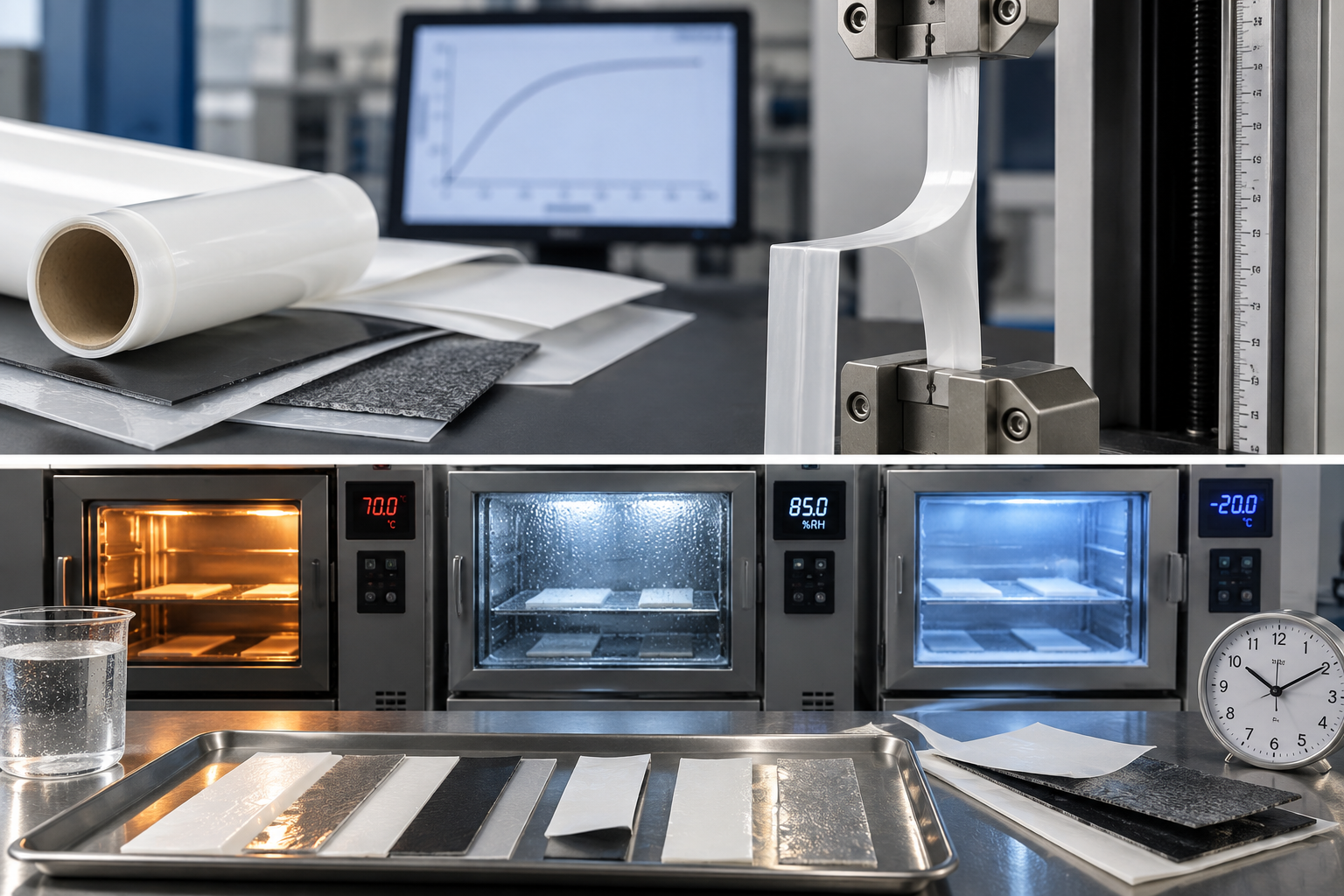
Match the test to the material and decision
Screen wetting tension on PE/PP film
ASTM D2578-23
RECORD WITH THE RESULT
Film identity, side, specified test liquid, condition and observation.
INTERPRETATION BOUNDARY
Wetting tension alone does not qualify adhesion; establish applicability for other polymers.
Compare water contact angle on corona-treated film
ASTM D5946-24
RECORD WITH THE RESULT
Film type, treatment condition, liquid, sampling locations and angles.
INTERPRETATION BOUNDARY
Correlate guide bands with the film and treatment; they are not bond-strength limits.
Estimate solid-surface free energy
ISO 19403-2:2024
RECORD WITH THE RESULT
Test liquids, angles, calculation model, morphology and chemical uniformity.
INTERPRETATION BOUNDARY
The model and surface condition matter; powder contact-angle measurement is outside this part’s scope.
Compare flexible-adherend joint resistance
ASTM D1876-08(2023)
RECORD WITH THE RESULT
T-type specimen construction, conditioning, test settings, force result and failure location.
INTERPRETATION BOUNDARY
Relative T-peel resistance applies to the tested construction, not every joint geometry.
Examine stressed-joint durability
ASTM D2918-99(2020)
RECORD WITH THE RESULT
Stress, temperature, air/water/other environment and exposure history.
INTERPRETATION BOUNDARY
Compare at uniform conditions and assess relevant exposure ranges; do not infer a universal service life.
Separate initial handling from final cure
Reactive polyurethane research
RECORD WITH THE RESULT
The published study measured final T-peel after 7 days at 23 °C and 50% relative humidity.
INTERPRETATION BOUNDARY
This is a formulation-specific research comparison, not a curing schedule or acceptance limit for your grade.
Check the finished laminate in use
Agreed application trial
RECORD WITH THE RESULT
Actual layers, process settings, intended loading, appearance and acceptance criteria.
INTERPRETATION BOUNDARY
Use a suitable agreed method; an in-house comparison does not automatically constitute compliance with a standard.
Application Review, Samples and Quotation
Both mating surfaces determine adhesive selection, including their coatings and finishes. Send the actual layer construction and intended service conditions so we can connect your sample request with material selection and application support.
Input Criteria & Decision Support
DATA MATRIXInput
What to send
Decision it supports
Materials
Both substrates, bonding faces, coatings, finishes and representative samples.
Compatibility review and the candidate adhesive family.
Construction
Layer order, required thickness and width, coverage and appearance constraints.
Film, web, powder or granule format and custom specification.
Process
Available heating, pressure, dwell or line speed, cooling and handling sequence.
A practical trial window and checks before downstream loading.
Service and supply
Washing, heat, moisture, flexing, target acceptance criteria, quantity and destination.
Exposure tests, sample scope, MOQ and a written quotation.
FIG.01 // REPAIR VS PRODUCTION
Compare the complete process cost
Treatment setup costs belong beside scrap and rework in the trial review. Record material usage, trimming, heating, line interruptions and rejected laminates for each candidate process, with the same acceptable finished output as the comparison basis.
Thermoplastic materials require cooling prior to setting, whereas reactive polyurethane hot melt adhesives can develop greater strength through a moisture cure post setting. Consider the balance between initial handling and the strength required later in the service. Initial results cannot be used to substitute full testing once the adhesives have cured.
Sample and order arrangements
STANDARD PROTOCOL01
We return quotes within one business day, with an engineering review.
02
We ship samples in 3-5 business days after specification approval.
03
We ship small-batch orders in 7-20 days after order confirmation.
04
We schedule production orders in 15-30 days after order confirmation.
05
We accept T/T bank transfer and L/C for larger orders.
06
We arrange air or express freight for urgent samples and cargo on request.
07
We supply TDS and SDS with the first shipment of each grade and on request.
How We Work: From Substrate Details to a Bonding Trial
Any changes in service, whether permanent or removable, change the brief for the sample request. Agree on the desired result, then keep a written link between the supplied material, the trial conditions and the acceptance decision.
Bond Qualification Records and Acceptance Discipline
A bond can deteriorate during repeated washing and can erode even when it was deemed sound at the first check. The Surface-to-Bond Evidence Ladder provides the records to help you compare the starting materials and joint results in line with your agreed acceptance plan.
Surface-to-Bond Evidence Ladder
STEP // 01
Identify the construction.
Record substrate and adhesive grades, batches, bonding faces, finishes and layer order so the tested assembly can be reproduced.
STEP // 02
Record surface screening.
Attach preparation details, treatment-to-bond time, sampling locations and the wetting or angle method to each specimen group.
STEP // 03
Measure the initial joint.
Use the agreed specimen and test conditions; report the result together with where the joint failed.
STEP // 04
Compare the exposed joint.
Repeat the agreed assessment after relevant environmental exposure and review changed failure locations as well as changed force.
Observation & Investigation Matrix
Investigation Direction
Cleanliness, wetting, surface stability and compatibility.
Next Comparison
Controlled preparation or formulation comparison.
Investigation Direction
Cohesion, layer condition, process history and loading.
Next Comparison
Adhesive and process checks under the same test conditions.
Investigation Direction
Strength of the layer carrying the load.
Next Comparison
Layer integrity and actual application requirements.
Investigation Direction
Multiple mechanisms or an exposure-sensitive layer.
Next Comparison
Photograph and describe both initial and exposed specimens.
“Keep the surface reading, the joint result and the failure location together. That combination gives the next trial a clear question.”Tengyang Engineering Team
Review a Bonding Trial
Open the record builder
APPLICATION SUPPORT
Request a Material Review
Bring the layer construction, bonding faces and intended service conditions into one application review. We will use those details to discuss material selection and the next sample step.
CONTACT PERSON
Betty Fang
EMAIL ADDRESS
Betty@hotmeltmaterial.com
DIRECT PHONE
+86 13122233268
HEADQUARTERS & LABORATORY
Shanghai Tengyang New Materials Technology Co., Ltd.
No.58, Fumin Branch Road, Hengsha Township, Chongming District, Shanghai, China
No.58, Fumin Branch Road, Hengsha Township, Chongming District, Shanghai, China
Surface Science Calculation Tools
Select a tool below to process test data, normalize specifications, or calculate effective production variables for hot melt laminations. Ensure all input units are consistent before generating the final comparative reports.
Peel Load Normalizer
Calculate and normalize peel adhesion loads across different sample widths and test standards to ensure accurate material comparisons.
Exposure Comparison
Evaluate and compare laminate performance variations after exposure to specified environmental stressors, heat, or washing cycles.
Good Laminate Cost
Analyze complete process costs including treatment setup, material usage, scrap, and rework to determine the true operational cost.
Adhesive Surface Science FAQs
It covers how the surface of the substrate interacts with an adhesive, including wetting, molecular attraction, contamination and preparation. For lamination, connect those observations with the performance of the complete joint.
Intermolecular attraction, mechanical interlocking, diffusion or entanglement, and chemical reaction can contribute in suitable systems. The active mechanisms depend on the adhesive and substrate, their condition and the bonding process.
Common routes include cleaning, controlled abrasion, activation and a compatible primer. Select the route for the actual surface and adhesive chemistry, then compare representative joints before adopting it in production.
Methods include observing specified test liquids or measuring a liquid drop’s contact angle. Record the liquid, surface, condition and method; wettability and surface tension are related concepts, but neither measurement alone is a bond qualification.
Use a target correlated with your material, adhesive and process. ASTM D2578-23 does not provide a universal release value for every laminate, and a dyne test procedure should preserve the specified liquid and observation conditions.
Accessible texture can support mechanical interlocking, but loose material, trapped contamination or insufficient wetting can undermine contact. Judge the prepared surface and the joint result together instead of maximizing roughness.
No: cohesive failure occurs within a material, while adhesive failure occurs at an interface. Record substrate failure separately and describe mixed failure, because each points toward a different follow-up comparison.
Evaluate the actual polypropylene grade, the other bonding face, the chosen formulation and the washing conditions. High initial strength does not necessarily mean good wash resistance, so a low surface energy adhesive recommendation still needs a representative washed-joint assessment.
Yes: tell us whether the joint should remain intact in service or separate intentionally. That requirement changes the material brief, loading conditions and the way sample results should be judged.
Send both substrates and finishes, required format and dimensions, available process settings, service exposure, quantity and acceptance requirements. Include representative materials or photographs that show the bonding face and the current failure.